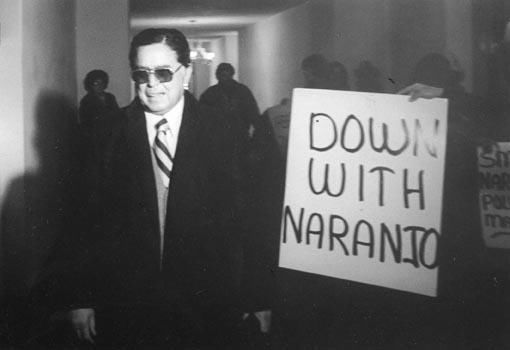
Despite engaging him in hard-fought and often bitter battles for elected office, Emilio Naranjo’s former rivals have a grudging respect for the mark he left on Rio Arriba County.
Former County commissioner and County Clerk-Elect Moises Morales has reason to feel harshly toward Naranjo; after he had criticized Naranjo, his opponent during a run for County Sheriff in 1976, Morales was charged with possession of marijuana by Sheriff’s deputies.
According to SUN reports from the time, Morales claimed the drugs had been planted on him, and in 1977 Naranjo settled a civil suit with Morales for $10,000. Morales said at the time that Naranjo was out to destroy his political opponents.
Naranjo was later convicted of perjury in federal court, and he resigned his seat in the state Senate. The conviction was overturned two years later, and Naranjo regained his seat in the Senate.
“That’s water under the bridge,” Morales said.
Morales said he remembers first meeting Naranjo at a rally he went to with his grandfather.
“I met Emilio when I was a young kid,” he said. “Whatever he said, everybody was clapping their hands.”
Morales said he respected the “unbreakable” Democratic Party that Naranjo formed, and how he united the northern and southern parts of the County like no one had before.
“He became a very strong man at a very young age,” he said. “He always outfoxed me.”
Morales said Naranjo’s grip on the County eventually disillusioned some people, who began to see the party under Naranjo as regressive.
Carol Miller, who ran unsuccessfully as an independent for the Third Congressional District seat this year, said when she first moved to the County more than 30 years ago, she remembers being told that she had better register as a Democrat and vote for the straight ticket if she wanted anything from the County.
“It was generally understood that Emilio was in charge of making decisions as to where the road crews would go,” she said.
Miller said Naranjo wielded County funds inappropriately at times, only helping people who were on the “right” side of the Party rather than those who were eligible to receive aid. She said Naranjo’s top-down type of leadership put too much power in one person’s hands, especially when he served simultaneously as County manager, state senator and Democratic Party chairman.
“That’s a lot of power to accrue for one individual,” she said. “He controlled all of the hiring for the jobs in the County, so that creates a very strong power base.”
Miller said a wide backlash to Naranjo’s “patrón” system occurred throughout the County when community groups began to spring up and demanded a more democratic system.
“It was quite a power struggle there in the County, really throughout the 70s,” she said.
Former Española mayor Richard Lucero also tangled with Naranjo in the 1970s. According to SUN reports, the politically down-on-his-luck Lucero claimed to be the target of a violent conspiracy involving Naranjo and city officials. Naranjo’s deputies arrested Lucero in 1975 for stealing bailing wire, and Naranjo testified against Lucero at the trial.
But that’s history now. Lucero said his parents served as padrinos for Naranjo’s first wedding, and Naranjo could be a beautiful person. The former mayor would tell just one story for publication — Naranjo came into his store in April to buy some seed, he said.
“I said, ‘I’m sorry, your credit card doesn’t have enough money to cover the seed,'” Lucero said. “He was kind of shocked at that, but after a while he understood.”
Lucero gave Naranjo the seed and urged him to come visit more regularly, he said. He walked him out to his car and that was the last time they saw each other.
“The last of the patrones is gone,” Lucero said. “Huey Long, Richard Daley and now Emilio Naranjo.”
Art Rodarte’s primary victory over Naranjo in the 1996 state senate race spelled the real end to Naranjo’s iron-grip over Rio Arriba politics. To this day the County is still split mainly into two factions: old Naranjo loyalists and an informal faction called Democrats for Progress.
Years prior to that historic race Rodarte, County Commission Chairman Alfredo Montoya and other younger Democrats helped form the Democrats for Progress in order to knock Naranjo’s Democratic Party allies out of County positions.
Montoya remembers his parents being involved in Naranjo’s political organization. He said Naranjo’s charisma was key to his finding favor with the public.
Montoya challenged Naranjo’s position as chairman of the Democratic Party in 1977, and he and his supporters claimed Naranjo was improperly elected, alleging secret meetings and illegal proceedings on Naranjo’s part. Montoya and his faction continued to battle Naranjo for two decades afterward.
Rodarte said he knew fighting Naranjo would be an uphill battle. When he ran against him for Democratic Party Chair in April 1991 he wasn’t received warmly, losing by 64 votes.
“They didn’t want to let me speak at the convention,” he said. “I ended up with four votes.”
When Rodarte decided to run for a seat on the County Commission in 1990 against Naranjo-backed candidate Salomon Luna, he said his family was sure he would lose. He said he filed five minutes before the deadline, because he didn’t want any surprises.
After he won the race, holding the office proved to be a challenge. He said the other commissioners would wait until hours before the Commission convened to let him know a meeting was scheduled.
“I was a slave to my phone,” he said.
Rodarte said Naranjo would storm out of the meetings when he disagreed with him.
“I used to sit across from him,” he said. “He used to get angry with me.”
However, Rodarte also said Naranjo was a “legend.” And arguably the County’s most powerful current politician added this:
“Emilio’s just one of those individuals that comes around once in a very long while,” Montoya said. “At one time, I think he probably knew every person in this county by first name.”