Broadcaster’s Big VoiceEmbraces Chama Valley

Published:

From a one-room schoolhouse in Avard, Okla., Scott Flury has followed a career in radio broadcasting across the United States. He found a home in the town of Chama and the surrounding communities of Northern New Mexico.

    “For the first time, I really feel like part of a family,” Flury said. “The way I’ve been accepted here, I feel like this is where I belong. To me Chama is my family.”

    Flury returned to New Mexico from working in the midwest and became news director for KARS station in Belen. While in Belen, he married his first wife  and they had a daughter, Amanda, who now works for the University of New Mexico. Flury is now married to his second wife, Lilija, whom he met 12 years ago while in Lithuania doing volunteer work for their local broadcasting network. It was at KARS that he became a bigger part of the community, becoming a member of the Rotary Club.        “That’s when I really started getting involved with the community,” he said. “ Our station manager, Bill Brooks, encouraged that. I was voted Citizen of the Year. They threw a big party for me before I left. Maybe I started to grow up after my rock-and-roll years.”

    He worked at many radio stations around the country before returning to New Mexico from a stint back east. He worked for KKJY station in Albuquerque for two years before moving to KKOB station, also in Albuquerque, where he was general manager. It was there that the opportunity to follow his dream of owning his own radio station presented itself.

- Advertisement -
- Advertisements -

    “Don Davis, a station owner, told me there was a frequency available in Chama,” Flury said. “If I ever wanted to own my own radio station, this was an opportunity. I wanted to get back to radio the way I remembered it. I gave up my 401K, my benefits. I’ve never regretted it.”

    In October 1999 Flury and partner Bud Healey purchased the frequency and opened KFLH, the first radio station in Chama.

Chama’s first station

    Chama is town of just over 1,000 nestled in the San Juan Mountains of Northern New Mexico at an elevation of 7,800 feet. A former timber hub, the predominate activity is ranching, raising cattle and sheep that graze on the lush mountain grasses and pastures along the Chama River which flows through town. Known for its fine elk hunting and trout fishing, its primary attraction is the Cumbres and Toltec Scenic Railroad, which operates from May through October between Chama and Antonito, Colo.  The Railroad climbs over Cumbres Pass to elevations over 10,000 feet and attracts tourists and railroad buffs from across the country.

- Advertisement -
- Advertisements -

    “I’d been to Chama two or three times for stream fishing and had a love for the area,” Flury said. “I didn’t know that much about the community.”

    Like most small Northern New Mexico towns, Chama’s population is predominately Hispanic. The town rallies around the local school, Escalante High School, in nearby Tierra Amarilla. It is surrounded by small communities like Cebolla, Canjilon, Coyoté and Gallina. The Jicarilla Apache Nation reservation, with its hub in the town of Dulce, is a significant presence in the area.

    “Bud Healey lasted about a half-year,” Flury said. “It was just too small for him.”

    Flury hosted a morning show, but quickly made his presence known by doing the play-by-play live broadcasts of local football, basketball and even volleyball games at Escalante and other local high schools. His background as a sports announcer served him well and local residents could now tune into the action and listen to their children’s names being broadcast over the air.

- Advertisement -
- Advertisements -

    “That was one of my strengths,” Flury said. “There had never been a radio station before and that’s what made it so special.”

    In addition, Flury broadcast and reported on city council meetings in Chama. He kept the community informed as it hadn’t been before. Rather than waiting for the weekly addition of the local newspaper, residents would know right away what was going on and what had happened.

    “Ever since he brought the radio station to Chama, the communication he provided made our community more of a family,” Ron Russom, a Chama Village Council member said. “The way he went about it. He didn’t storm into town. He’s a very humble man who doesn’t like to shine a light on himself.”         Russom now does the play-by-play for local high school games. After serving as color commentator beside Flury, Russom took over in 2004 from Flury.

    “We weren’t going to broadcast the NRG (Northern Rio Grande) basketball tournament and Ron asked if he could do it,” Flury said. “He took the bull by the horns. It was time to turn over the reins.”

    It was Flury who taught Russom the ropes.

    “Two or three years of sitting by him, listening and absorbing what he did allowed me to hone my skills,” Russom said.    

Community work

    Flury founded a chapter of the Rotary Club in Chama in 2001 to create a community-service organization in the community, serving as president from 2006-2007.

    “We’ve provided computers for the library and brought exchange students to Chama,” Flury said. We provide funds for home renovations to make them handicapped-accessible.”

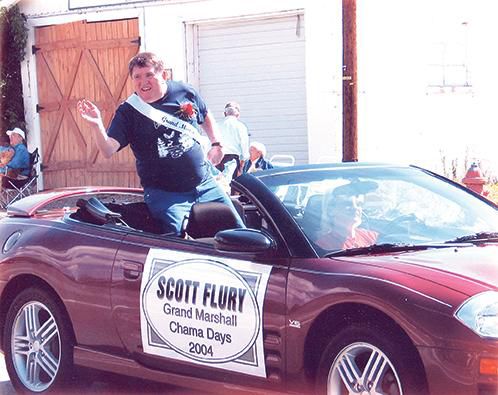
    Flury was a founding member of the Chama Valley Open Golf Tournament  in 2002, held annually in nearby Alamosa, Colo. It provides scholarships for local students and a golf camp for local children. In 2004, Flury was named Grand Marshall of the annual Chama Days celebration in August.

    “To me, that was just a real honor,” Flury said. “For me, not being from here, for the community to select you.”

    In 2005, the Escalante High School football team had to cancel its season due to a lack of players. The community began to question whether  the football program would continue. A group of citizens, including Flury, helped form the Wolf Pack Booster Club in 2005 to support sports at Escalante.

    “I really got involved with that,” Flury said. “There was concern that they wouldn’t be able to put a football team on the field.”

    The Club provided funds to help purchase helmets and other equipment for the team.

    “We held an auction and Scott turned the station over to us for two days, donating his time,” Bill Elbrock of the Booster Club and Chama Village Council member said. “He’s always been there for us. He’s just so community-minded, especially when it comes to the kids, the school and the sports.”

    Escalante football has thrived since then, culminating in a 2012 Class A state  championship. The Booster Club now holds an annual sports banquet at the end of the high school year to honor Escalante’s athletes and brings in a guest speaker.

    Flury became a member in 2005 of the board of the La Clinica del Pueblo in Tierra Amarilla.

    “I’m really proud to serve on that board,” he said. “Providing health care here is critical and we have the only ambulance service. It’s always a constant battle to keep providers here and find the funding to keep a clinic open.”

    Flury attended a Primary Care Medical Conference June 19  in Albuquerque, with Rio Arriba County Manager Tomas Campos.

    “He’s always very positive and his ideas about advertising and helping the clinic are spot on,” Campos said of Flury. “We need it in these small communities where people don’t have the ability to go to a doctor.”

Oklahoma youth

    Avard is a small town in the panhandle of Oklahoma. Flury’s father William Flury owned the only grocery store in town. The economy centered around agriculture.

    “My dad would extend credit to the farmers until their wheat harvest came in,” Flury said. “It was just a little railroad town. I loved it. There were only about 90 people in the whole town. To me, when you went to church, there was one church. I didn’t even know there were other denominations.”

    Flury attended school in a one-room schoolhouse with Joyce Kilmer as the only teacher for all grades,

    “In the first grade, I sat in the first row,” Flury said. “In second grade I moved to another row. Third grade, another row.”

    His family moved to Albuquerque when Flury was in the fifth grade because his mother Thelma suffered from asthma and doctors felt the dry air in Albuquerque would be good for her. Flury’s mom taught elementary school in Albuquerque, while his father found work as a meat cutter and later ran a convenience store, where Flury would work. They were held up twice.

    “One robber held a gun to my head,” Flury said. “It made quite the story the next day at school.”

     Flury attended high school at Del Norte, a member of the first freshman class at the school. As such, they were able to decide on what the school colors would be, who the school mascot would be and his class was the first to have spent all four years of high school at Del Norte when they graduated in 1967.

    “It was great being at a new school,” he said. “I was never big enough to play sports, so I became the team manager for all four sports — football , basketball, baseball and track. I wrapped ankles and treated blisters. I took classes under Tow Diehm (then athletic trainer at the University of New Mexico) in athletic training.”

    Flury entered a contest and became bat boy for the then Albuquerque Dodgers, later to become the Albuquerque Dukes and now the Albuquerque Isotopes. They played their games at Tingley Field.

    “After they won the championship of the Texas League, they voted me a share,” Flury said. “I think I got $100. We were right across from the zoo. When the wind was blowing right, the aroma from the zoo would flow across the field. My first job was as main concessions manager.”

Poor pig judge

    Flury had developed a love for the outdoors and upon graduation from high school entered New Mexico State University with the goal of becoming an officer for the state Department of Game and Fish.  He was in for a rude awakening.

    “I didn’t realize that you had to enroll in animal husbandry,” Flury said. “They put me into a pen with a pig and asked me to judge it. It looked like a good pig to me, but I was wrong. It didn’t take me long to realize I was a fish out of water.”

    The dean of the School of Animal Science of the University suggested Flury consider broadcast journalism as a career.

    “They said, ‘You have a great voice,’” Flury said. “That’s when I got started in radio. I remember once I forgot to turn the transmitter on. After I finished broadcasting, they told me I’d been off the air.

    “We did a little bit of everything,” he said. “I remember doing a documentary of the professional athletes that had come from New Mexico State.”

    Flury broadcast on the university’s station, KRWG.

    “Back then, we worked out of a barracks,” Flury said. “Of course, now they have state of the art equipment.”

    Flury found life at the University too much.

    “College was just overwhelming to me,” he said.

    However, he had established himself as a radio announcer and got a job in Ulysses, Kan. with station KULY, where he was the sports caster and morning show host.

    “By then, I had fallen in love with radio,” Flury said.

    After two years there, he moved to KOAM radio in Pittsburg, Kan. There Flury hosted a rock-and-roll program from 7 p.m. to midnight.

    “We broadcast to four states and did the top 40,” he said. “That was in the early ‘70s. Once I had a contest where listeners could make their own Valentines. My dad was visiting around then and they would bring in a mail bags full of letters to the station. I emceed a Neil Diamond concert.”

    From there, Flury moved to Midland, Texas. He broadcast the local football games for Midland Lee High School on station KBAT.

    “I thought I’d died and gone to heaven,” Flury said. “Football was everything in that town and they really knew how to put on a football game. It was a fun time to be in Midland. I got to know George Bush Jr., who had a small, independent oil company. When Ronald Reagan was campaigning for president, all the top Republicans would come to Midland because of the oil money.”

    From Midland, Flury traveled across the country to Worcester, Mass. and worked at station WESO, where he first got into sales management.

    “I took a vacation in New England and just fell in love with it,” he said. “On a lark I looked into any openings in broadcasting and got a call asking if I’d like to get into management. I jumped at the opportunity. I still have a soft spot in my heart for Boston.”

    He was there for six years. The company that owned the Worcester station acquired a station in Albuquerque. Knowing he was from the area, they offered Flury a chance to return home.

    “I had a feeling I had to get back close to home,” he said. “Amanda was in the fourth or fifth grade. Her grandpa (William Flury) lived in Albuquerque. We bought a house right across the street from him.”

Chama snowstorm

    In 2008, the community was hit by a massive snowstorm. Roads were impassable. The weight of the snow caused the roof of Chama’s only grocery store to collapse, as well as damaging a church and several homes.

    “I actually, physically got stuck trying to walk the sidewalk from my house to the station,” Flury said. “I was able to crawl over the snow to a streetlight where they had cleared  the street  so I could walk. I mentioned it when I got on the air and an elderly gentleman shoveled my sidewalk. He told me, ‘We can’t have our announcer getting stuck in the snow.’”

    It was an emergency situation.

    “I can still remember the National Guard trucks rolling through town,” Flury said. “It was pretty incredible. I gave the mayor (then Archie Vigil) and Ron Russom keys to the station so they had 24-hour access for any emergency.”

    On the air, Flury urged  neighbors to check on each other and organized snowmobilers to deliver needed prescriptions. He was the voice of the community in a crisis situation.

    “People couldn’t leave their houses. Scott’s voice calmed them and kept us together when things could have fallen apart,” Russom said. “It was a time of need and Scott did research into what services were available. He calmed us.”

    The community has survived other difficult situations. In 2010, the Lobato trestle outside of Chama on the Railroad burned, forcing the cancellation of trips to and from Chama. The trestle has been rebuilt, but people worried about the future of the Railroad. In 2011, the station was a finalist for small-market radio station of the year  by the National Broadcasters Association. Flury continued to be the voice of the community. Changes were coming for KZRM.

Out of radio

    Flury was the host of a morning show from 6 a.m. until 10 a.m.

    “I never set the alarm once,” Flury said. “I always looked forward to playing the National Anthem at six in the morning.”

    The station was purchased in 2003 by Lance Minnite and became KZRM. One of the first things Minnite did was upgrade the station’s antennas.

    “It was just a struggle financially,” Flury said. “No way you could survive being just a Chama station.”

    Flury continued to work at the station as general manager and continued to provide access to the community.

    “Anybody that wanted to do anything on the radio, nobody was turned away,” Flury said.

    The station was in danger of going off the air in September 2011, when Minnite was able to sell the station to George Freeland. It looked like Flury would stay on the air. That same year, Flury suffered a medical condition that would require gall bladder surgery. Without medical insurance, he was worried about how he would pay his medical bills.

    “The community rallied around me,” Flury said. “They paid my medical bills.”

    Among the contributors to pay Flury’s medical bills was the Jicarilla Apache Nation, whom had appreciated Flury’s broadcasting of Dulce High School’s athletic events and the relationships he had built within the community.

    “I went before the Nation with a resolution,” Leon Reval, legislative council member for the Nation said. “The Nation gave him a donation just because of the relationship he’d made. When I presented him with it, I wanted it to be a surprise. Hopefully, it helped with his speedy recovery.”

    Reval, a big man, had first met Flury in 2006 and had an immediate response to Flury, a small man with a big voice.

    “I had heard a lot of positive things about him,” Reval said. “It was just one of those things where you knew you’d found a friend for life.”

    Flury’s days with the radio station were numbered.

    “They had taken away my sales position and that was a huge loss of commissions for me,” Flury said. “They wanted me to be on the air from 6 a.m. until 1 p.m. That was about the time I decided I needed a change in life.”

    Flury made his last broadcast in 2012.

    “My last show consisted of nothing but people calling in,” Flury said. “Every coach, every kid that I’d touched.”

    He was not unemployed long. Flury applied in 2012 for an opening in marketing at the Apache Nugget Casino in Dulce.

    “I called about it and was told it was the deadline for applications,” Flury said. “In two days I had an interview.”

    Flury was hired by the Casino. He is now head of marketing. He is in charge of creating ads and promoting the Casino, its restaurant and hotel. There is a brand new event center that he manages and promotes.

    “I feel blessed, he said. “To be able to get a job at my age. I love it.”

    Reval feels it’s a reciprocal relationship.

    “Scott’s a wonderful addition to our community,” Reval said. “Just his dedication to just being a human being that’s all the way down to the bone. That’s the heart of Scott and that’s what makes him a giant.”

    In addition, Flury sits on the advisory board of Dulce radio station KCIE. He still misses being in radio.

    “Every morning I wake up and miss being on the air,” he said.

Into politics

    Fittingly, Flury’s contribution to the community took another step in March, when he was elected to the Chama Village Council, where he works with Elbrock, Russom and newly-elected Chama mayor Jennifer Gallegos.

    “He was a huge asset when he was on the air and he’s just a wonderful person,” Gallegos said. “He’s the mayor pro-tem when I’m gone and I have all the confidence in him.”

    The Council recently received good news when Governor Susana Martinez authorized $8 million for the Village to build a waste-water treatment facility.

    “There was no way we could have afforded that,” Flury said. “We were facing daily fines from the Environmental Protection Agency.”

    There are things Flury would like to accomplish.

    “I’d love to see a full-time summer recreation program for the kids in Chama,” he said. “We need to diversify and become a four-season destination rather than relying so much on the Railroad. There are just so many needs. I wish we had more money.”

    There is not sufficient space to list all the ways Flury has touched Chama and the surrounding communities. In his humble fashion, Flury feels that he is the one who should be grateful.

    “Everything I’ve given I’ve received back 100-fold,” he said.

Related articles

- Advertisements -

Recent articles

- Advertisements -