Hard Cider Apples Gain Popularity

Published:

Tim Seaman’s apple orchard, Los Silvestres, (“the Wilds”) is located on the Rio Chama, three miles upstream from the village of Abiquiú. The name comes from the fact that Abiquiú represented the edge of Spanish Colonial influence in New Mexico during the 18th century—beyond Los Silvestres were lands controlled by the Navajo, Ute, and Apache. The orchard is irrigated by the historic Abeyta-Trujillo Acequia, established in 1735. Manzanar translates as “apple orchard.”

    It’s early morning in Abiquiú. Seaman is thinning one of his trees. That process allows for better fruit. An apple blossom has five parts. It will produce five pieces of fruit.

    “What I do is I go in and choose the best one and cut the other four off,” he said. “That (he points to a very full tree) is already thinned. You can imagine how heavy that (the branches of fruit) would be. I’m thinning but also trying to space them out. I like to have a hand (the space of a hand) in between each piece of fruit.”

    Seaman said it is all a balancing game because as he summer prunes he must leave a certain amount of leaf area to support a piece of fruit.

- Advertisement -
- Advertisements -

    “I just wait for it to start pulling the branches down, which is a good thing for a pear tree, because they produce more fruit when they are horizontal,” he said.

    Seaman looks quite comfortable and you get the impression he does a lot of sitting and thinking in the orchard. He looks as if the trees that surround him and those that spread into the orchard and off toward the Chama River are like friends to him, or family.

    There is a slight breeze and Seaman attributes the lack of mosquitoes this year to a cold spring.

    Seaman grows apples that, for the most part, are varieties used in hard cider.

- Advertisement -
- Advertisements -

    “I moved into a place that had a nice orchard,” Seaman said as he gestures toward the more mature trees on the property he and his wife, Glenna Dean, purchased around 2003. “Most of these larger trees in here were already here when Glenna and I bought this place in 2003. They were planted by David Yates back in about 1989. He used to be a schoolteacher in Gallina. Wherever David lived around here he planted trees — heritage trees. Varieties other than golden delicious or gala. That was most of what the market was in this valley until the market dropped out.”

    Seaman said most of the varieties Yates planted would be unrecognizable, “unless you put your nose into some pretty dense books.”

    There are also some websites that are pretty good about explaining the European varieties and such.”

    Seaman grew up in the east and went to college at University of New Mexico and worked as an archaeologist. Most of his career was spent at the Laboratory of Anthropology museum in Santa Fe. His first job in archeology was to survey the big power line that starts in Ojo Caliente—the Ojo substation—and goes to Farmington.

- Advertisement -
- Advertisements -

    “I did some of the archeology along that (he says as he points to some massive power poles running atop the hills to the east of the valley) and this valley always got me,” he said. “Coming down Trujillo hill — it’s just such a beautiful place. That was around 1975. I got to know a few people in the area.”

    When the Los Silvestres property coincidentally came up for sale, the Seamans snapped it up.

    Seaman scratches his six-month-old pup, Rufus’s head.

Grow your own

    Seaman said he has brewed beer and cider a long time. He used to get his apple juice from Dixon’s orchard near Cochiti, before the property flooded. He made cider every year.

    “So when I got in here I thought, ‘These are neat trees,’” Seaman said. “I tasted them (the apples) and they were very different than anything you could buy in the store.”

    He thought this was for him. However, Seaman said he is less into brewing than in the past.

    “I just fell in love with the apples and with the trees,” he said. “Growing them and grafting them, the only way you can taste some of these apples that have been around for hundreds of years is to actually grow them.”

    He gestures to the more mature trees that were planted when he bought the place and one that produces regularly.

    “This is a gravensteon,” Seaman said. “This is a northern spy (pointing to another).”

    He speaks as if he’s introduced you to some of his close friends.

    “This is a German apple that came through Holland in the 1800s,” he said.

    Most of the apples on Seaman’s property he calls “market failures.”  For one reason or another, they are no longer in stores. The northern spy is the best cooking apple in the world, Seaman said.

    “It was Julia Childs favorite apple,” he said. “The balance between the acid and the sugar, in this case, pies and the apples hold their shape when they are cooked.”

Hard cider history

    Mike Zercher, of Santa Sidra Hard Cider, is the primary buyer of Seaman’s apples. He said New Mexico has a lot of orchards, more orchards than it should for its population.

    “It’s basically because New Mexico was a big apple producer in the ‘40s and ‘50s prior to the invention of these storage technologies that now enable us to have apples in the grocery stores year round,” Zercher said. “That technology is great because we can eat apples but on the other hand, it destroyed the market for New Mexico.”

    New Mexico was important to the early apple industry because they harvested earlier than anywhere else in the country. The state is farther south and warmer. New Mexico apples used to be shipped to Chicago, California and other far off places.

    “Apple trees are funny,” Zercher said. “They keep giving you apples even if you don’t want them. Most other crops you have to do a lot of work every year to get a crop.”

    Zercher said hard cider’s popularity is tied to its inherent qualities.

    “Hard cider is a nice alternative to beer and wine,” he said. “It’s lower alcohol than wine. It’s fizzy, unlike most wines and people like fizzy beverages, and it’s not bitter like beer and a lot of people don’t like the bitterness of craft beers in particular.”

    It also doesn’t hurt that it’s gluten free.

    Hard cider is also a heritage beverage for America. It was, at one time, the most popular alcoholic beverage in the country, particularly in New England where the soil is so rocky.

    “It’s hard to grow grain or corn, but apples grow wonderfully in that kind of soil,” Zercher said. “In time, cider started going by the wayside because there was so much immigration from central Europe and those folks were beer drinkers and the nail in the coffin for cider was prohibition.”

    When prohibition came along a lot of the spitter trees (you take one bite and spit it out because it’s so bitter) were chopped down or burned or torn out of the ground because the teetotalers wanted to make sure nobody was making hard cider at home. Farmers then needed to grow a different crop from which they could make money.

Eclectic orchard

    Seaman puts on his camouflage hat and grabs a reference book from inside the house and leads the way to the orchard. He seems authoritative enough that you trust what he says without the book being brought into the mix. He exits the house, book in hand, and Rufus moves to his side. You know this pair spend a lot of time together roaming the orchard and down by the river.

    One of the things that sets Seaman apart from other apples growers is the fact that he has a very eclectic selection in his orchard.

    “So I started out pretty quickly putting in trees out there (he points to the hay field),” Seaman said. “I converted half of that hay field into an orchard and Gordon (Tooley) did the grafting for me and they were little things like this (he indicates a length of about a foot) and they are well over my head now. Because I have so many varieties, I’ve made it a very difficult management trip because in the springtime there is always something blooming and something is always in danger. Something is always susceptible to different kinds of funguses… (so with so many varieties you add to your orcharding problems).”

    Seaman said his isn’t a commercial orchard, regardless of the fact that he does sell his apples. It’s more a hobby. It’s in his nature.

    “But there is a lot to be learned here,” he said. “It’s sort of a conservation orchard. A lot of the trees out there, I may never get fruit from because of the frosts around here. It’s difficult to control and I can’t afford a $30,000 wind machine (to help when cold weather and frost comes).”

    Seaman said many of the heirloom apples he grows, he planted just because he loved the name. They’re not popular for fruit growers for a number of reasons.

    “But in order for someone to grow these commercially today, you wouldn’t get a crop for at least eight or 10 years,” he said. “That’s characteristic of this variety. And who is going to wait eight or 10 years for a return on their investment?”

    Additionally, a lot of his trees are biannual in their production. They’ll produce a bumper crop one year and the next year they’re too tired, having used up all their reserves and you get nothing.

    “I’m doing things that I can to bring them back to more even production,” Seaman said. “Summer pruning is one thing I’m doing. Summer pruning emphasizes growth so when the tree comes back in the spring it sends up all of this stuff on the ends of the branches. (he gently caresses the end of one branch to show off this emphasized growth).

    Seaman explains the type of summer pruning he’s doing. Pruning one variety of tree in the summer limits growth. It forces the tree to develop fruit spurs, increasing production the following year.

    “That’s for this particular tree,” he said. “If I did the same thing to that tree over there, a tip bearer, I’d be cutting off my apples.”

    It’s one of the hazards of having multiple varieties in an orchard.

    “I’m taking notes on all the different varieties and I think it’s going to be useful to people down the road who are producing apples for the cider market,” he said. “I can advise them to which ones are going to work and which ones probably aren’t.”

Hard cider apple

    Apples used to make hard cider have specific traits. Apple-growers develop their orchards toward those traits if they’re supplying cider-makers.

    “They’re interested in apples with significant amounts of malic acid and tannins.” Seaman said. “Those are the things that give them character. If you take some golden delicious apple juice, it really tastes great when it’s fresh, right? The process of fermentation turns all that sugar into alcohol, and what are you left with?”

    Seaman said a lot of people in the commercial area will back-sweeten their product, meaning they will add some sort of sweetener after fermentation. If you do that with apples that have a lot of tannin, that have significant amounts of malic acid in them and other things that come off the skins, then you have something left.

    Seaman calls it character. And character is an important word in this hard cider world.

    It’s just like varietal wines. If you take table grapes and make wine out of them, they’ll make alcohol, you’ll get drunk, but you won’t get any complexity or anything interesting.

    Traditionally good cider-makers balance their cider with varieties to reach about 50 percent sugar content. Golden delicious is a good base. Then they use heirloom or tart apples with tannin in them, for the bitterness and charcter.

    Mike Zercher concurs on the character importance.

    “Apples are pretty simple fruits,” he said. “Generally they are a combination of sweetness and tartness and then aroma. Everybody knows what an apple smells like. Most people would recognize the tartness of an apple.”

    The malic acid allows that recognition. It doesn’t occur in very many other things.

    “What’s unique about a lot of the apples Tim is growing, is that there is an added flavor component from the tannins,” Zercher said. “Some tannins give you the astringency and others more of a bitterness. Astringency is often described as putting a teabag in your mouth. That puckering, dry feeling you get in your mouth even though you are drinking something wet.

    Cider requires a certain amount of astringency but not too much.

    “The cider I made from his apples was a blend of northern spies, mostly, and I don’t remember if they were galas or Rome beauties,” Zercher said. “So it’s a blend of a dessert apple and an heirloom apple, which is the northern spy. The northern spy is not super high in tannins so that blending gets some of those favorable flavor components.”

    “The cider-makers have a hard game here in New Mexico because God laughs at fruit here,” Seaman said. “All three producers in Santa Fe try to stick with New Mexico growers because some years there are so many apples and they can get them cheaply and brew a lot of cider.”

    However, a downside to that strategy is brewers must back sweeten, because so many of the apples are varieties like delicious  and Fujis. They want different kinds of apples. If they don’t have the right kind of apples, they’ll get apples from the western slope of Colorado and adjust for the lack of quality, such as adding powdered tannin.

Varietal ciders

    Seaman continues through his orchard. He stops at a tree.

    “This is a golden russet,” Seaman said. “There are very few apples that you could make a single varietal cider and have it be balanced. This is one of them. I don’t have many this year. This one was in full bloom when we got down to 28 degrees. It’s an excellent apple.”

    The names of the apples in Seaman’s orchard are not familiar. They are not names you’ll run across in your local grocery.

    “This one here is an interesting little apple,” Seaman says enthusiastically as he points to another tree. “It’s called a Kingston black. This is an English apple. The golden russet is an American apple I think, developed in New England. This one also makes an excellent single variety cider. In England you’ll go to the bars and they’ll have four or five different varieties of cider on tap and usually one of them will be a varietal like that.”

    The tour makes an abrupt stop at a tree and Seaman leans down and points to the label attached to the tree. It says “Cox’s orange pippin.”

    “There’s a market for varietal ciders and some people are selling them for $20 a quart,” Seaman said. “They don’t produce much so they cost a lot.”

    Adding to the cost is the difficulty to produce a certain apple. Cox’s orange pippen, also developed in England, is hard to grow. The one Seaman is pointing at has been in the ground for two years and he’s gotten one apple.

Tough apples

    Seaman said there are not many apples farther out in the orchard where more mature trees live. It’s because these trees were hit by frost. The frost sticks close to the ground and then builds up, so you notice there are no apples below a certain level, and when Seaman explains this he indicates a level on the tree he is standing near.

    He points to another tree and said, “That’s a liberty and that’s a dual-purpose apple. You can use it for anything. I have a lot of these planted because it’s one of the most disease free.”

    The liberty was developed in Minnesota and is not an old apple, developed in the 1960s. He said growers are trying to develop apples that are tasty for the market and don’t require insecticide. The liberty is made more disease-resistant by breeding certain sub varieties and combine them with the root stock. A lot of that resistance is from the root stock.

    So if a root stock is resistant to something and it’s grafted to another variety that is resistant to something else, the result is the apple version of a super hero.

    Seaman walks on to other varieties.

    “Here is one that is supposed to taste like pineapple,” he said. “It’s an English apple. There is a white pearmain over there and it can be traced back to the Romans.”

    Then he indicates another.

    “This is probably the ugliest apple in the world,” he said. “They tell me it’s called a knobbed russet, which means it has a russetted surface, It’s hard like those bosc pears and it also has these nasty lumps on the surface.”

    “This is a giant Russian, also a red flesh apple,” Seaman said pointing to another. “I have grafted on a Kingston black. So there are two varieties on this tree. I did this because the elk came in and destroyed the tree but I was able to save something. That’s when I put in this expensive elk fence.”

    Mixing varieties has its limits. Varieties’ different traits would make it difficult.

    “Well, it would sure make pruning dangerous,” Seaman said. “You could prune off your whole variety. I added the Kingston black because it’s an excellent varietal and cider apple. It seems to grow really well here and it’s very late in its flowering.”

    Seaman did that with eight or 10 trees other trees. He also grafted on a crabapple he has on a road that travels though Chamita. There are a couple of trees there he said are really good crab apples so he grabbed a couple and grafted them .

Farm lab

    Seaman’s orchard feels like an experimental farm, one in which Seaman plants numerous varieties and gauges which ones work best in this climate and for the cider market. If he weren’t so casual, you could imagine him in a white lab coat jotting down his notes precisely. But the scientist reference isn’t too far off since Seaman is a retired archaeologist.

    “Here’s an old-timey one, it’s called a Ribston pippin, also known as the glory of York,” Seaman said as opens the book he’s been carrying. “This one I don’t know that much about yet. They only bloom early. But it’s got a great growth habit.”

    Seaman reads that the Ribston is a parent of Cox’s orange pippin. It is a classic dessert apple of England. The book describes it as hard, crisp fine grained, extremely sugary flesh. Not attractive.

    That’s true, a lot of the apples aren’t attractive. It is also a triploid, which means its pollen can’t fertilize the tree itself or other trees. It requires pollen from another variety to have any apples.

    Seaman’s reference to “growth habit” is a way for growers to identify different types of tree growing patterns, such as single trunk. This is the standard growth form of most trees consisting of a single large trunk growing from a simple root mass below ground.

    There are a number of categories.

Going viral

    Seaman’s orchard is punctuated with trees that have small red ribbons on them. The ribbons indicate trees that have fruit on them. When he sprays for coddling moths, he need only hit the trees with fruit. Moths don’t affect trees, just the fruit.

    Seaman said he doesn’t use Kaolin Clay spray, such as Gordon Tooley uses in Truchas.

    “I use two things and I go back and forth between them so the bugs don’t get used to one or the other,” Seaman said. “The first thing I spray is a virus called Cidex. It’s very specific to coddling moth. You can spray with the bees out there and it won’t hurt them. They (the moths) ingest it when they are in the larval stage and it blows up their gut.”

    The beauty of the virus is the first generation of coddling moths get sick and die. That creates more of the virus that will continue to kill future generations.

    “They end up spreading it for me,” Seaman said. “The second generation is easier to control and the third generation is often non-existent. It works well for me but it’s expensive.”

    Seaman’s orchard is not organic.

    “When I first moved in here I got registered,” he said. “If they certify you organic, that is a bigger deal and you have a lot more work to do. For cider apples I don’t think anyone is dying for organic. I’m more than organic. So I spray that and I use traps to monitor when the moths will be laying eggs.”

Agrarian life

    Seaman said he has always liked growing things. It ties you to the land and your neighbors. He’s a commissioner of his acequia and a part-time mayordomo.

    “I get to know everyone in the valley who is along the ditch,” he said. “I wanted a sense of community and growing things really solidifies you (in the community). Someone who comes in and plants a tree that is not going  to produce apples for 10 years, this person is going to be here a while. There is a commitment. The other people, they don’t have a commitment. You know the kind of people who wanted to be near Georgia O’Keeffe. And then they move because ‘there isn’t a Starbucks.’”

Bottle it up

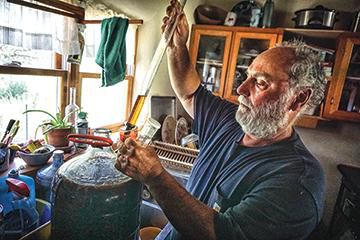
    Seaman is preparing to bottle some two-year-old cider.

    “I like to experiment, try different things,” he said. “And being a beer brewer, there are certain beers out there like Belgian beers that have unique flavors.”

    Seaman is standing in his kitchen. There is a five-gallon bottle sitting on the counter near the sink. The light comes in through the kitchen window and  little round objects can be seen floating on the surface of the cider.

    “Raisins,” Seaman said, in a voice that says raisins on top are the most natural thing in the world. “Adds another flavor and a little more tannin. These are raisins that we raised out there (he points toward the parking lot).”

    Seaman has made a Belgian barrel cider. The last batch he made was a New England barrel cider.

    “It’s a classic recipe from Massachusetts, where they add the raisins and it goes into a big oak barrel,” he said. “It foams over and it’s really disgusting. But it’s very strong.”

    Other cider-makers add brown sugar and molasses. Seaman has substituted a Belgian sugar, a rock candy sugar and a Belgian yeast.

    Seaman said once it’s bottled this hard cider will continue to get better in the bottle. Seaman tastes it and warns you have to be prepared to take a couple of swigs to decide whether you are going to like it or not.

    “Just like the first time you try wine,” he said. “It’s pretty powerful. It’s already removed all the sugar so it’s very dry. If you let it go longer it will mature. It’s got in it some ground up oak barrel so it would extract more of that vanilla flavors from the oak.”

    Eventually the hard cider will turn into vinegar. Fruit flies cause the turn to vinegar.

    “They carry the bacteria and that chemical reaction takes the alcohol and turns it into acetic acid,” he said.

    Seaman takes a couple of tastes and admits, “If I don’t bottle this soon it will keep going down from my thieving it — from my constant ‘testing’ it.”

    Seaman said he’s going to bottle half of it as ‘still’ and he’ll add carbonation to the other half. That is accomplished by adding a set amount of pure sugar in the bottle and the yeast that is still in there will turn that, over time, into carbon dioxide.

    Zercher said Seaman’s apples are unique. There are not many people who grow the apples Seaman is growing, so it creates a cider with a different flavor.

    When asked to describe Seaman, Zercher said, “I think he told me he’s a retired archaeologist. An archaeologist is kind of an interesting profession because it’s mixture of science, history and then getting your hands dirty. I think growing heirloom and cider apples is as close as you can get to being an archaeologist but being a farmer.”

    Zercher said Seaman is taking land used for non-traditional farming and growing something traditionally New Mexico. New Mexico actually was the first place in the United States to have an apple orchard. Manzano, down near Albuquerque, where they have identified the very first orchard probably in North America.

    “So I think he’s kind of blazing a trail for other apple-growers in the state,” he said. “The reason I say that is that hard cider is just booming in popularity all across the country.”

Related articles

- Advertisements -

Recent articles

- Advertisements -