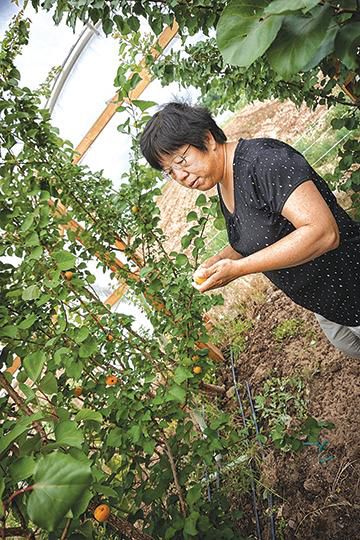
When fruit specialist Shengrui Yao first arrived in Alcalde for her job interview in 2009 at the New Mexico State University Sustainable Agriculture Science Center, she was surprised to see a few jujube trees planted on site. She knows the tree well, as her hometown in China is in a jujube producing area. She said the jujubes were her candy in the fall, and feels in a sense, she and the trees grew up together.
Initially, she was not thinking of the jujubes as an alternative crop, but she realized later the advantage of the late-blooming jujubes over the other crops. The climate of Northern New Mexico, while appropriate for growing the jujube, is different in that it is hotter and drier than the area in China where jujubes are grown. They have the heat of summer, but also the monsoons, so there is much more water.
Less water may be an advantage in some ways, though, as too much moisture when the fruit is maturing can cause the skin to crack.
There are several plots of jujubes now growing at the Alcalde station. The oldest jujube plot was planted in 2006, before Yao arrived. The previous fruit specialist at the station undertook this initial planting. Others were planted in 2011, with 40 cultivars planted both in Alcade and Los Lunas to compare how the trees do in different areas. They have placed some new plantings this year and also have a nursery area where grafting is done.
Yao’s appointment at the Center is half research and half extension. She splits her time between doing experiments at the Center and passing the information gleaned to the public.
“It’s more like 100 percent research and 100 percent extension,“ Yao said.
She said she splits her time indoors and outdoors, and points out that her research inside and outside go together. In the spring, the majority of the time is spent on training, and various workshops are offered to local growers and the general public. She regularly offers a pruning workshop before the growing season starts, and this winter they had additional workshops on growing greens and other crops in hoop houses. After the season starts, she is more focused on research, but feels if training is needed, she will do it.
The importance of passing any beneficial findings from experiments to the local growers is evident. This is the main goal of the research station.
Yao’s work has always related to fruit. She studied in China for 13 years at the Shandong Institute of Pomology prior to receiving her doctorate degree from Cornell University. Before she arrived in New Mexico she worked at a research station in Minnesota.
The late frost is the number one issue for fruit production here, Yao said. For example, this year, the Gala apple plot on the property was mostly frozen out, with maybe five to 10 percent of an average crop remaining on the trees this year. The last two years have seen almost nothing as far as apple crops go. She said 2012 was a good crop year for apples. She didn’t know how bad the late frost was here before she experienced it, and understands the impact the loss of a crop has on small growers.
“They can’t overcome it,” she said.
In her research at the station, she is trying to serve the local fruit grower by finding an alternative, more-reliable crop. She is looking for something that does not necessarily guarantee an annual crop, but a good yield almost annually. They have tried blackberries, strawberries, and jujubes, Yao said. The jujubes seem to be a great opportunity for local growers.
Since Yao began work there, the Center has had a good crop of jujubes every year. Compared to the same timeline, they’ve had two good apple crops, and one peach crop in six seasons.
The jujubes have a few advantages over their early-blooming neighbors. One advantage is that they leaf off late. In the Rio Grande Valley, trees leaf off by late April or early May when the majority of chance for late frost has passed. Yao said if frost does hit them, they are can regenerate themselves and still produce fruit.
Around May 14, 2014 all the jujubes were frozen, but they still bloomed and set a reasonable crop. In addition, they have almost no native pests or disease. Yao said they never spray the jujube plots for insects, only with herbicides. The jujubes are also drought resistant.
Yao said marketing is key to build the initial interest in growing jujubes. Home gardeners will want to plant them. Jujubes are very sweet. They are high in vitamin C and are very nutritious. Some varieties are good for fresh fruit, or steamed to preserve most of the nutrients. Others types are better dried.
In China there are hundreds of ways to process the fruit, Yao said. Here she encourages people to try them in ice cream, pie, or jam.
“The pie is very good,” she said.
Southern planting
Becky and David Thorp own SunStar Herbs, near Madrid, N.M. They have grown and sold jujubes for many years.
The Thorps provided information about jujubes to previous fruit specialist Ron Walser for the initial planting of jujube trees at the Alcalde station, and a similar group of trees was planted on the SunStar grounds for a comparison study, though the trees on the Thorp’s property were stunted by a lack of water.
The Thorps have over 130 trees, with the oldest ones planted in 1994. There are four stages of trees on their property: 21 years, 20 years, nine and eight years. It typically takes up to five years for a tree to be mature enough to produce a sizeable crop, Becky Thorp said. The younger trees will begin to produce fruit at one to two years.
Becky Thorp said the jujube is drought tolerant and will survive without water, but the trees will be small and stunted. Heavy water is required for good jujube crop production.
They have a younger group of jujube trees planted in the drainage plain of an arroyo on their property they have not watered for three years. The floodwater from rainstorms waters them. There is quite a bit of silt build-up but they try to locate crops where they can get water from runoff, and situate plantings in dugout areas to collect as much natural rainfall as possible.
“We’re here to collect water, Thorp said.
The jujubes bloom mid-June, Thorp said. You can observe different stages of setting fruit and blooms all on the same branch. Fruits that set later in the season, late July, have no time to ripen.
The Thorps currently have three varieties of jujubes growing on their property. They bought the original bare-root trees from L.E. Cooke Nursery, a wholesale nursery located in California. Thorp said although they do have rootstock available for grafting, they have yet to produce grafted jujube trees, but that may be a project they will pursue in the future.
The jujube is the only ”alternative” crop the Thorps grow, though they are working toward producing figs as well. The figs have been a little more difficult because they die back each year, but Thorp is hoping to get a greenhouse set up in which to grow them.
“September is when the fruit comes in,” Thorp said. He reports strong sales in both fresh and dried fruit, with additional markets found with local acupuncturists who use the berries as part of a Chinese medicine treatment.
Thorp regularly sells produce, including jujube fruit, at the Santa Fe growers market, and knows of one other grower who currently sells jujubes. She said the other grower lives in Española and has about 13, but other than that, there are few growers of the jujube.
Workshops
As part of her Extension Center fulfillment, Yao offers a variety of workshops throughout the year. She offers a general fruit tree-pruning workshop in March, which gains a large crowd each year. Seventy people attended this year. She also offers a summer grafting workshop.
Yao also offers annually at least two workshops on jujubes. Earlier in the year she does an overview workshop on jujubes: how they grow, how they produce, pruning basics and, occasionally, jujube grafting. She said the wood is really hard, making grafting more difficult. This workshop covers the basics of how jujubes are different from other fruiting trees. They are in a different family than apple and peach trees, so the growing habits and fruiting habits are different.
The fall jujube-tasting workshop is held in late September at the Center. It is partly a promotion program, and is open to the public. Thirty or 40 varieties of jujubes are available to taste to aid in the selection of a particular cultivar to grow in a home garden.
Yao said preference for the home grower is more focused toward taste and size of fruit. Personal preference decides which tree you’d like to plant based on larger or smaller fruit, or the flavor of a particular variety. The yield is more critical for commercial enterprises, which should be more focused on larger yields, Yao said.
Yao said the favorite thing about her work is that she can get her research results directly to the growers. She said it’s hard to adapt the research from other states to fit our needs, because so much is different about the climate or market from one state to another and much research done elsewhere doesn’t apply to conditions in New Mexico. By doing the research here, where the results will be implemented, she can confidently tell the grower what works, because she has tested it in the same environment.
Yao hosted a high tunnel workshop June 26. She said she may help some growers make money, due to the increased fruit production. The apricots are the first to bloom and are very susceptible to freezing temperatures. Because of the nature of the crop, farmers market growers can get a high price for apricots during years that trees produce enough to sell.
Yao said she has talked with growers in the area who are interested in implementing the hoop houses or high tunnels to grow apricots, peaches and other smaller variety fruiting trees. The sheltered environment leaves these trees less vulnerable to late frosts, which can completely wipe out a crop, especially in those early-blooming trees.
Yao looks at the covered blackberries.
“They are doing pretty good,” she said. “Compared to the plantings in the field, which have winter damage.”
At five below, there is cane damage, Yao said. The ones outside have damaged portions that will need to be cut off. Under the covered plot, there are a few different blackberry cultivars – some with thorns, some without. The purpose of planting different varieties is to compare how well each type does in the local environment and then to give recommendations to the growers.
Reliable jujubes
Jujubes will grow here and provide a reliable crop. There are currently few varieties available. With fewer options, it proves to be more of a high-risk trial to the small growers. Later, Yao will be able to make recommendations based on growth patterns in different locations. It will be more known which varieties are good for the Northern New Mexico growers, or good for the southern parts of the state.
Few, if any local nurseries sell jujubes. All the trees planted at the Alcalde station are also from L.E. Cooke Nursery. For a while, Yao was buying trees from the wholesaler and would sell them at the same price to locals looking to plant them, but had problems with people trying to return trees to her if they didn’t do well. After cultivation is further established in Alcalde, nurseries will be able to enter the market, grow the trees and have them more widely available locally.
The next, bigger step and long-range goal, is to get jujubes into commercial production for farmers. This means developing markets, said Science Center Superintendent Steve Guldan. It’s a combination of getting more local people used to them so there’s more of a demand, but it’s also important to connect with some of the Asian population who are right now importing jujubes as part of their regular diet. There is opportunity to grow.