Farm Gives Couple Something To ‘Cluck’ About

Published:

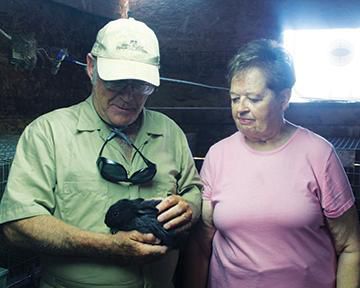
What started out as a hobby, with 25 chickens, approximately 15 years ago, has turned into a lifelong passion and lucrative Tierra Azul farming operation for Ken and Judy Baltz of KJ Farms.

    But a natural disaster almost wiped out their farming operation five years ago.

    The Las Conchas Fire, burning near Los Alamos, which began June 26, 2011, was a massive blaze that grew in intensity, in a short period of time, and which, according to local news accounts, burned more than 150,000 acres. It knocked down power and phone lines in its wake, on its way to becoming the largest wildfire in state history, at that time.

    “Smoke came over the mesa and hung over the place for five weeks,” Ken Baltz said. “It killed about 2,000 of my chickens. Chicken lungs are small so it doesn’t take much smoke to affect their lungs. Most of them didn’t survive.”

- Advertisement -
- Advertisements -

    He said the approximately 800 surviving chickens quit laying eggs for about four months. The Nebraska native was forced to reach out to an avian specialist at the University of California-Davis to confirm it was the fire, causing his chickens to die.

    “I called him to explain the situation to him and he advised me that’s why they were dying,” he said. “At first I wasn’t sure if the smoke was having that effect.”

    Ken said the chicken doctor told him he was lucky he didn’t lose the entire bunch and that the remaining chickens may not lay eggs for three or four months, following the fire.

    Ken, whose farm is spread over a bit more than four acres, produces hormone and antibiotic-free brown and white eggs and has expanded to accommodate rabbits. Including chickens actively laying eggs and chicks, there are approximately 1,700 chickens in all, on the property.

- Advertisement -
- Advertisements -

    After the Las Conchas Fire, Baltz said he tried to get state support and reached out to the Federal Emergency Management Agency, but was told he was not eligible for federal relief because chickens are not considered livestock.

    According to information provided by the United States Department of Agriculture Farm Service Agency, the Agricultural Act of 2014 extended disaster programs previously authorized by the 2008 Farm Bill. Programs were made retroactive to Oct. 1, 2011, but chickens and rabbits are not considered livestock.

    In addition to the fire, in January 2014, neighborhood dogs dug in behind the property fences and killed brand new pullets, wiping out a large amount of hens.

    Ken said he had to go in front of the Rio Arriba County Commission to complain. He was told by officials at the New Mexico Department of Game and Fish to tell his neighbors to keep the dogs at home or they could be shot.

- Advertisement -
- Advertisements -

49 years

of marital bliss

    On July 1, the Baltz celebrated their 49th wedding anniversary. They met in Wyoming when Ken was 17 and Judy was 20. Ken Baltz said they have lived in every state on the front range, all the way up to the Canadian border.

    Ken came to Northern New Mexico in April 1990 and fell in love with the region and especially, the food.

    Judy said they have enjoyed their lives, even though their marriage has had a few ups and downs, like most couples. Ken said he got her a puppy, an Anatolian Shepherd Ground Dog, who is going to be their guard dog against farm animal intruders.

    “I was told I could shoot neighborhood dogs,” he said. “I am allowed to protect my property, but I am not a killer.”

Jack of all trades master of farming

    The Baltzes had to borrow money from their life insurance to try and make it back from the multiple setbacks which derailed their farming operation.

    Ken started back up with 1,000 laying hens and 550 new chicks. Within three weeks, the hens were laying eggs.

    He said for the last six years, he has been researching low-income programs and grants to help get his farm back on track.

    “I was not successful at all in my efforts,” he said. “After I lost all my chickens, I wasn’t in the position to go out and borrow any money. It wasn’t until this year, that I got a loan from the Farm Service Agency.”

    Now, the farmer has five pens housing a wide range of animals, including chicks, hens, ducks and turkeys.

    Ken said turkeys are natural deterrents against chicken predators because they help keep hawks away. The ducks are there to appease the tastes of people who enjoy eggs, but are allergic to chicken eggs.

    You can also find a pair of South African geese on the farm.

    “I was born and raised on a ranch and I have always enjoyed ranching,” he said. “I really liked animals more than having to spend time taking care of humans.”

    After his difficulties with chickens following the fire, Baltz decided to start raising rabbits to butcher and sell their meat to local restaurants. He has about 100 rabbits, including their litters, and he builds his own rabbit cages, which keep them cool in the summer heat.

    Ken said the rabbit cages are kept cool through the use of cooling units built into and around them and by constantly monitoring their temperature.

    He builds the cages himself. The ideal temperature is below 85 degrees Fahrenheit because rabbits will not breed in high temperatures.

    Ken said he was looking for something easier to work with than chickens, after multiple back surgeries. He initially injured his back while working in the oil fields in Colorado, approximately 30 years ago.

    “Most people would have quit after so many incidents and setbacks, but I guess I really must like animals,” he said.

Warmer climates

and fortunes

    Born and raised in Nebraska, Baltz spent 45 years of his life in Wyoming and moved to Northern New Mexico in 1990.

    He said he grew weary of the 30 to 40 degrees-below-zero-weather and worked myriad jobs, including spending 13 years in the oil fields in Colorado, six-and-a-half years working at the Arroyo Seco Animal Hospital, south of Española, and five years working at the state penitentiary. He also worked for six-and-a-half years at a maximum security prison for the criminally insane in Wyoming, before moving to New Mexico.

    Judy said her husband spent 13 years working for Haliburton Oil field Services during the oil boon in Evanston and Brighton, Colo., from 1972 to 1985. He got hurt when he strained his back from lifting heavy iron. 

    “He was not home very much at that time,” she said. “He was working a lot of hours.”

    Judy worked on medical transcriptions, during Ken’s employment with Haliburton.

    Ken said he learned a great deal while working as a veterinarian technician at the animal hospital.

    “They taught me how they wanted me to do things,” he said. “Everything from giving them rabies shots, to learning the anatomy of different animals, to helping out with surgeries. I also learned to love the sloppy kisses of dogs.”

    He also worked as a custodian at Los Alamos National Laboratory.

    “I have  had a number of interesting jobs,” he said. “I guess I am a jack of all trades and a master of none, as they say.”

    Ken got his associates degree in criminal justice from Northern New Mexico Community College in 1994.

    “I wasn’t sure what I was going to do with it,” he said. “I really thought I was going to stay working in the criminal justice system. But like they say, ‘They can’t take it away from you.’”

    He said the toughest job he had was working as a correctional officer.

    “People don’t realize how hard it is to work in the criminal justice system,” Ken said. “Prisoners have 24 hours a day to think about how they can get somebody in trouble.”

    He said six months after he started the job, an inmate told him he was going to let him do his job, but not to do it too well.

    “He said they had people outside the system and could have my wife raped or killed,” Baltz said. “That’s when my alert system was raised to red. I really could not take the stress.”

    He said he took care of his mother-in-law when she was ill with Alzheimer’s disease for about nine years. Judy’s mother was bedridden for several months and died at the Baltzes’ home March 2015

    Over the years, the Baltzes have given tours of their property to students in the local school districts. Ken said he enjoyed having disabled children tour his property and was also glad to see the YMCA bring students to learn about agriculture and farming.

    “I asked them if they knew where eggs come from and I had one of them say ‘The grocery store,’” he said. “They don’t know the process or the work that’s involved until they experience coming down to the farm.”

    Ken said he is the type of person who is always striving to learn about different topics.

    “If I could live another hundred years, I would love to learn about pottery, geology,” he said. “I think education is very important.”

Regional favorites

    Ken said he sells B-graded eggs after a state inspector came to his farm about six weeks ago to look at his egg output. He said even though they are in great condition to merit an A grade, he can’t afford to pay the $1,000 certification required by the federal government.

    “We pride ourselves in the quality of our eggs,” Baltz said. “You can ask any patron of ours and they will tell you that I have the best eggs around.”

    Ken said white eggs take around 18 weeks to hatch, while the brown variety can take up to 22 weeks.

    Weather plays a big factor in raising chickens as well, as production goes down during the winter months. Mother Nature can be unkind to farmers who rely on a steady production, but Ken said there are ways to counter some of the problems presented by the elements.

    “If you got a big flock, they can generate their own heat,” Baltz said. “It’s really rough during that time of the year.”

    The Baltzes wake up at 3 a.m. to prepare their booth at the Santa Fe Farmers Market every Saturday, and regularly get started selling eggs at approximately 6 a.m. They sell eggs for $5.50 a dozen.

    “My clients say they will not buy any other eggs because mine taste so damn good,” Ken said.

    He said he can sell 200 eggs on a typical Saturday morning at the Farmers Market.

    While Ken also raises rabbits to sell their meat, he said an interesting aspect of their breeding is they have to be constantly kept cool and won’t breed if the temperature is hotter than 80 degrees.

    The cages Ken built for the rabbits also have cooling mechanisms built in to them to maintain them at a comfortable temperature.

    “Rabbit meat is very high in protein and is very lean and good for you,” he said. “It is always in high demand. I actually can’t keep enough of it. I usually butcher the rabbit and sell it for $10 a pound. But I always butcher the animal the night before I go to market.”

    Ken said he prides himself in providing his customers with fresh, unfrozen meat. The same goes for his eggs, he brings them to the house from the farm and inspects them regularly to make sure there are no cracks. They get washed and dried and are made ready to go to market.

    No egg older than five days ever makes it out of the farm. At the height of production, Ken said he produced 8,449 dozen eggs, over a year’s time, off the farm.

    The Baltzes’ clients include the Española Farming Co-op, the Los Alamos Co-op and the Farmers Markets in Santa Fe and Los Alamos. They have been with the Santa Fe Farmers Market since 2004.

    The couple also takes cases of meat to two restaurants in Santa Fe — The Fire & Hops Gastropub and Dr. Field Goods Kitchen.

Related articles

- Advertisements -

Recent articles

- Advertisements -