County, City, Pueblo Officials Ask Governor for Help

Published:

Gov. Michelle Lujan Grisham Declares State of Emergency in Española, Surrounding Areas

Gov. Michelle Lujan Grisham declared a state of emergency in Española and Rio Arriba County, citing violent crime, homelessness and overdose deaths, allocating $750,000 for local and state agencies to deal with the problem.

The governor declared the state of emergency because of a “surge in violent crime, drug trafficking, and public safety threats,” under the reasoning that it is overwhelming local resources.

Lujan Grisham declared a similar state of emergency in Albuquerque in April, also signing an executive order where National Guard troops were readied to deploy.

- Advertisement -
- Advertisements -

National Guard troops can be deployed, according to executive order declaring the emergency, but a press release sent by her office makes no mention of them.

“The emergency declaration comes as police calls in Española and surrounding areas have more than doubled in the past two years,” Lujan Grisham spokesperson Jodi McGinnis Porter wrote in a press release. “Police dispatches to businesses in the area have quadrupled in the same period. Rio Arriba County currently has the highest overdose death rate in the state, with residents struggling with addiction to fentanyl and other illicit substances.”

The executive order states the state of emergency will last either until the problems have been alleviated or the $750,000 allocated to the Department of Homeland Security and Emergency Management to “coordinate response efforts and provide resources to affected communities” is exhausted.

“The surge in criminal activity has contributed to increased homelessness, family instability and fatal drug overdoses, placing extraordinary strain on local governments and police departments that have requested immediate state assistance,” McGinnis Porter wrote.

- Advertisement -
- Advertisements -

Unlike in Albuquerque, the state of emergency is not coming with the deployment of National Guard troops — yet. While the press release makes no mention of the National Guard, the executive order demands the ordering into service of National Guard “elements” to support “civil authorities.”

While the emergency is framed as a criminal problem by the governor’s office, the executive order and the letters requesting help from the various communities make it clear that much of the problem lies in the lack of drug treatment resources in the Valley.

In letters from the city, county and the two pueblos, each representative made a point that drug treatment resources are missing.

The lack of a “culturally relevant detox treatment facility” in the community is a “significant barrier” to addressing the exploding problems of addiction, along with post-treatment support, Santa Clara Pueblo Gov. James Naranjo wrote in a letter to the state.

- Advertisement -
- Advertisements -

Española City Councilor and Mayor Pro Tem Peggy Sue Martinez wrote that support is needed for community service staffing, including detox and “long-term recovery resources.”

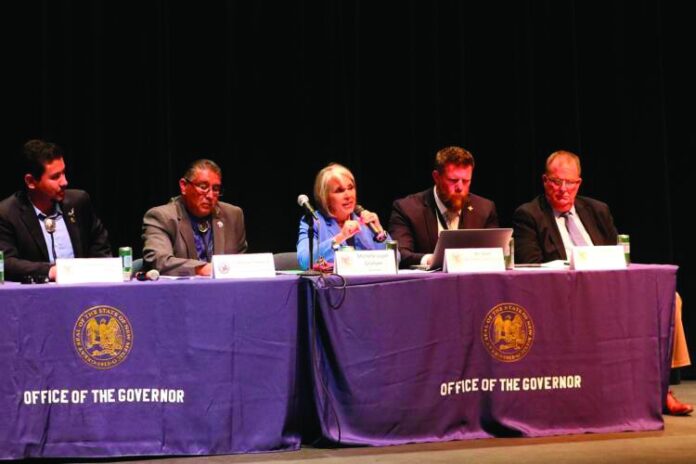
Española City Police Chief Mizel Garcia said Tuesday morning that he and other law enforcement leaders met with the governor Monday in a two-and-a-half hour meeting during which they discussed how the funding would be used.

He said initially, his department will use the funds for quality of life operations.

“It’s important that we utilize funds for body armor, vehicles and other equipment,” he said.

He’s been talking to Rio Arriba County Sheriff Lorenzo Aguilar, Santa Clara Chief of Police Mitchell Maestas and Ohkay Owingeh Chief of Police Roger Trujillo, about how they can work together, communicate more and share information.

“A lot of good ideas came up,” Garcia said of the meeting. 

He said there was no mention of sending National Guardsmen to Española and pointed out that the mention of them in the governor’s executive order is “standard verbiage” in those types of orders.


Local Response

Martinez wrote an undated letter to the governor, along with Rio Arriba County and the Ohkay Owingeh and Santa Clara pueblos.

She wrote in text messages that she sent the letters, part of a coordinated effort, to the governor’s office, then had no further input on the planning.

She did not answer a phone call from a Rio Grande SUN reporter and wrote in a text message to send all questions via text.

“The intended goal is to improve public safety,” Martinez wrote. “To provide Chief Garcia and staff with anything that will help his officers be as efficient as possible. We have heard numerous times about the short staffing and the enormous volume of calls the officers receive during every shift. Hopefully this will help alleviate the pressure our officers have had to endure.”

She wrote that she wants the city’s social services department and fire department to get more help when dealing with people who are overdosing.

“It would help if we could streamline the process for anyone wanting rehab by providing Medical Detox center so anyone seeking help can get it,” she wrote.

She wrote that the “‘round-about’ law” needs to get repealed so “our officers are not chasing the same people over and over again.”

“Also we NEED a jail in Española,” Martinez wrote. “Currently, if an officer makes an arrest they need a medical clearance for the prisoner from the hospital and then a transport to a jail outside our community. All of this makes it hard on an officer, taking them away from doing more policing here in town.”

Española’s troubled jail closed in 2010. Now, prisoners are taken to Tierra Amarilla or Santa Fe.

Asked if she has any concerns about the military deploying to the city, she wrote that their presence will be welcome and that the city staff “will work well with anyone coming into Española to help.”

The city’s police officers should be involved in the “strategic planning” of how to best use the $750,000, she wrote.


Possible Uses

The executive order states that the $750,000 will be used “to avoid or minimize economic or physical harm until the situation becomes stabilized” for things like lodging, shelter, health care, food, transportation or “shipping.”

Anyone looking for money or for a reimbursement from the Department of Homeland Security and Emergency Management will need to show that the “action” exceeds their available resources.

In the undated letter to the governor, Martinez wrote that the city needs:

• Increased coordination with state law enforcement to “combat drug trafficking and violent crime.”

• Funding for public safety and community service personnel, including mental health professionals.

• Support for behavioral health and substance-use disorder treatment services including “detox and long-term recovery resources tailored to our region.”

• More license plate readers and cameras that track vehicle movements.

• “Enhanced support for intergovernmental cooperation.”

In her letter, she wrote that the police department is dealing with double the calls since 2023.

While homelessness is cited heavily in the executive order, and the requests for a state of emergency from local governments, housing, the solution to homelessness, is not mentioned anywhere, either in those letters or the governor’s executive order.


County’s Ask

Rio Arriba County is experiencing an increase in violent crime, homelessness and overdoses and county officials want more coordination with state law enforcement, money for treatment, equipment, training and money for the Sheriff’s Office and “support for cross-jurisdictional collaboration,” County Commission Chairman Brandon Bustos wrote in a letter that cited no increased burden on the county.


DA’s Request

In an email, First Judicial District Attorney’s Office Spokeswoman Catherine Lynch wrote that the office has asked for updated equipment and technology for the Española Police Department to help with the sharing of discovery in criminal cases.

The ask is not new, as it was made last year and was denied, she wrote.

The District Attorney’s office will “continue to advocate for prosecution resources that become even more critical when police staffing increases and the courts continue to unilaterally impose rules that make the prosecution process more difficult.”

The Supreme Court recently imposed a new set of time limits in criminal cases, set to start in 2026, with “simple” felony cases needing to go to trial in 210 days.

In anticipation of the new timelines, the First Judicial District Attorney’s Office asked for increased funding during the last legislative session for 13 more hires, which didn’t go anywhere.


Pueblos’ Letters

Naranjo wrote in a letter to Lujan Grisham that there is an uptick in homelessness, crime and “individuals and families desperately seeking help.”

“The Pueblo has expended thousands of dollars trying to address this crisis: to increase police patrols, to provide behavior health and mental health services to Pueblo members, and to protect Pueblo children who are directly and negatively affected by a parent’s or guardian’s addiction,” he wrote.

The Santa Clara Pueblo has seen a “three-fold” increase in members seeking help from the substance abuse program in the last two years. In 2023, 39 members sought help. Between January and May of this year, 114 people have sought help.

“Family members make up an increasing number of the Substance Abuse Program’s clients, and fentanyl is increasingly the drug of choice of the addicted family member, though alcohol and other opiates continue to be abused as well,” Naranjo wrote.

In the tribal courts, alcohol and/or fentanyl abuse plays a role “in nearly every case on the court docket,” including civil cases.

Police responses to Santa Clara businesses has increased four-fold in the past two years, and 95% of the cases at businesses are either related to drug use or homelessness.

Naranjo wrote the Santa Clara Pueblo wants police equipment, including tactical gear and drones, money for police overtime, money to defray the costs of treatment and the National Guard “supporting non-law enforcement duties.” He did not write how tactical gear or drones would help deal with the issues he identified in his letter ­— drug and alcohol abuse.

Ohkay Owingeh Gov. Benny Lujan wrote that an emergency declaration is needed but, like Rio Arriba County, did not cite any facts or figures to back up claims of a “surge in violent crime,” drug trafficking and fentanyl abuse.

He wrote coordination with state law enforcement is needed, along with drug abuse prevention programs.


Sheriff’s 

Response

In a text message, Sheriff Lorenzo Aguilar wrote that he is grateful for the state of emergency and extra funding.

“We look forward to working together with local agencies and her office to address the pressing challenges our community is currently facing,” he wrote.

Aguilar wrote he had been briefed about the declaration before it was made and a meeting was scheduled for Monday to discuss what to do.

The executive order notes that police calls to businesses in Santa Clara have quadrupled in the past two years, compared to the doubling of police calls in Española.

Opioid and alcohol addictions are fueling fatal overdoses, leaving Rio Arriba County with the highest fatal overdose rate in the state, according to the order.


Amanda Martinez and Managing Editor Jennifer Garcia contributed to this story.

Related articles

- Advertisements -

Recent articles

- Advertisements -