Dancers Flock to Jicarilla’s Pow-Wow

Published:

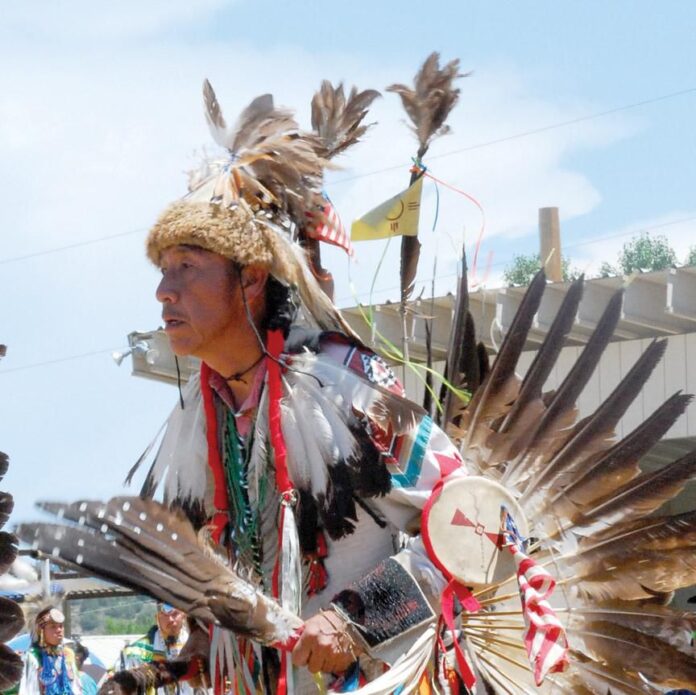
    Feathers shook, shawls waved and bells jangled under the glaring July sun and around a circular dirt court where dancers from tribes throughout the country converged for the Little Beaver Festival’s annual pow-wow and dance competition.

    “Everyone here’s from all over,” Nate Goatsen, of Page, Ariz,, said, gesturing around to the crowd around him.

    The second day of Little Beaver, the Jicarilla Apache Nation’s annual celebration, kicked off the morning of July 18 with a parade down Dulce’s main drag.

    The preceding days had featured a pony express race and the ninth annual Spam-carving competition, and the afternoon would also include a softball tournament and “Battle of the Bands” and Dulce Park.

- Advertisement -
- Advertisements -

    Around lunchtime, the festivities moved to the Dulce rodeo grounds for a rodeo and dance competition.

    Around 2 p.m., more than 100 dancers and musicians waited, huddled under tents, for the competition to start with a ceremonial Grand Entry.

    Goatsen himself was practicing drumming and traditional songs with four fellow Dineh Navajo tribal members.        

    “We come for the dancing, for the celebration,” he said.

- Advertisement -
- Advertisements -

    A power outage knocked out the event’s speaker system, but the dancing took off nonetheless to the beat of a dozen musicians singing and beating steadily on a massive drum.

    The dancers slowly entered the arena, dancing in a line and each wearing a different, elaborate costume pieced together from buckskin, beaded shawls, feathers and brightly-colored frills. As the dancers spiralled around the circle, each performed a different dance.

    The dancing stopped when all the dancers had entered the arena and stood around it in a circle. In the middle, a group of tribal leaders delivered words of prayer for war veterans, for children and for tribal elders.

    The competition resumed for the afternoon with dancers competing in five categories: the jingle, in which dancers wear bells around their ankles; the cone, in which dancers wield cones made of feathers; the traditional Southern and Northern, in which dancers wear traditional cloth and buckskin suits; and the fancy shawl, pow-wow chairwoman Miranda Harrison said.

- Advertisement -
- Advertisements -

    “The dancers come from as far as Idaho,” Harrison said. “It’s a tradition.”

Related articles

- Advertisements -

Recent articles

- Advertisements -