Herbs: They’re Not Just for Cooking

Published:

There are some things a girl can only learn from her grandmother, and most of them are part and parcel of the oral traditions passed down from one generation to the next.

    According to Camilla Trujillo’s theory, many of the traditional arts skip a generation. Trujillo’s mother grew up in the wake of World War II, when the culture demanded consumers buy, rather than make, household products for themselves.

    She expanded on the theory while manning her tables at the Santa Fe Farmers Market, where she is most Saturday mornings, selling her traditional and newly-formulated balms and tinctures.

    “I really think that this sort of thing skips a generation,” she said, referring to her balm making.

- Advertisement -
- Advertisements -

    She sipped from her melon-sized coffee cup.

    “My mother’s grandmother did it as well.”

    What Trujillo learned from her grandmother was two-fold: how to make a classic balm and a love of the herbs used to make the balms.

    Trujillo is named after her great-grandmother, Camilla, while she named her balm business after her grandmother, calling them, “Tonita’s Best Balms.”

- Advertisement -
- Advertisements -

    “I gave it my grandma’s name because I want it to be the best,” she said.

    Trujillo’s own mother did not pick up the balm and herb crafts. Trujillo credited her great-grandmother’s age, when her own mother was a child, as part of the break in the generational chain.

    “She was so old when my mom was a kid,” she said. “I think there’s a big gap in their particular generation. My mom knew of it and she used it, but, (her) generation, they were sidetracked into more American products, like Colgate (toothpaste), Pall Mall cigarettes and Crisco. Her generation was, sort of, they were after the depression and encouraged to buy rather than produce the things they needed at home and some were ashamed of homemade products.”

Green expansion

- Advertisement -
- Advertisements -

    Since she started commercially making balms, Trujillo has been trying to grow all of her own herbs, but since she moved back to Española in 2005, her efforts have become that much more intense.

    She spent five years in Santa Fe before moving back to the town where she was born.

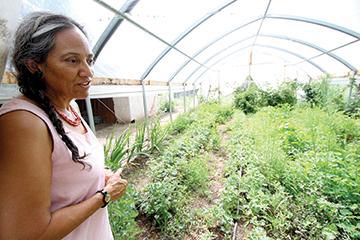
    Trujillo has a hoop house, an uncovered herb garden next to it, and an entire back yard filled with herbs.

    “My parents had a big, big garden,” she said. “We grew our own food and our parents would kick us out of the house. There was no TV watching in the middle of the day. Summer was always spent outside, helping (with the garden) or playing. We had to be outside, getting dirty. The rule was, you leave your shoes outside.”

    In the old days, so many more people farmed that excess produce was given away. Now, fewer people are farming, reducing the total amount of food and creating a demand for vegetables.

    “Now there’s more value in food,” she said.

    In the hoop house, she points to the left row of plants, the only row in the hoop house composed of herbs.

    “I pledged to myself, I would only plant stuff in here that I can eat,” she said.

    Instead, she devoted only one row to herbs, relegating the rest to the uncovered portions of her property.

    “I can’t sell (the herbs),” she said.

    Part of her back yard is filled with a type of arugula that is far not fit to be sold for consumption, evidenced by its very bitter and mustard-like taste, leaving the tongue tingling. Still, Trujillo has a soft spot for it, hence why she has not pulled it all up.

    Her recalcitrance at killing the arugula is likely rooted in something deeper, in her feelings of energy and vibrations that come out of all things, the soil, the rocks, the plants and the water alike.

    Herb horticulture and foraging is not a entirely benign occupation and there are many pitfalls and dangers for those who are not aware of what is being picked.

    Trujillo pointed to an herb called comfrey or nit bone. While it works great in certain balms, it has a large amount of calcium in its leaves and like many herbs, it should not be touched or consumed before it has matured enough.

    When some herbs are still young, they carry alkaloids, which can be dangerous if they are absorbed.

    As she walks through her gardens, she points to small piles of eggshells and pulled vegetation. Before, she would keep one large compost pile but recently, she has decided to start composting in place.

    Next to a large Chinese elm tree, Trujillo points to a compost pile of leaves with three plants growing out of them. They are her best growth of potatoes, ever. She uses the compost to mound around the potato stalks and the compost keeps them fed.

The invention mother

    In 1983, at age 19, Trujillo took her first pottery class with Rose Naranjo, a Santa Clara woman, who also happened to be her friend’s mother. Hanging out with her friends, she would also be hanging out with Naranjo, learning from the hands of a working artist.

    “I learned from helping them, really,” she said.

    Each day after class, she would head to her grandmother’s to steal the balm.

    “It kept my cuticles from cracking,” she said.

    The clay was never a hobby.

    “I always felt it was a path, something my body had been longing to do all my life,” she said. “It was more like an LTR, a long-term relationship.”

    Although pottery may have been one of the loves of her life, it did not bring her any income until she was able to show at the Spanish Colonial Market.        For Trujillo, the paths of her pottery making and her balm creation have been intertwined from the start, but her desire to create things has been with her since she was a child.

    She began her pottery path with a little help from her uncle, his truck, a shovel, a map, two five-gallon buckets and night classes.

    “We drove up way into the mountains, turning here and turning there,” she said. “He stopped and said, ‘It’s right there.’”

    Right where he said it would be was a deposit of clay. They loaded up the two buckets and headed back into town.

    “A little clay goes a long way,” she said.

    At the same time, Trujillo had started taking pottery classes. At the end of the class, she would find her cuticles entirely wrecked so she would pay her grandmother Tonita a visit in Pojoaque and “borrow” some of her encerado balm.

    After too many trips to grandmother’s house, Tonita decided it was time to teach her granddaughter how to make the cuticle-healing balm herself.

    “It used to be common to Rio Arriba,” Trujillo said. “It still is.”

    A Santa Fe woman came up to Trujillo, as she was explaining the first balm she made for her hurting hands.

    “Your tender balm healed a very difficult sunburn I had,” the woman said before bustling into the throng at the crowded market.

    Trujillo said the encerado balm has three simple ingredients, although she has changed the formulation to fit the type of customer that comes to Santa Fe: bees wax, fat and pine sap.

    Since those first batches, Trujillo has been making far more types of balms than just the one her grandmother would make.

    Traditionally, encerado is made with lard, either in its porcine or bovine forms.

    “Some used vegetable oil, which was a very new thing,” she said, referring to those of her grandmother’s generation.

    Tonita was surprised at Trujillo’s interest in balms, considering her own daughter’s move toward premade products.

    Trujillo now uses vegetable products to make her balms, rather than lard, because of the inability to find high-quality animal fat that lacks preservatives and because the Santa Fe customer base is uncomfortable with the idea of putting lard on their bodies.

    Before she started selling at the Farmers Market, she would make a batch every three months or so, mostly to keep her skills up. Before she started making the balms professionally, she did not think to write her recipes or experiments down. Making the balm every three months meant she had enough to give away to friends and it kept her from forgetting the craft.

    Often she would stash the balms, using them up over the course of a couple of years.

Don’t buy, make

    At 16, Trujillo decided to try her hand at the ageless art of making products for personal consumption when she made her own shampoo from a yucca root.

    “I pulled the yucca root and processed it,” she said.

    She used to add it to the shampoo that was already in the house or wash her hair with the yucca water. The root would be pounded and washed into the water, lending its essence only after a fair amount of hard work.

    “It always made it better,” she said.

    Part of the do-it-yourself ethos came from her grandmother’s distrust of the claims being made by the consumer industries.

    “She didn’t even take aspirin,” Trujillo said. “Maybe it’s my grandmother’s influence.”

    Although her grandmother might have had a lot of influence on her, Trujillo was predisposed to be the kind of person who makes and bakes and experiments.

    “I was the kind of kid where, at Christmas, I was getting the yogurt maker and not the doll,” she said. “My family was always supportive.”

    When she would visit one of her great aunts, she would find her with a type of stamp on her temples in an attempt to alleviate the pain of a headache, instead of taking a mass-produced drug.

    “She was the tia who would tell me, let’s make our own face cream,” she said. “We would buy good beef bones and cook them until they were white, grind them and mix them with lard and put it on our faces.”

    Her grandmother’s generation came from a time when, if it was not at the local general store, someone in the village was going to have to make it.

    “The old ways, all of that stuff, it’s tried and true,” she said. “It’s no surprise that people are coming back to it. It was just a matter of time.”

Farmers market start

    With a spread of soothing balms and tinctures, Camilla Trujillo does brisk business at the Santa Fe Farmer’s Market. At least half of her customers each Saturday she has seen before. Once they try her product, they keep coming back.

    “This is the only place I sell unless someone comes to my house or gives me a call,” she said.

    Trujillo began selling at the Santa Fe Farmers Market in 2002. Much like the fight she previously had to have her works included in the Spanish Colonial Market, Trujillo found she had to fight for a space at the Farmers Market.

    “They challenged me,” she said. “With me, it seems every door is already closed with no doorknob. They (farmers market personnel) were unaware of how rich our herbal traditions are. There was this feeling, that, Santa Fe is a step ahead and they’ve lost a lot of their traditions.”

    Trujillo had to convince the people who ran the farmers market that her value-added products, her balms and tinctures, are made from 80 percent local ingredients, referred to as the 80-percent rule.

    Her move to the Farmers Market prompted her to begin expanding her knowledge of herbs and her experimentation with balms and tinctures.

    Expanding on the basic formula, she began to add astringents. One of her balms uses rose petals and cottonwood flowers to get the right amount in.

    “We can use it every day to protect and heal but also to clean, or to maintain clean,” she said.

Healing trip

    A pair of identical twins came up to Trujillo’s booth. JoyAnn Gold took off her classes and pointed a spray bottle of a tincture at her eyes, took a deep breath and pressed down.

    Trujillo told her, if her eyes are dry, the tincture would burn a little.

    “I love it,” Gold said.

    She and her sister, Joyce Rose, came to Santa Fe on a healing trip from Phoenix.

    “It worked on my eyes,” Gold said. “It eases the dryness. When I first put it in, it burned, but now, I just feel refreshed. It’s some wonder you have here.”

    Trujillo’s spritzer was all a part of that healing journey, she said.

    Since the first encerado, Trujillo has expanded to seemingly endless combinations of balms and tinctures. She consistently uses a stable of 50 herbs, almost all of them grown either in her own backyard or in New Mexico.

    She makes balms to repel insects and soothe their bites, for sunburns and other maladies.

    Part of the restrictions Trujillo must deal with, along with the entire cosmetics industry, is she cannot make claims about efficacy or healing.

    As soon as a product is labeled or described as “healing,” it comes under the purview of the Food and Drug Administration and its rigorous, and endless, testing policies and procedures.

    Trujillo does not make salves, only balms, because salves are considered to have healing properties and are therefore regulated by the FDA.

    She said she met a former FDA employee who was stationed in Texas who schooled her on the rules. When she said one of the main ingredients in her balms was pine sap, he said that the FDA had run a whole series of tests on the sticky stuff and found it to have no chemicals known to have healing properties, even though his own grandmother had used traditional herbs to cure ailments.

    “You can do whatever you want, so long as you do not claim that it heals,” she said.

    After a market browser moved back into the crowds, she began spraying down the balm tester he had just touched. She watched as he had been coughing into his hands, before handling the balm.

    “It’s two-thirds grain alcohol, one-third water and a stick of osha root,” she said.

    She stuck the nozzle in her mouth and gave herself a spritz.

    “I use gin,” she said. “It works just as well and I like gin better than vodka.”

    Hygiene is extremely important to Trujillo, evidenced by the battle between the masses and her spritzer bottle.

    Although Trujillo may be adept at making balms, she makes no such claim to her acumen as a businesswoman.

    She is not particularly quick on her toes when it comes to calculating sums and jokes with customers that sometimes they might get more than a discount: they might get accidentally paid when getting their change.

    What she lacks in business, and math, sense, she makes up for in personality.

    “I like people,” she said. “I do. Sometimes I get the math sort of blurry. It’s like rollerskating: if you don’t look down, usually you’ll get right. If I’m wrong, people will usually correct me.”

    Numbers, like her clay, her pottery, her balms and most things in heaven and earth, are alive, she said.

    “They have a life of their own,” she said. “I think that about everything. I think everything is alive.”

15-mile radius

    Trujillo sources the vast majority of her ingredients locally, 85 percent within a 15-mile radius around her house.

    Only 10 percent of the ingredients she uses come from outside of New Mexico, and for some ingredients, it is because they are not made here at all.

    She has to buy essential oils from out-of-state and sometimes she buys sacred herbs, specifically, a type of pseudo-sacred basil, from Amma, the South Indian woman called the “Hugging Saint.” Amma blesses the special basil variety, giving it a further air of the holy.

    Almost all of her recipes and formulas carry a little bit of the special herbs that are said to be sacred or hold special, spiritual powers.

    “Whether it’s osha or the blessed saint basil, in most my formulas, it serves its function and it has that extra mojo,” Trujillo said.

    In her grandmother’s day, those essential oils would have been sourced locally but lard has fallen off in popularity as a local product and it now carries a squeamish stigma.

    Early on, to replace lard, Trujillo began to experiment with coconut and olive oils and then branched out to cocoa butter.

    “I’m going to be using it a lot more,” she said. “I just bought three pounds and I’m going to make some lotion with it.”

    If she were to make lard-based balms, she could certainly sell them in Española, if only Españolans were willing to buy balms rather than make them themselves.

    She had lotion on her to-make list for a long time but it was not until a friend demanded they take her formula and try it out that she finally took the plunge.

    “She said, ‘Let’s do it,’” Trujillo said. “It’s the best little cream of rose petal tea and (other) flowers. I was using a blender to beat in warm canola oil and melted beeswax. It came out like a thick body cream.”

    Her beeswax falls into the five percent of ingredients that she sources from New Mexico, but are not immediately around her house. She buys from a beekeeper in Mosquero.

    For four years she had a single bee hive but eventually, after a long and productive life, the Italian queen died and the rest of the bees abandoned Trujillo without their monarch.

    “Tending bees is a lot of work,” she said. “I’m so busy anymore, what’s one more thing? But, they raise themselves.”

    When she had the bees, it provided some of the wax she uses in her balms. Much of the time, she keeps the excess wax in her freezer so it neither melts in the summer months nor becomes brittle and hard to use.

    Someday soon, she hopes to get another hive, switching from the Langsroth hive she had, which looks like a filing cabinet, to a top-bar hive, with bars that hang down for bees, rather than the sideways slant of the Langsroth hives.

    If nothing else, Trujillo believes in her herbs and in the land around her.

    “I’ve learned over the years, the herbs you need will show up at your door,” she said. “As I got more and more into it, I wanted a pain remover, so I went hunting for wild lettuce. I used to hike an hour an hour away to get it. Then, it started growing in my back yard.”

    Trujillo credits lettuce’s nature for the wild growth. The herb has spiny leaves which stick to one’s clothing. When she brought some of it back, more of it piggybacked on her clothes, furthering its own propagation.

    Trujillo has 50 different herbs she consistently uses for her products.

    “The ones I don’t grow, I’m trying to transplant into my yard,” she said. “There are some that I can’t.”

    One of the plants she does not try to transplant to grow in her own backyard is osha, which normally grows at 10,000 feet and depends on a symbiotic relationship with a type of fungus.

    “But, you know, a little (osha) goes a long way,” she said.

    Once a year, she hikes high into the mountains to collect her osha quota.

    Overall, she is growing two-thirds of the herbs she uses and is trying to get the other one-third down to a more manageable proportion, to reduce her foraging needs.

Artist in residence

    For 10 years after Trujillo made her first balm at 19, she worked as a lifeguard in Española until she went to a conference put on by what would become the state’s Department of Cultural Affairs.

    The conferences allowed teachers to mingle and proposition artists to come into their classrooms and inject a little arts and culture. Many teachers came with preconceived plans of what the individual artist would do and how it would be included in classroom activities.

    Trujillo offered her services as a pottery teacher. Where her clay may have needed just a little water added, she found teachers needed to add a little bit of her teaching into the classroom.

    Her first experience was in Bernalillo County at a high school. While there, she stayed with friends to mitigate the commute, becoming a true artist in literal residence.

Spanish pottery

    In 1990, Trujillo decided to obtain space in the Spanish Colonial Market to sell her pottery. First, she had to convince the people who ran the market that the type of pottery she makes is Spanish Colonial. She turned to remnants of soup plates found in a defunct village near El Rito.

    The soup plates were the exact same style as those found in southern Spain.

    “They traveled in the minds of the settlers,” she said.

    After much effort, she was finally able to earn herself, and her pottery, a place in the market.

    “This pottery, it had to go through a judging process,” she said. “It hit like lightning (in the market.). It was this new real Spanish colonial ware.”

    Trujillo washed dishes as she waited for the balm to melt, before she would pour it into a plastic mold.

    She looked up toward her garden and picked up an incense boat, made of “red brick.”

    Although the piece of traditional pottery would normally retail for $90, she uses it as a bowl for catfood.

Saving the oral

tradition

    The oral history of Rio Arriba has been speaking to Trujillo for a long time and she is always trying to do her part to make sure that it is retained and preserved in one form or another.

    Although much of the knowledge Trujillo has accumulated came from her grandmother, much more of it has come from two seminal books that captured the oral history and traditions of herbs in Northern New Mexico and Rio Arriba, including the Spanish names of the herbs.

    “Michael Moore, he was an herbcrafter and he was a chemist,” she said.

    Moore used his background in chemistry to explain why the herbs have the effects that they do. His work was built on that done by Leonora Curtin, who also wrote down the oral traditions and knowledge from her time spent in villages in Rio Arriba.

    Trujillo has done her own part for codifying the oral traditions of Rio Arriba, when she wrote the book on Española, part of the Images of America series by Arcadia Publishing. Contracted in 2009, deadlines pushed her through to its 2011 publication.

    “Every time I drove through the west side, I could almost see the ghosts, the old stories of the valley, the forms of the people,” she said.

Uninterested locals

    Trujillo sells in Santa Fe because she can actually sell her product. The few times she has tried to put up a booth at the Española Farmers Market, most people will tell her, they already make their own balms at home or they want to try some first, before they are willing to buy.

    In Santa Fe, the locals are not that local and not trained in the balm-making arts. Many take the train up from Albuquerque.

    Margot Guerrero stopped by the market to buy a few balms from Trujillo. She said she has been buying from her for five to six years, after first meeting her at the Spanish Colonial Market.

    “My skin looks pretty good,” she said.

    Patricia Antelles, who lives in Abiquiú but is from San Francisco, buys balms from Trujillo as well.

    “I first met her at Ghost Ranch, when she was teaching,” she said.

    She said she uses Trujillo’s balms and loves them.

    “I use them all the time,” Antelles said.

    Selling in Santa Fe is just good business sense, Trujillo said.

Cooperative

    Trujillo is part of a local cooperative, along with some of her farming neighbors in Upper San Pedro. Together, they have been able to land a contract with the Santa Fe Public Schools to provide salad greens. Everything Trujillo is able to grow this year, that is not an herb, she should be able to harvest and sell to the Schools, giving her a sense of security about her own farming and removing the extra work required to hawk her vegetables at either the Española or Santa Fe farmers markets.

    Those rows and rows of vegetables in the hoop house will keep the stomachs of Santa Fe children filled with roughage.

    She said she hopes the cooperative can become a vendor for the Española School District sometime in the future.

    In addition to growing greens for consumption, Trujillo is trying to make the jump from teaching pottery to herbcraft, the discipline of identifying and using herbs for household products.

    “I’ve already had two sessions at Ghost Ranch,” she said. “There is an interest out there.”

Related articles

- Advertisements -

Recent articles

- Advertisements -