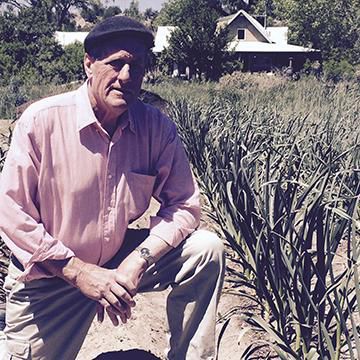
Farmers in the 21st century are an increasingly rare act, but for Rio Arriba farmers like Bill Page, the centuries-old tradition is alive and well in land tucked away, untouched by time.
Page has been growing garlic for more than 15 years on property in La Madera he’s owned for 20 years. He hasn’t always had ties to New Mexican land.
“I attended elementary school and junior high in Denver, Colo.,” he said. “For many reasons, I attended high school in Switzerland and I lived with a family that did not speak English.”
After returning from Switzerland in 1960, Page said he attended college at the American Graduate School of International Management, where he received a bachelor’s degree in international trade in 1967.
In addition to living in Switzerland, he also lived other places overseas.
“I’ve lived in Liverpool and Geneva,” he said.
Following his time abroad, and after getting his international trade degree, Page and his wife, Claudia, wound up in Colorado.
“I attended the University of Colorado, where I became certified as a social studies teacher before I moved here in 1992,” Page said.
In the early 1990s, Claudia’s family moved from Pojoaque to Ojo Caliente. Following that move, Page and Claudia found a piece of land they liked in La Madera and settled there, moving from Denver. Bill Page said they made the decision to move to New Mexico because his parents were deceased and Claudia’s parents were here, so they wanted to be around her family.
The Pages and Bill’s two siblings began construction on what would become a family compound and got ready to settle down in the rural area.
“We finished building the houses in ’95,” Page said. “We have 30 acres between three families with river frontage, three houses and 10 acres of water rights on these 30 acres.”
Page, 72, a father of two and grandfather of five, is semi-retired, reads books and tends his garlic. His children have both moved on. One lives in California and the other in Santiago de Chile.
He’s become so immersed in the community in which he lives, that he served as mayordomo for almost 15 years.
Teachers meet
Page had a 12-year stint as a teacher, mostly substituting, with the Mesa Vista Consolidated School District from 1993-2007. He taught kindergarten through 12th grade.
It was during that time, that Page met Eddie Campos, a fellow teacher and farmer, who lives in El Rito.
“We met through teaching,” Campos said. “I knew some people who helped cultivate his farm. I also helped because I had known him previously.”
Campos said he asked Page if Campos could market his garlic for him at the local Farmers Market, since he’d always see him around town and at Farmers Markets.
“I wanted to market the garlic because I sold chile and I knew people would also want garlic, so they could put it in the chile,” Campos said.
“I marketed his garlic for about two years before I started growing my own,” he said. “I have my own farm and my primary crop is chile.”
Campos said in addition to the chile, depending on the climate, he also plants watermelons. His farm is located in the center of La Madera, near the mercantile.
“I also grow garlic,” Campos said. “The same varieties as Page, that’s where I got them from.”
Dubbed the “heirloom garlic farmer of La Madera,” by Campos, Page enjoys giving garlic to new farmers in order to spread the tradition.
“I just brag about it. I eat a lot of garlic and I give a lot of garlic away,” he said. “I’ve been known to give garlic as Christmas presents. It can ship, it’s not breakable, it doesn’t spoil, people love it, so they talk about it.”
Getting established
Page’s history with farming can be traced back to his family, more specifically, his father, who read books by garlic farmers, like Dixon farmer Stanley Crawford.
“My people grew up in Kansas, where there were a lot of wheat farmers,” Page said. “My father used to read Stanley Crawford books and that’s what got me into garlic farming, along with Ron England’s book, ‘How to Grow Great Garlic.’ Our family has had a connection to land for generations.”
Originally, Page started his farm with seeds he acquired from Filaree Farms in Okanogan, Wash. Filaree Farms specializes in the genetics of garlic. Page said they have been known to test thousands of varieties, to determine which are the best suited for any particular condition.
Page said that early on, when he first began farming, he wanted to be good at growing only one thing, so based on his influence from his father and the books he read, he chose garlic as the crop in which he wanted to specialize.
He sometimes planted watermelons, as well, but he mostly focused on garlic. Claudia, on the other hand, plants and grows other things, he said.
Throughout the years, Page has perfected his growing techniques and settled on three different types of garlic out of the 17 varieties with which he started.
“I plant Red Rezan, Romanian Red and German White (garlic),” Page said. “They are of a hard-neck variety with a better, stronger flavor that are suited for our sandy soils.” Page said.
He said the hard-neck variety can be identified by the white stripe in the middle of the bulb. He also said the woody stalk makes it hard to braid, so he prefers to not braid it.
Planting seeds
Page’s planting process begins in the fall. He plants his garlic every October.
“I get them into the ground before the first freeze so the roots are put down,” he said. “When I plant them, I plant them six inches apart, four inches deep. This ensures the garlic is spaced out enough that it produces the most marketable head, which is about three inches. If you plant the garlic closer together, they can’t spread out.”
After the October planting, the waiting game begins. Results aren’t typically seen until February of the following year, or late December, at the absolute earliest.
“During the first of months April through May, I use the process of top dressing,” Page said. “I use alfalfa, manure and an organic manufactured Yum Yum mix made by a woman from New Mexico. It’s low in nitrogen — you want phosphate and potassium. This fertilization could increase your yields by 15 percent.”
Garlic doesn’t need a lot of water, it’s one of the most resilient plants available, which makes it perfect for Northern New Mexico’s climate.
“I water them once a week from March through June 20,” Page said. “Depending on rain, I might not have to water the garlic at all.”
He said the garlic he plants comes from the caucus regions of Russia and China, so it’s drought-tolerant and adapts to the soil every year.
Page said if farmers can avoid eating the garlic and use it strictly for planting each year, they can yield five times more than the previous year.
Harvest time
Harvest for the garlic begins six weeks after cutting the scape, which is the flower stalk of hard-necked garlic plants. If left on, the scape diverts the plants’ strength from forming plump bulbs.
Bill and Claudia hand-harvest the garlic when it’s ready. He first sizes every head and cleans it.
“After I take the garlic out of the ground, I cure them by making stacks of the plants, and leave them on the portal to dry for about six weeks, depending on weather,” Page said.
During curing, the garlic heads shrink and since garlic farmers are paid according to the size of the garlic head in the field, it’s best to take measurements of the garlic right when taken out of the ground, Page said.
He said there’s a type of garlic called Elephant Garlic that has a bigger head, but it has almost no taste, so genetically, it’s a leek.
Page said a lot of people sell fresh garlic, but in doing so, the consumer has to use it pretty soon after harvesting.
“Garlic begins to risk deterioration from the first of the year, onward,” Page said. “However, if stored carefully, garlic can last for up to nine months.”
Because of the deterioration process, Page prefers to preserve his garlic heads for later use. He said at most restaurants, garlic is not stored properly.
“They peel and chop it, then store it in five-gallon buckets,” he said. “It really messes up the quality.”
Those who don’t enjoy the pungency of garlic can bake it. The baking process destroys the pungency, Page said.
For the past eight years, Page has entered his garlic in the Rio Arriba County Fair and won first place. He was one of the only contestants that entered garlic for competition, but last year, he distributed enough seed for six other people to compete with him, and even though they grew the same variety, he still won.
When he was selling his wares at the Farmers Market a few years ago, Page said he met a Korean lady who really liked his garlic.
“I have no idea who she was,” he said. “She was just a patron. She said it reminds her of Korea.”
Tending the garden
Normally, only the couple tend their farm, occasionally though, when needed, a few extra hands might be hired to help.
At his peak in 2011, Page harvested as much as 10,000 heads of garlic. As the years have gone by, he sticks to about 1,000 heads.
“Now that I’m down to just 1,000 head, I estimate my labor hiring, compost and fertilizer at around $300,” Page said.
He said he and his family eat and give away most of the production.
“I probably sell $400 or $500 worth, mostly as seed,” he said.
Of the 1,000 heads Page plants, his yield is close to all of what he planted. During the growing process, the garlic only needs to be tended about two hours per day, Page said.
“Garlic is very resilient,” Page said. “I haven’t ever really had a devastating year, the garlic takes care of itself. No predators eat it and no insects are attracted to it. The use of herbicides or pesticides would be almost useless.
Occasionally, elk and deer from the valley might come in and experiment with the garlic, or trample some of it, but the garlic is planted deep enough that it seldom gets destroyed.
Page said he raises chickens and guinea hens, which helps keep the grasshopper population down.
The chickens and hens don’t just help Page, however, his garlic also helps them. He said garlic has antibiotic properties, so he chops it up for the chickens. Chickens can get a disease called coccidiosis, so the garlic helps keep them remain intestine-healthy.
Helping neighbors
In addition to cultivating his own garlic, Page has helped his neighbors grow their own. One of his neighbors bought 12,000 seeds and grew 8,000 heads.
Another neighbor, Alfides Ortigova, also got introduced to garlic-growing by Page.
Ortigova, originally from Paraguay, and his wife, moved to New Mexico in 2005. His wife was in the Peace Corps and wanted to go to school in Albuquerque.
“I didn’t speak English before moving here,” Ortigova said. “We moved here because of the Spanish culture.”
The couple moved to La Madera two-and-a-half years ago and that’s when he met Page and was introduced to the garlic-growing process.
“The neighbors told me to be careful with just driving to meet people,” Ortigova said of his first experiences in La Madera. “But I figured I’d just go talk to Bill Page anyway.”
After meeting him, Page gave Ortigova 1,000 heads of garlic and told him that the following year, when he sold the garlic, he could pay him back.
Ortigova said he wanted Page’s garlic because it was “amazing.”
“He’s a great guy,” Ortigova said about Page. “He’s wonderful, caring and compassionate. I haven’t met that kind of guy before. He’ll never turn people away. He’s very welcoming and everybody loves him. He’s a great human.”
Ortigova became so serious about growing garlic, that La Montañita Cooperative Market gave him a loan to grow it. His venture has been so successful, that he still grows for La Montañita and also sells his garlic in Española and in Santa Fe.
“I used to sell at farmers markets,” Ortigova said. “But now I focus on wholesale.”
In addition to his garlic, Ortigova grows lettuce, beets, carrots and melons, which he also sells to La Montañita, Whole Foods and the Española Community Co-op. He has also sold his produce to Santa Fe Public Schools a couple times and also to food depots.
He’s currently focusing on planting cucumbers and said summer squash is on the way.
Though garlic-growing is a new venture for Ortigova, he’s no stranger to farming. He’s been doing it since he was 9 years old — he’s now 32.
“I’ve been farming for a long time,” Ortigova said. “I farmed 40 acres in Albuquerque. I really like working outside. You make your own life, you work hard. At the end of the season, you see what you’ve done.”
He has four acres of land in La Madera, three of which are under production. He said he likes the whole planting process, from plant to harvest, because it’s exciting.
Other ventures
Page said he now farms garlic because of his love for farming and of the tradition.
“I’m not in the business of selling to Farmers Markets anymore, the notion of sitting for hours and talking to tourists doesn’t entice me,” Page said. “I just want to help other people and introduce them to potential buyers. I have no plans for expansion.”
That doesn’t mean he’s not interested in other business ventures involving garlic.
“I’m working on selling the garlic to restaurants from Albuquerque and in the north,” Page said. “One restaurant is Jennifer James 101. They’re small, gourmet and organic. They only use hand-picked foods.”
He said the most tedious part about the farming is the weeding.
“It’s easy to plant and harvest,” Page said.
Having farmed for more than 15 years, Page greatly recommends farming and dreams of one day starting a New Mexico Garlic Growers Association.
“If I had a piece of advice for new farmers, it would be to work hard, get up early, stay awake late, and you won’t get rich doing it,” Page said. “Farming is also a great way for kids to grow up. Agua es vida.”