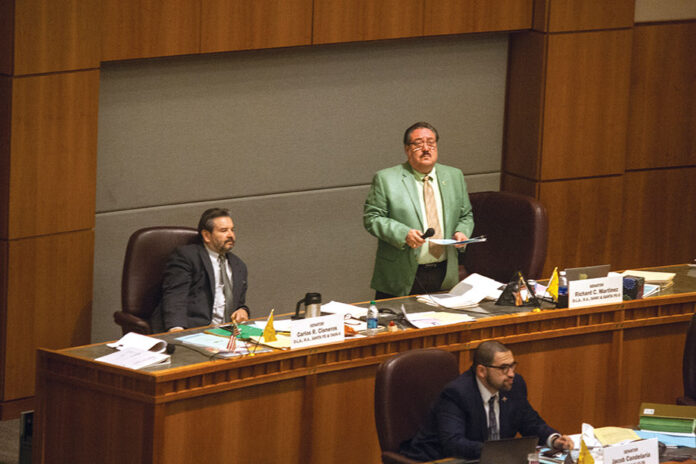
During the 60-day legislative session that ended March 18, 278 bills passed, with 138 from the House and 140 from the Senate, including a balanced budget.
Gov. Susana Martinez vowed to reject the budget during a March 18 press conference and said she would call a special session to pass a new budget, without the bi-partisan tax increases.
Despite Martinez’s claim to need a special session, the representatives for Rio Arriba County managed to pass a wide range of bills, protecting vulnerable populations, increasing funding for the courts and a minimum wage bill that Martinez said she will kill.
Fights between the legislative and executive branches over funding and vetoes have led some efforts to a dead end, Rep. Nick Salazar, D-Colfax, Mora, Rio Arriba, and San Miguel counties, said.
“I’ve served in legislature during good times and bad times,” he said. “This, to me, was the worst of times.”
Martinez vetoed a bill that would have created a research program for industrial hemp, which Salazar said would have helped with the state’s budget woes.
“It was the wrong veto, because the governor is always talking about economic development,” Salazar, who is on the House Appropriations and Finance Committee, said. “We import millions of pounds of hemp from Canada. Farmers all over the state could be raising it here. She should not have vetoed that.”
He said the state is still facing a $135 million budget deficit for the current fiscal year.
Sen. Richard Martinez, D-Rio Arriba, Sandoval, Santa Fe and Los Alamos counties, said he hopes the governor signs a few of his, which would help relieve some of the budget pressure by creating alternative funding structures for the court system.
“I thought it was a good session,” he said.
The governor has until April 7, or 20 days from the end of the session, to sign all the legislation passed in the last three days. If she doesn’t, the bills will die — a result of her pocket veto.
All bills passed outside that three-day window automatically become laws, unless the governor specifically vetoes them.
Exploitation
of seniors
The sole bill that Salazar was able to get through both chambers, House Bill 326, attempts to prevent financial exploitation of citizens over the age of 65 or incapacitated adults over the age of 18. It is meant to make it easier to prosecute those who wrongfully take assets from an eligible adult or deceive them in order to take their assets.
“It seems like it happens every day, some senior gives money away to predators that try to get them to invest in whatever they’re selling,” Salazar said. “This would make it a crime. These predators should have better sense.”
Salazar is unsure whether the governor will sign the bill.
“I can’t see why she wouldn’t sign it,” he said.
The bill’s other sponsor, Rep. Sarah Maestas Barnes, R-Bernalillo, told the House of Representatives, March 13, that the bill provides immunity to those who report possible financial exploitation to the Securities Division of the state Regulation and Licensing Department and the Adult Protective Services Division of the Aging and Long-Term Services Department.
“Financial health affects overall health, and financial loss impacts available food, medication, housing and other services, so this will be critically important to help protect these vulnerable individuals from exploitation,” Barnes said.
Salazar introduced a measure that would have restored about $1.2 million in cuts to the state Aging and Long-Term Services Department, but the bill died in committee. He also introduced a bill that would provide funding to the state’s organic farming certification program, but that died in committee, as well.
Salazar said he does not know the fate of the certification program without the funding.
“I’m a realist,” he said. “I sit in Appropriations (Committee), and I see good bills going down the drain because of lack of money. It’s not that anybody did anything wrong.”
Overdose
protections
In all, Richard Martinez had six bills pass both chambers and get to the governor’s desk. All of his bills passed during the last three days of the session, which means they are eligible for a pocket veto by the governor.
Richard Martinez’s bill to add protections to the Overdose Immunity Act, the first of its kind in the country, passed the Senate unanimously, while it passed the House on a 58-5 vote.
The bill was last in the legislature in 2015, after it died in a House committee.
Assuming the overdose bill is signed, it will expand on the law that prevents people who are overdosing, or people who call for help, from being arrested for drug possession.
The bill passed this session, expands those protections to prevent civil forfeiture and cover those experiencing alcohol overdoses.
Previously, only drug-related overdoses were covered.
In addition, anyone who calls 911 to report an overdose, or the person overdosing, can neither be charged for violating a restraining order, nor have his probation or parole revoked for either overdosing or reporting it.
“I don’t see why she wouldn’t (sign) it,” Richard Martinez said. “It’s already law, this is just updating it.”
He said that probation officers can still call in the people they oversee for urine tests whenever they want, even if the person cannot be violated for overdosing.
Another of Richard Martinez’s court-related bills that passed, Senate Bill 142, will, if signed, allow the director of the Administrative Office of the Courts to apply for grants — a duty that position is not currently allowed.
Senate Bill 49 also passed, which creates a fund for private donations to pay for temporary district court judges. Richard Martinez had that legislation pass in 2015, but it was vetoed.
The district courts were not the only ones to get help from the senator. The magistrate courts might be getting a funding boost if the governor signs Senate Bill 304, which brings back a fee for magistrate court cases that had previously ended.
When it comes to funding, Richard Martinez co-sponsored House Bill 64, which appropriates $1.3 million for the wastewater facility construction loan fund, to gain a match of federal funds.
When it comes to the environment, those who intentionally violate the Pipeline Safety Act will be looking at much harsher fines, after Senate Bill 303 passed. Assuming the bill is signed into law, it will sharply increase the penalties for violating the Pipeline Safety Act by matching New Mexico’s penalties with those imposed by the federal government.
Richard Martinez said he drafted the bill because it will allow the federal government to match New Mexico’s funds for repairing pipelines, further relieving budget woes.
Currently, the federal government lists New Mexico as non-compliant, and therefore ineligible to receive funds, because the penalties for gas pipeline violations do not match those in federal law.
“If we come into compliance, we’ll get more federal funding,” he said.
One of the bills that Martinez was not able to get passed would have made it easier for Española residents in Santa Fe County to get their petition, to be annexed into Rio Arriba County, on the ballot.
Richard Martinez said his annexation bill died on the House floor, after it went missing.
“Somehow it got lost in the House,” Richard Martinez said. “They didn’t know if it was on the floor and the floor said it was in the House Judiciary Committee, and Judiciary said that they read it out. So, it was lost for a couple of days.”
When the bill’s location was finally clarified, on the House floor, it was near the very end of the session and it never came to a vote.
The governor’s spokesman, Mike Lonergan, wrote in an email, that the governor has 20 days to review the bills.
“(As) with any legislation, she’ll analyze it and take a close look at them before acting,” he wrote.
She has until April 7 to sign the legislation and if she doesn’t, the bills will die.
Proposed minimum wage increase
Rep. Debbie Rodella. D-Rio Arriba, Santa Fe and Taos counties, also had six bills make it to the governor’s desk before the session ended.
Lawmakers in both houses voted to send House Bill 442, the Minimum Wage and Related Conduct Act, to the governor’s desk. If signed, it would raise the state’s minimum wage from the current rate of $7.50, to $9.25 per hour.
She sponsored the bill with four other representatives: Brian Egolf, D-Santa Fe; Carl Trujillo, D-Santa Fe; Patricia Ruiloba, D-Bernalillo; and Miguel Garcia, D-Bernalillo.
However, the governor publicly vowed to veto that minimum wage increase and a competing measure that would raise the minimum wage to $9 per hour, because she said they would hurt small business owners.
When reached Tuesday afternoon, Rodella hung up on a Rio Grande SUN reporter.
Rodella’s lawmaking colleagues also signed off on House Bill 83, the National Guard Employment Protection Act.
If the bill receives the governor’s approval, it will mandate private employers to save a service member’s job for more than three months, after they return home from deployment.
That time would be extended to a year if the service member is hospitalized, resulting from the deployment.
Rodella also sponsored a measure to require healthcare professionals to offer pneumococcal and influenza immunizations to patients 65 and older, before they are discharged from the hospital.
Before voting on House Bill 274, the Immunization for Certain Seniors Act, Sen. Craig Brandt, R-Sandoval County, wanted assurance that it would not result in seniors being forced to have immunizations that they don’t want or need.
Those who may be thinking about embarking on any type of agricultural economic development initiative my find some help in the law if the governor signs House Bill 289, agriculture in Economic Development Finance Act.
It would make agricultural development eligible for economic development funding through the state’s Economic Development Department and the New Mexico Finance Authority.
Those producing energy via an energy generation system such as a solar array, or distributing or selling energy produced by a third party, would have to meet minimum disclosure requirements, if the governor signs House Bill 199, the Distributed Generation Consumer Protection Act.
The Consumer Protection Act would also require the energy seller to provide proof within 30 days, that they obtained all permits required to move forward with the project.