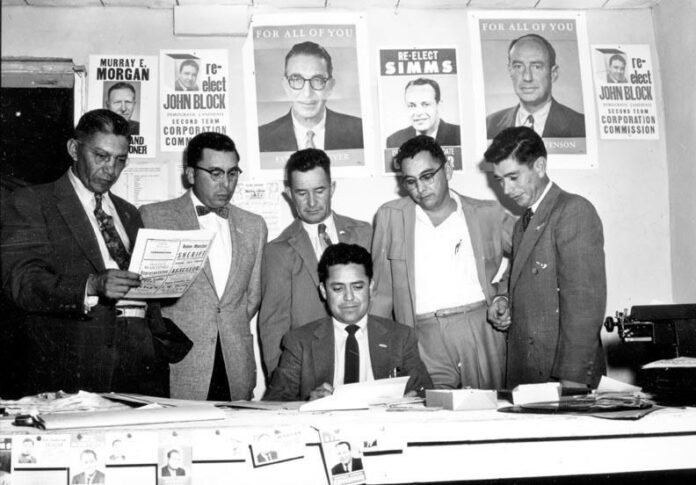
“There was a bunch of sheriffs that didn’t like me but he said, ‘nope he will be the undersheriff’ and what Emilio said was gospel.”
Robert Rodella
former undersheriff
“I’ve known of him since I was a kid since my aunt used to work for the County up in T.A. So I remember going to political rallies that were hosted by Mr. Naranjo. When you look at Mr. Naranjo he was like the boss. Back then it was almost like shaking the president’s hand I guess is what it felt like. He was just that powerful a guy at the time.”
Christian Lopez
Española Police sergeant
“I talked to the man once, in 2002, when I ran for County commissioner. I was a first-time politician … I went to his house, we talked for an hour, maybe two. The thing that really impressed me about him, he has this way of talking to people, he has this finesse. That was his power. He had a way of doing things, of manipulating people to like him … There’s this one saying about him, that you hate Emilio 364 days a year and you love him one day — election day. The rest of the time? ‘Emilio didn’t do this, Emilio didn’t do that.’ The Northern New Mexico way of thinking. If he liked you, he helped you. If he didn’t like you, he’d say something like, ‘Well, it’s just not the right time, things just aren’t going to happen right now.”
Charlie Trujillo
Chimayó
“I was with him from the mid-60s to when he quit — he quit about six years ago. As a leader, this kind of leadership comes to this earth once every 400 years …”
“His main lieutenant, Archie Medina, has been deceased about eight years. As his lieutenants went, I was a little below that. A lot of the heavy hitters have now passed on …”
“A lot of things were not done unless he knew about it — city projects, school projects. He carried enormous power. I think it was a national commentator, who said (former Chicago mayor) Dick Daley didn’t die, he moved to Española, New Mexico.”
Joe Romero
Española School Board Pres.
“It was hard to grow up in Rio Arriba County and not be aware of who he is. My first recollection of him was at my first political event that I ever went to in 1972. It was a political rally and I remember Senator Edward Kennedy was there and spoke very highly of Mr. Naranjo and subsequently the Kennedys have been very close to him as well as the Clintons. I was five or six years old.”
A.J. Salazar
chief deputy district attorney
Evie Naranjo and her son, Robert, remembered going to restaurants with Emilio.
“He was a great father,” Evie said. “He always made you giggle. He had a good heart.”
“He would insist on ordering for us,” Robert said.
However, Robert said Naranjo’s hearing wasn’t great, and he would usually end up ordering what he thought everyone should have rather than what they actually wanted. Once, when Robert tried to correct his grandfather after a mistaken soft drink order, he was quickly and wordlessly rebuked by his siblings.
“How come everybody’s kicking me?” Evie remembers Robert asking.
Evie Naranjo,
daughter-in-law
Robert Naranjo
grandson
George Vigil said he remembers Naranjo helping deliver wood to his family when he was a child, and he said Naranjo helped him get a job repaving roads in Truchas when he was older.
“He was a man of his word,” Vigil said. “I know he’s gonna be missed.”
George Vigil
Guachupangue
Silviano Romero said he first met Naranjo in 1952. Romero said he used to work under Naranjo as a precinct chair in Dixon. He said the most effective vote-getting tool for Naranjo was his ability to place people into government jobs.
“There wasn’t nothing around,” Romero said.
Silviano Romero
Dixon
Marlo Martinez said he first met Naranjo through his father’s office-supply business in Española. If you wanted to sell to the schools and the County, you had to work with Emilio Naranjo, he said.
“Instead of the (County) Commission running the manager, the manager ran the Commission all those years,” he said.
Martinez said he also spent eight years as a reader in the state Senate, where Naranjo sat next to then-Senate Pro Tem Manny Aragon.
“When I went into the Senate, Manny Aragon was godfather of the Senate. It was quite something to see our godfather go to that session. I really got a political science degree,” Martinez said.
Martinez said Naranjo was soft-spoken even in the Senate. He felt more comfortable speaking Spanish than English, and rather than debating on the Senate floor he worked behind the scenes — particularly with Aragon, Martinez said.
“He didn’t have to debate to get what he needed,” Martinez said.
Marlo Martinez,
former County Probate judge
Orlando Cordova said he met Naranjo through his father, former County treasurer Orlando “Toast” Cordova.
“In 1978, when I was 8 years old, at the old Angelina’s Restaurant — across from the smokehouse they just closed — they used to talk politics on the radio. He asked me to speak on the radio and I froze,” Cordova said.
Cordova said Naranjo would start every political rally with “Senoras and caballeros.”
“You knew it was gonna start, and it was business.”
Orlando Cordova
State Police officer
“There’s one thing my Dad used to always tell me — and that’s just when you’re campaigning, never promise anybody any more than you have in your pocket. I didn’t really understand what that meant from a practical political perspective until I grew up and started running myself. I realized he wasn’t talking about funding, but rather what you could really do for somebody. If you’re running for city council, you can’t promise to somebody you’re going to help insure Social Security’s going to work, because that’s not within your purview.”
Larry Naranjo
son and Rio Rancho councilor
“He got my first state job,” Annie Urban said.
She said she started at the state Bureau of Revenue, and other state workers she knew had nothing but respect for Naranjo.
“He wasn’t only handsome, he was charismatic,” she said. “We used to call him ‘Robin Hood of the North,’ plus ‘King of the North.’”
Urban said Naranjo could never eat in peace; whenever she went out to lunch with him she would see him take money out of his own pocket to buy meals for anyone who approached him. He said they were always surprised when Naranjo knew more about them than they thought he would.
“To me, he was always for the poor, for the underdog,” she said.
Urban said she remembers going to visit him in the hospital when he had pneumonia and seeing people lined up around the block to see him.
“When I got there, I thought it was some kind of demonstration,” she said.
Annie Urban
Albuquerque
Abiquiú resident Richard Bock, who sits on the County Planning and Zoning Committee, said he visited Naranjo at the state legislature in 1996, to give him a photograph of Jack and Jacqueline Kennedy at the 1960 Democratic National Convention.
“I worked for Look magazine in New York in the ‘60s, which shows you how old I am. I knew that he had strong feelings for Jack Kennedy, and he was involved in getting the nomination for him in 1960, so I took this picture — it must have been 18 inches high by 12 inches wide — to the legislature. I went in to see him in his room, and I introduced myself. Actually, the appointment was set up by Joe Romero — I’m still a shepherd, and he used to raise sheep. So I went to the legislature, it was either January or February of 1996, and I gave him a copy of that. When he opened it up, I could see the tear in his eye, running down his cheek. That was really the time when I had an audience with him. It was kind of interesting to see, because he was the center of attraction in the legislature back then. Then of course Art Rodarte beat him that year in the June primary.”
Richard Bock
Abiquiú
Brian Naranjo said he remembers taking frequent family trips from Washington, DC, where he grew up, to Española.
“We were out here all the time,” he said. “Camping was the big thing.”
Naranjo said their big family would “take over” National Forests for their reunions.
“He would try to teach us to fish,” he said.
Naranjo said the deep family roots in Rio Arriba County always contrasted sharply with the transient population of Washington, DC. He said he works at the embassy in Panama but knew he had to come to the County when he heard Emilio Naranjo had died.
“It’s really the end of an era,” he said.
Brian Naranjo
grandson
Valdez said he is related to Naranjo through his grandfather, and when Valdez graduated from high school, Naranjo invited him to his office for a visit. Naranjo asked Valdez about his plans for the future and wondered if he might be interested in a position in state government.
“I told him I wanted to see the world, and I left for California.”
Lorenzo Valdez
County manager
Kenneth Salazar said he first met Naranjo, who later became his father-in-law, by running into his car. It was 1964, and Naranjo was sheriff.
Salazar said he was leaving the Chrysler garage in front of Hunter Motors when he saw Naranjo’s daughter Jeanette walking down the street on her way to the sheriff’s office. He was pursuing her at the time, he said.
“I rolled down the window and started whistling,” Salazar said.
Not looking where he was going, Salazar ran into Naranjo’s car.
“We both got down. He walks up to me and says, ‘Don’t worry, son, these things happen every day,’” Salazar said.
Salazar said when he was in college, Naranjo made him a deputy U.S. Marshal. He helped transport prisoners, and during one memorable transport Naranjo pre-arranged to have Salazar taken in with the prisoners, as a prank.
“I had a great time with him,” Salazar said. “He was like my dad.”
Kenneth Salazar
son-in-law and chairman of the Santa Cruz Irrigation District Board
Henry Valdez said when he first decided to run for district attorney, he went to visit Naranjo — like everyone else in Rio Arriba, you had to talk to Naranjo or you’d lose, Valdez said. Valdez brought a picture of the St. Michaels class of 1932, which included Naranjo and Fidel Valdez, Henry Valdez’s grandfather.
“He looked at the picture and he just stared at it for a few seconds,” Valdez said. “I could see his tears starting to come down his cheeks. ‘How are you related to Fidel?,’ he asked me. I told him he was my grandfather. He just thanked me so much for bringing that picture, and went into probably half an hour, 45 minutes of dialogue of the escapades of my grandfather and himself back at school.”
Henry Valdez
First Judicial District Attorney