Reps from governor’s office and National Guard join police chief, city manager for discussion
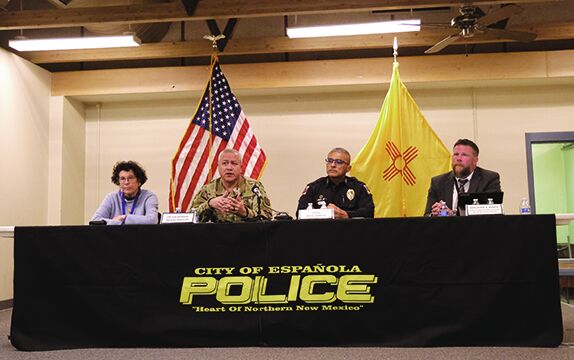
Community members got the chance on Oct. 29 to join a discussion at the Beatrice Martinez Senior Center, between Española City Police Chief Mizel Garcia and New Mexico Army National Guard Major General Miguel Aguilar.
The event was designed for the public to listen to the exchange of ideas and learn how they will jointly integrate the “vital initiative throughout the community,” a post on the Española Police Department Facebook page said prior to the event. Senior Public Safety Advisor Benjamin Baker with Gov. Michelle Lujan Grisham’s office also sat on the panel with City Manager Lauren Reichelt.
The event lasted two hours and had about 30 attendees, to include personnel from the Rio Arriba Sheriff’s Office, New Mexico State Police and members of the public. During that time, the panel talked about various issues that plague not just Española, but the surrounding communities and the state.
Baker told the audience that there are 10 entities involved in the plan to bring soldiers to Española.
“This is an unprecedented collaboration between public safety entities,” he said. “There’s a criminal element that distributes a highly toxic substance that is killing people … this is a New Mexico solution.”
He said one of the major goals is to reduce, prevent and eradicate overdoses. He also mentioned there are a specific number of wanted felons walking around every community in the state “as we speak.”
“… They are so dangerous they need to be in custody,” he said.
Reichelt said she was glad to hear they were aiming for a reduction in overdose deaths and agreed that criminals need to be removed from the community.
“A lot of problems in the community are caused by minor crimes and things that are really annoying, like breaking into empty houses and burning them down or leaving trash,” she said. “The only way to reduce that and the overdose deaths is if there’s a behavioral component to this MOU (Memorandum of Understanding).”
She said there are excellent treatment providers in Española who are not “tied together” in the system. She called the treatment clinic at the Española Hospital “amazing.”
“We need the help of law enforcement to respond to misdemeanors and people who are committing crimes because they are addicted to drugs,” Reichelt said. “Put them in the healthcare system and keep them there. And get them into treatment …”
Aguilar, meanwhile, said that the community is not going to arrest itself out of a problem. Baker seemed to agree.
“There’s no reason for you to go to jail for criminal trespass when you’re suffering from addiction disorder,” Baker said. “Let’s get you help. It’s beyond their control, it’s not their fault.”
Another common sentiment amongst those who spoke is that Española needs a jail.
Jan Gilbrecht, who attended the meeting, said she moved back to the area in 2020 and has worked in the criminal justice system as a defense investigator in a number of states across the country.
“I’m really concerned about the state of the jail, the number of overdoses and deaths that people suffer,” she said. “I think a lot is due to the distance (of the jail), all the way up in T.A. (Tierra Amarilla).”
District 2 City Councilor Peggy Sue Martinez was in the audience and said the governor’s office had someone come out and look at the old jail to see if it’s usable. It’s not. It has to be razed and rebuilt.
“People have warrants,” Martinez said. “We know who they are. To pick up someone and arrest them, go through the process, take them to the hospital, look for a place to house them and hope someone will accept the prisoner … it’s unfair to officers to have to go through that every time they go to make an arrest. There’s no accountability. We have a little bit of lawlessness. We really need help in funding and creating a new jail. Rio Arriba County is a partner. I’m sure the pueblos would be interested.”
However, Baker said if a jail is built in Española, there will be problems staffing it.
Meanwhile, Aguilar said he’s having conversations with Garcia and everyone agrees on the jail system.
“I have some ideas,” he said, “But we haven’t worked through them yet to alleviate some pressure in the short term.”
He said the long-term plan would be to have either a city jail or a regional jail.
Gilbrecht also said there is not enough medical support.
“I think it’s brilliant we have a new medical detox facility or potential for that at our own local hospital,” Gilbrecht said.
She also said while she’s impressed with the local police department, from the leadership down, things are falling apart when it comes to moving forward with prosecuting cases and the jail system. She said a district attorney that’s responsive to “our particular needs” is necessary.
When Lujan Grisham declared a state of emergency in August in Española, due to rising crime and drug issues, she did not immediately deploy the National Guard, but left the option open. About a month later, it was announced that soldiers would soon deploy to Española, in response to the declaration.
Garcia said in September, that he anticipated soldiers coming to the city in mid-October, however on Monday, he said there’s a possibility that they would arrive on Tuesday (11/4).
“I have no control as to when the general is authorizing it (troop arrival),” he said when contacted by phone. “That was my potential target date. I have to adhere to their manpower and availability.”
He said the operation is all about community engagement and the safety of the community.
Aguilar did not respond to an email inquiry requesting information about when the troops would arrive, where they’re coming from and where they will be housed during their deployment.