Española Students Take on Challenge of City Evacuation

Published:

    Imagine the Española Valley is struck by a major natural disaster. Or worse, picture a meltdown at the Los Alamos National Laboratory that forces all area residents to run for their lives.            Now see yourself stuck in your car, in sluggish, bumper-to-bumper traffic. Most streetlights would likely be out, forcing police to direct you and 10,000 other people to safety. How long would it take for you and your family to reach safety? What’s the quickest, safest route you should take? How long would it take officials to evacuate the city altogether?

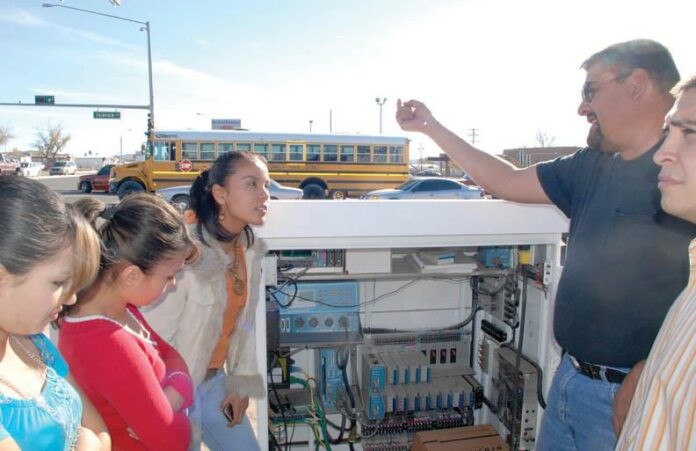
    Three Española Valley High School students are studying that scenario.

    They will learn how stoplights and other traffic control systems work and gather traffic data from the city of Española and state agencies, then plug that data into a computer program of their own creation to build a model of what a large-scale evacuation of the city would look like.

    Then they will submit their project to the New Mexico Supercomputing Challenge, a statewide competition in which high school students tackle real-world problems by creating computer simulations. Española Valley High School is fielding three teams for the Challenge this school year.

    “If there’s a fire, like the Cerro Grande fire in Los Alamos, for example, where would everybody go? How would they get the people out?” junior Dulce Avitia, whose three-person team is studying the evacuation, said. “Our goal is to figure out, if there’s an emergency and we have to evacuate, how would it work?”

    As Avitia and her teammates, juniors Perla Gomez and Keila Baca, study traffic patterns, another trio of high school juniors is collecting water samples from city water wells. Their goal is to model the patterns of uranium contamination in city water.

    “We started wanting to study uranium in the Rio Grande, but then we realized it was way too broad of a subject,” junior Caitlin Dow said. “So we decided to focus on wells.”

    The group will focus on water quality in the two wells nearest to the high school. They plan to gather current data and study past contamination data from the state Environment Department to build a computer program that predicts future water contamination patterns, Dow said.

    Group member Andrea Garcia said she, Dow and classmate Patricia Jaramillo have already started researching federal environmental regulations, as well as the health effects of uranium contamination. They have also met with state Environment Department and Santa Clara Pueblo Water Department officials.

    To snag a victory at the statewide competition, the groups have their work cut out for them. They must turn in a report in early December describing their project, detailing their progress and forecasting their expected results. To submit a viable computer model in April, when the Challenge’s main event takes place, the students will have to learn one of four programming languages.

    To that end, Avitia and Dow’s groups have enrolled in a twice-weekly class at Northern New Mexico College with instructor Jonathan Naranjo, who tailored a class that will teach them the skills they’ll need in the Challenge.

    A third team of high school freshmen and sophomores is still deciding what problem their project will tackle. They initially wanted to model morning and afternoon traffic patterns at the high school, where students, parents and school buses crowd a small parking lot every day when dropping off and picking up students.

    “Now they want to do something with thermodynamics,” science teacher and Challenge coach John Reese said. “They’ll figure something out.”

What Plan?

    It’s a good thing three Española Valley High School students are working to develop an emergency evacuation plan for the City of Española. If the city was forced to evacuate its residents, the students’ school project could be the city’s best hope.

    Española Public Safety Chief Julian Gonzales said the city doesn’t have a plan, but one is in the works.

    “It’s definitely been on our radar screen. We’re going to poll some exercises to test how we react to an emergency, and from there we’ll be able to determine what our weaknesses are,” Gonzales said. “Right now, there’s probably not one that’s really set in paper. It’d probably be one of those things where we do our best to handle the situation.”

    Rio Arriba County has a plan, but not even man in charge of handling a potential emergency is sure what the plan is.

    “I know there is one, but I haven’t had the chance to look at it,” interim Emergency Services Director Mateo DeVargas said.

Related articles

Recent articles