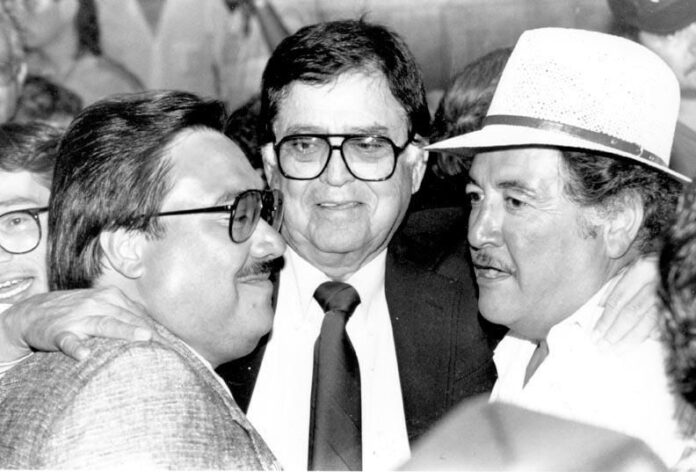
Passing of the Patrón: Emilio Naranjo Honored at State Capitol and in Española

Published:

SUN Staff Report

    Hundreds of Rio Arribans and other New Mexicans, paid tribute Monday to the man who crafted a Democratic organization unique in the state’s political history.

    Emilio Naranjo, whose political acumen produced election day majorities that delighted Democrats and were envied by Republicans, died Nov. 13, at his son’s home in Albuquerque. He was 92.

    His colorful and controversial career was launched as a youngster in Guachupangue, working the precincts on behalf of his father’s candidacy for sheriff as a Democrat in a largely Republican county. He never forgot.

    At the time of his death, he had served his county as sheriff and county manager; his state as state senator for 15 years and his country as U.S. Marshal for New Mexico. In the process, as Democratic county chairman, he turned the once Republican county into a Democratic stronghold whose strength Naranjo declared came from “my people,” not a quest for personal power.

    Naranjo had lived quietly in his home in San Pedro for a number of years, his social life and political activities severely curtailed by a serious hearing problem.

    He ventured forth in November 1999, for a “roast” in his honor attended by several hundred admirers and state political leaders and spoke briefly to acknowledge the complimentary honors bestowed on him. He also attended a small political rally several years ago featuring a visit by Sen. Ted Kennedy on behalf of the presidential candidacy of John Kerry. And just before this month’s general election, he appeared in an ad in the SUN endorsing President-elect Barack Obama.

    Naranjo had a longtime association with the Kennedy family dating back to John F. Kennedy’s campaign for president in 1960.

    Naranjo’s retirement from politics was not planned. In 1994 he declined to seek the party chairmanship as rebellion grew within the ranks of young Democrats who felt shut out of the party. In 1996 he was out of the party. In 1996 he was defeated in the Democratic party primary for state senator by Arthur Rodarte.

    Naranjo’s influence continued after his “retirement” as demonstrated by his support of David Chavez, a loyalist, as party chairman, and magistrate Richard Martinez as the man to defeat Rodarte in the next primary. Martinez did go on to do just that and remains state senator today.

    But his career in the rough and tumble of Rio Arriba politics was never easy. There was always an opposing faction in the party challenging him at the polls. In fact, when he replaced Sen. Matias Chacon who died during a legislative session, he was succeeding the lone Democrat he could not defeat at the polls.

    Naranjo enjoyed telling about his start in politics as a youngster campaigning for his father, a Democratic candidate for sheriff. That was in pre-Roosevelt days and Republicans had controlled Rio Arriba county since territorial days.

    Naranjo said his father lost, but he was hooked on politics. After graduating from St. Michaels, in Santa Fe, he joined the United States Army. He was shipped to Europe for nine months at the tail end of World War II, in which he operated a tank. He would later tell his children that when he got to Europe, Hitler gave up.

    He returned to Española and in 1942 was elected chairman of the Rio Arriba Young Democrats. In 1952, at age 36, he was ready for the big-time and was elected chairman of the county Democratic central committee.

    In the general election of 1956, Naranjo-supported candidates won all but the positions of school superintendent and treasurer, lost to Republicans. In 1958 those two were defeated by Democrats and with rare exceptions, Naranjo candidates regularly won office. In recent years, Republicans in Rio Arriba haven’t bothered filing candidates.

    In February 1977, in the midst of a legislative session, Naranjo’s longtime political foe, Matias Chacon, died of heart failure. The county commission named Naranjo to the vacancy and he served as senator with one exception until 1996. The one exception was while he appealed his 1979 felony conviction on perjury charges, in January 1979. He was forced to resign as senator pending his appeal. The appeals court overturned the conviction, and the state supreme court upheld the decision. He returned to the senate in April, 1980.

    Naranjo was married twice, to Mary Rodriguez and Mary Maestas Sanchez, and fathered 16 children. He is survived by 15 of those children, 38 grandchildren, 41 great-grandchildren and one great-great-grandchild.

Related articles

Recent articles