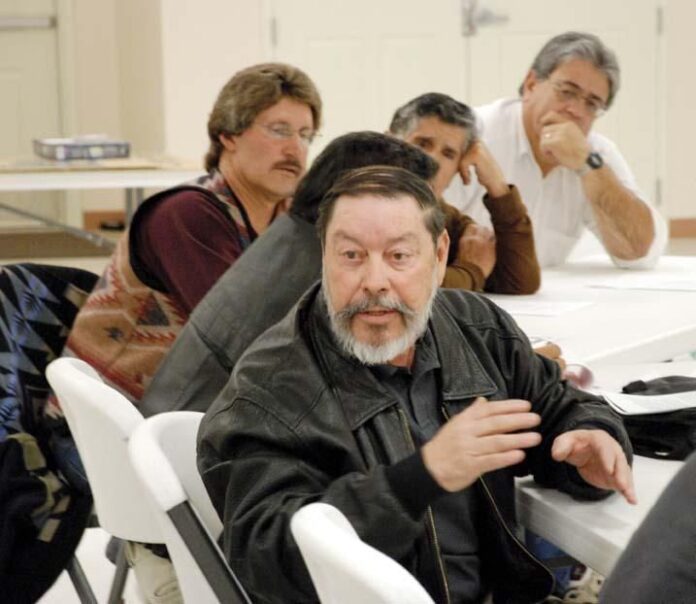
“We’re Not Country Bumpkins”

Published:

    State Environment Department officials met a wall of resentment and mistrust over Gov. Richardson’s proposal to expand the state’s stream protections, at a contentious meeting Jan. 7 at the Alcalde Community Center.

    Water and Waste Management Division Director Marcy Leavitt presented a summary of the current version of the governor’s proposed expansion of the list of streams designated as Outstanding Natural Resource Waters. She said the final proposal, due to be written by June, will nominate dozens of streams in national forests throughout the state for the highest level of protection, including the Rio Chama and upper Rio Grande watersheds.

    Leavitt struggled unsuccessfully to reassure Rio Arriba cattlemen and acequias members that the new designations would not imperil traditional activities. She told the audience that grazing would not be considered a polluting activity under the new regulations so long as ranchers engaged in “best management practices” such as fencing sensitive stream banks and providing livestock water sources away from stream banks.

    Leavitt said the proposal will strengthen pollution discharge permit requirements to discourage development of new oil and gas operations, mining and road building activities — but not grazing — near designated waters. Those seeking permits for such activities would have to show they are not degrading water quality in designated streams, she said. Grazers would only be required only to observe best management practices.

    But that did not reassure many at the meeting.

    “I know how these things work,” Rio Arriba County Manager Lorenzo Valdez said. “I’ve run community meetings (for Rio Arriba County). In the end, this (meeting) is due process. You do the democracy thing and then do what you want to do anyway.” 

    Valdez said he holds grazing permits in the Santa Fe National Forest near Coyote and Youngsville, on what was originally part of the Juan Bautisa Valdez Land Grant. He said the proposed changes open the door to additional designations of other streams in the future, and lawsuits against ranchers by environmental groups.

    “We are sure there will be future petitions to designate several small streams there,” Valdez said.

    Holding up a copy of a report by the Santa Fe-based environmentalist group Wild Earth Guardians, Northern New Mexico Stockmen’s Association President Carlos Salazar said, “This regulation is just a vehicle (to attack grazing). These people frighten me.”

    Leavitt acknowledged the group brought the original version of the proposal to Richardson, and that anybody can nominate waterways for the designation, for the Water Quality Control Commission’s consideration. Commission members are appointed by the governor, she said.

    Leavitt brought wall maps of the nominated outstanding waters in the Carson and Santa Fe national forests, but not a list of nominated streams.

     “You can’t blame these people for being angry,” County Commission Chairman Alfredo Montoya said. “Historically, we’ve lost so much. Further regulation is very threatening.”

    Leavitt emphasized that the waterways proposed for designation within Rio Arriba County are located only in current roadless and wilderness areas in the Santa Fe and Carson national forests. She acknowledged that under existing regulations, other waterways can also be nominated — including waters within national or state parks, wildlife refuges, special trout waters and waters with recreational or ecological significance. No state or private lands are included in the proposal, she said.

    Leavitt said the proposal had undergone significant changes since last year, reflecting public comments received at the Department’s previous 10 community meetings.

    “We are trying to be sensitive to the concerns of grazers,” Leavitt said. “We have significantly revised this plan in recent months. We are trying to come up with a balanced proposal that will protect water quality — the quality of water you all depend on.”

    Another concern voiced at the meeting is that state agencies and environmental groups will use any new regulations on water quality as a pretext for further restricting livestock grazing and tree thinning — regardless of the Governor’s intentions — on public lands.

    “Indigenous people are losing power each time we see a new regulation,” Valdez said. “It’s a tool to put us on the defensive to use our resources. When it comes to regulation, they view their role not as coming to help, but to fine us and impose your views on us.”

    Valdez said the current intentions of Department officials and Richardson matter less than how environmentalists and the courts interpret the regulations in the future.    

    “Five years from now, when Wild Earth (Guardians) is in court using these (new state) regulations, you’ll remember me,” Valdez said.

    Wild Earth Guardians Public Lands Director Bryan Bird denied that the group seeks to push ranchers off public lands.

    “This is about securing clean water for everybody  — a nice way for the state to secure its water supply,” Bird said. “It’s an effort to protect the state’s most remote forested headwaters. All of the newly proposed waters fall within high altitude national forest roadless and designated wilderness areas. It will require that the next time the Forest Service renews grazing permits near outstanding waters, they will have to determine whether the grazing will degrade the waterways, and if so, to work to mitigate that.”

    Valdez said big corporations had clear-cut forests and built extensive road networks in Northern New Mexico’s National Forests but that regulators blame cattle grazing near headwaters for stream siltation.

    “We are not targeting grazing,” Leavitt repeatedly responded.

    But few in the audience seemed to accept her assurances.

    “As soon as we have new people at (the Department), they will want new things,” Valdez said. “New bureaucrats can change their mind and get more aggressive with regulation. We never have any finality as community people when we face state regulators.”

    Velarde rancher and farmer Walter Medina said the proposal did not strike him as a threat.

    “The grazing we’ve been doing for years won’t be affected,” Medina said.

    But that seemed to be a minority view among audience members.

    Former Otero County Commissioner Michael Nivison said the Department had failed to alert grazing permit holders of the planned changes. Nivison said he had attended most of the Department meetings around Northern New Mexico even though he is no longer a commissioner.

    “I’m not going to let this go,” Nivison said. “Have you alerted all cattlemen and all tribes? Why are you rushing to a decision?”   

    Leavitt said the Department is not rushing toward the new regulation, and would be willing to phase in best management practices requirements — though she said the details of such a phase-in would “have to be worked out” and would not suggest potential time frames.

    “We’re giving people a lot of time to comment,” she said. “We’ve changed this document dramatically.”

    For example, Leavitt said, an earlier version of the proposal included state monitoring of silt loads in designated streams. But the current version of the proposal no longer includes any provision for measuring stream silt loads.

    She said the proposal would now emphasize enforcement of best management practices rather than environmental outcomes.

    But the Forest Service already requires best management practices on grazing allotments, said Carson National Forest spokesperson Kathy DeLucas.

    “The regulations do not require our doing anything different than we’re already doing (for grazing permits),” DeLucas said. “The state respects our monitoring and use of best management practices.”

     Two waterways have already been designated under existing regulations: the Rio Santa Barbara within the Santa Fe National Forest’s Pecos Wilderness, and the Valle Vidal Special Management Area in the Carson National Forest.

    “My understanding from the Forest Service is that there have been no impacts for livestock grazing (in these areas),” Leavitt said. 

    Velarde rancher Joe Romero disagreed. He sees the designations as just another assault on traditional land use practices by driving up the costs of doing business.

    “My allotment along the Peñasco (in the Carson National Forest) is under review by the Forest Service right now and the impact is going to be a lot bigger than they want to disclose,” Romero said. “The impacts are being studied in the 10-year review, but one thing they identified is silt from my allotment. The new regulations will be even worse. Anytime a cow comes near a river, they consider it an impact. The regs are more than anything about livestock — about putting us out of business — more than addressing erosion. People need to get educated, because when you first read the (proposal), it seems open minded, but dig into it a little and you’ll see what the underlying agenda is.” 

    Salazar agreed.    

    “The concern is how these regulations will be interpreted in the future,” Salazar said. “The other question is, if there is no (state) money to implement best management practices on grazing allotments, then who is going to end up paying?”

    Valdez suggested that protection of streams in the national forests is best approached through state-funded projects rather than regulation. The state could help ranchers pay for fencing and installing livestock water sources away from sensitive stream banks, he said.

    Bird said Wild Earth Guardians could support state funding for restoration of degraded streams.

    “The state legislature may be able to fund restoration efforts for degraded streams once they’ve been designated (as outstanding natural resource waterways),” Bird said.

    But he acknowledged that very few, if any, of the proposed waterways are actually degraded.

    “Most waters in this petition or proposal are very high quality waters,” Bird said. “The Forest Service and grazing permittees have been managing these lands well.”

    Bird said the new designations are nevertheless necessary because there are rare cases where headwater streams may become polluted, and to prevent development like oil and gas drilling or mining. Also, Rio Arriba County enacted a temporary moratorium on oil and gas drilling in the County last year in order to stop a company from drilling in a watershed near Tierra Amarilla.

    Department Assistant General Counsel Adolfo Mendez provoked Valdez’s ire when he physically acted out pollution sources for the audience as a visual demonstration of the difference between “point-sources” like drainage pipes and “non-point” or diffuse sources of pollution like roads. He stood in one spot in front of the audience to illustrate a drainage pipe, and then walked around to represent a cow or other mobile sources of silt for streams.

    “We’re not country bumpkins. Carlos (Salazar) and I are on the same grazing permit. We’re university trained. I think we have a pretty good understanding of these issues. We don’t need you to walk around and show us what pollution sources look like,” Valdez angrily told Mendez in response to the demonstration.

    Mendez defended himself by saying that he is a visual learner and learned about pollution in a similar fashion.

    Several attendees noted that the Department did not send out final announcements for the Alcalde meeting until Jan. 6 — the day before it was held. Leavitt attributed the late notice to the holidays and bad weather.

Related articles

Recent articles