The Española School District’s next superintendent will have a master’s degree, if not a doctorate. He or she will have some experience teaching and at least five years as a district-level administrator.
If he or she speaks Spanish and understands special education laws, the School Board would be thrilled.
The District’s next superintendent will also receive annual salary of $120,000, minimum.
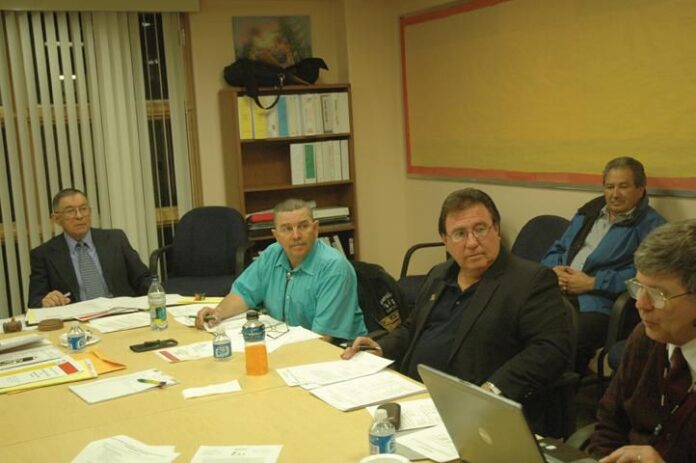
The Board more or less settled on these specifics when it spent three hours Jan. 21 drafting the application packet for the superintendent’s position and compiling a selection process that will guide candidates through one committee, several focus groups and a private interview.
The District began advertising for a new superintendent Jan. 22. Superintendent David Cockerham’s contract expires June 30. The District had given Cockerham a bonus of almost $60,000 on top his annual salary of $122,430 last summer in exchange for cutting a year off his contract.
$120,000 Salary
After looking at other school districts’ superintendent salaries for last school year, each Board member suggested a minimum salary for the new superintendent before settling on $120,000.
The highest proposals were from Board member Leonard Valerio and President Joe Romero. Each offered $125,000. Floyd Archuleta offered the lowest, $115,000, and insisted on lowering it throughout the meeting. Four parents at the Jan. 21 work session agreed with the $120,000 figure.
“My feeling is educators have always been underpaid,” Rudy Valdez, whose sons graduated from Española Valley High School said.
The applicant at some point was an underpaid teacher, he or she deserves a good salary, Valdez said.
Board members said the figure is “subject to qualifications,” and the final candidate could wind up with a salary lower than $120,000. But listing a salary lower than that could discourage applicants, they said.
A $120,000 salary would make the new superintendent 17th highest-paid out of 89 superintendents in the state, according to a state Education Department listing of superintendent salaries for last school year. Data for this year’s salaries was not available.
Applications
To Be Made Public
The application the Board developed is missing one important — and illegal — feature previously included in a draft application that Cockerham had given the Board: a clause promising applicants the District would keep confidential all applications except those belonging to finalists.
Cockerham had long insisted it was necessary to keep most applications confidential in order to protect applicants’ current jobs. State law makes every application public, and Cockerham could have faced misdemeanor charges had he attempted to keep them secret.
Four Board members — all but Romero, who mostly kept quiet during the discussion — turned on Cockerham at the Jan. 21 work session, calling his calls for secrecy “ridiculous” and requesting that he include a disclaimer in the application packet that once the District receives an application, it will be subject to public inspection.
Cockerham argued the disclaimer would make almost all “quality” candidates think twice before applying.
“I can tell you right now — you’ll lose 75 percent of your applicant pool, the cream of the crop, right off the bat,” he told the Board, then shrugged. “But if that’s what you want …”
His argument did not persuade the Board.
“You know what? If they have something to hide, we don’t want them,” Valerio said. “We’re planning on going out for a bond this year. We need to show voters we can be trusted.”
Secretary Joann Salazar pointed out that even when the governor is hiring for cabinet positions, the applicants are made public.
“When somebody applied for secretary of health, it was known who the candidates were,” Salazar said. “That’s a pretty high-profile job. They still applied.”
Board candidate Coco Archuleta, who is running unopposed to replace Romero, also jumped into the fray. He pointed out confidentiality would do nothing to protect applicants — the application already requires a recommendation letter from the applicant’s immediate supervisor.
Board Vice President Floyd Archuleta and member Andrew Chavez simply said state law is clear, and they were sticking to it.
“I don’t even understand why we’re having this discussion,” Archuleta told Cockerham. “The idea that we have to conceal the applications to protect their job is just ridiculous.”
The Española School Board established a complex selection process for hiring a new superintendent at a Jan. 21 work session. The process is planned as follows:
• Feb. 27 — All applications are due at School District central offices. The Board will meet that evening to weed out applications that don’t meet minimum requirements.
• March 4 — An 11-person committee will review applications and rate them according to a set of desirable attributes and qualifications. The Board will meet that evening to select an unspecified number of finalists, partly based on the committee’s findings. Each Board member will appoint two people to the committee except outgoing Board President Joe Romero and the unopposed candidate set to replace him, Joe “Coco” Archuleta, who will jointly appoint three members. Board members said District employee union President Brian Every will almost certainly be on the committee, as will Jeremiah Harlan, the parent of two Chimayó Elementary students.
• March 18 — The Board will meet to set interview dates for finalists and appoint members to several focus groups. On interview dates, the focus groups will interview candidates and make recommendations to the Board. The Board will interview candidates in private the same day.
• Date to be determined — The Board will meet in private to select the new superintendent.