State legislators are slashing programs left and right in a desperate attempt to balance the budget, and now they’ve hit a nerve. Under a bill pending in the state Senate, nearly all public employees would have to pony up more money for their retirement accounts while the state would contribute less.
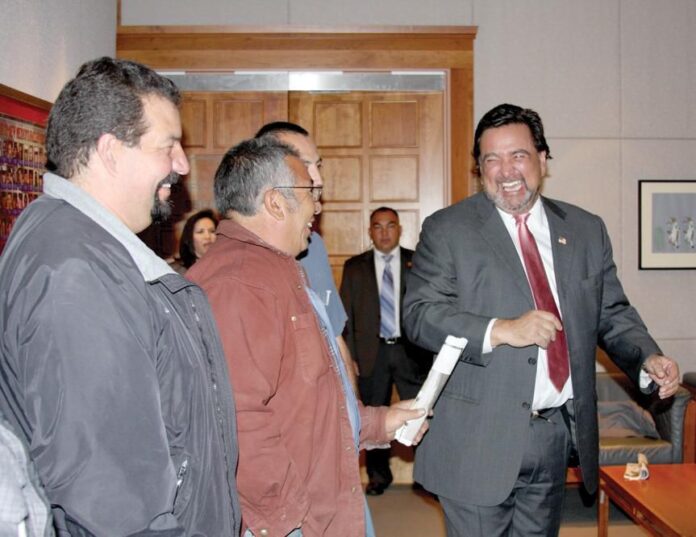
To protest this and other financial pinches on public employees, a group of about a dozen Northern New Mexico College employees visited the Roundhouse March 13. They pressed Rio Arriba County legislators to find different solutions for the budget crisis.
“We’re the ones that make America work, you know what I’m saying?” Northern carpenter Ignacio Coronado said. “It’s our own tax money, and we’ve gotta fight for it. For the past five or six years, we get a 2 to 3 percent raise but our insurance goes up, so we don’t get anywhere.”
Northern’s staff won salary increases of between 1.7 and 5.7 percent in February, but rising insurance rates and the pension bill could essentially roll back those raises.
House Bill 854 would reduce the gross income of all public employees by 1.5 percent. The money would go into the employee’s retirement account, to offset an equal reduction in the state’s own contribution. The measure would save the state about $42 million per year for two years.
American Federation of Teachers New Mexico President Christine Trujillo said it represents a dual blow to workers already facing the possibility of doubled co-pays and fewer benefits under changes being instituted by the state Public Schools Insurance Authority. The pension bill purportedly protects employees’ retirement accounts, but it really just shifts the burden onto the worker without a salary increase to compensate, she said.
“This is an unfair and unjustifiable practice,” Trujillo said.
It’s not a bill with many friends, at least not in public. Even the bill’s sponsors said it pained them to introduce the measure. Members of the Senate Public Affairs Committee, who voted unanimously March 12 to send the bill onward, expressed nothing but sympathy for everyone involved.
“I applaud you for bringing this,” Sen. George Munoz (D-Gallup) said to the bill’s sponsors. “When everyone can give a little bit, we’ll get through this.”
No Money?
The Northern employees heard essentially the same refrain as they circled the Roundhouse traveling from office to office: to save jobs, the state has to cut spending.
“We’re in the hole about $600 million,” Rep. Nick Salazar (D-Ohkay Owingeh) said. “The only way we could do it was to make some cuts.”
Sen. Richard Martinez (D-Espanola) said some funding could be restored when the federal stimulus package comes rolling in. But right now cuts are inevitable, he said.
“I hate to give you this doom and gloom, but the reality is there’s no money,” Martinez said.
Rep. Debbie Rodella (D-La Mesilla) emerged from her office after a long wait to tell the group that people don’t want to pay more taxes, and the revenue simply isn’t there.
Union lobbyists, however, point out that the legislature has plenty of money for certain things. It considered using state money to purchase the failed College of Santa Fe, and it’s weighing approval of new tax districts that opponents say raid the general fund for the benefit of private corporations.
Perhaps most importantly, the state is still carrying massive cuts to the personal income tax that were enacted in 2003, cuts that disproportionately benefit wealthy taxpayers. The cut was slowly ramped up over time, and it now costs the state $400 million each year, according to the non-profit organization New Mexico Voices for Children.
“They can afford to do these other things,” Northern union president Tim Crone said. “So why are they telling us there’s no money?”
On March 13 the Senate Finance Committee did remove the line item for the College of Santa Fe purchase, and on the floor of the House March 12 Rep. Miguel Garcia (D-Albuquerque) broached the subject of repealing the 2003 tax cuts.
“A lot of us in this body, even though we voted for it, we were reluctant,” Garcia said. “Was that a wise investment? We kind of learned our lesson.”
It’s unclear how much support such a move would generate. Salazar said he would support a repeal, but he hasn’t heard anyone discussing it.
When the Northern group met with Sen. Carlos Cisneros (D-Questa), who serves as vice chair of the powerful Senate Finance Committee, biology professor Catherine Clark asked him directly about the possibility of repealing the cuts. Cisneros said tax increases could be on the table when legislators return later this spring for a special session to discuss the ongoing economic crisis and the federal stimulus package.
“Those are the things we’re gonna be talking about in the special session,” Cisneros said.
If legislators do move forward on such a plan, they’ll likely hit a brick wall in Gov. Bill Richardson’s office.
Richardson spokesman Gilbert Gallegos said repealing any part of the tax cuts or tax credits, which he said total $1 billion, is not an option.
“Absolutely not,” Gallegos said. “I think those tax cuts have led to increased economic growth in the state. If not for those tax cuts and the number of new jobs, we’d probably be in a bigger hole than we are now.”
The issue didn’t come up when the Northern group scored a brief audience with Richardson. He listened to their concerns about insurance, pensions and the difficulty in making ends meet, and then encouraged them to talk to senators.
“I’m very conscious of this,” Richardson said. “I’ve always been on your side. You know that.”