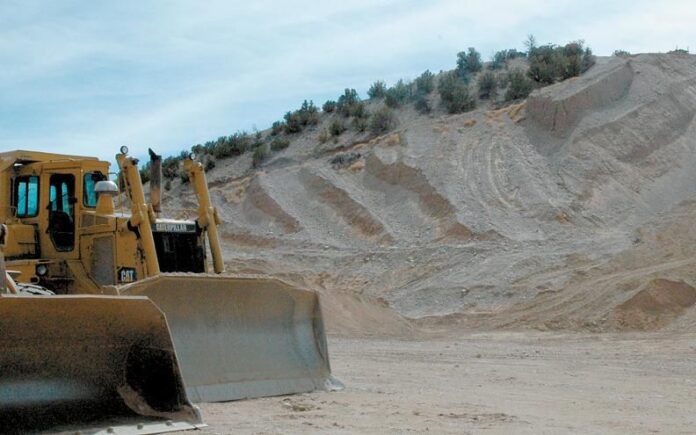
State Plans To Allow Mining To Continue at Controversial Velarde Site

Published:

    Despite opposition by Velarde residents and Rio Arriba County commissioners, the State Land Office will likely issue a new lease that will allow Coppola Mining to continue gravel operations at a controversial mine in Velarde.

    “Some residents in Velarde don’t want mining, we understand that,” state Assistant Commissioner for Oil, Gas and Minerals John Bemis said Tuesday. “(But) it’s hard to compromise on a yes or no issue like this. It’s part of the highway stimulus package projects. Those are putting a lot of people back to work. This is a critical component for the stimulus package.”

    Bemis cited the state Highway Department’s $68 million Highway Hwy 84/285 reconstruction project between Pojoaque and Española as an example of stimulus projects that require gravel supplies.

    Coppola Mining has expressed an interest in continuing to mine gravel on the state land, Bemis said.

- Advertisement -
- Advertisements -

    Land Commissioner Patrick Lyons issued Coppola a five-year lease in 2004. Lyons said the lease was necessary to “mine down” a dangerous cliff face — known as the “high wall” — left by gravel mining on adjacent private land owned by Española businessman Richard Cook. Coppola and Cook could not be reached for comment.

    But Coppola’s role in the lease has been that of a straw man for Cook, according to Steven Rudy, environment chairman for the Velarde community organization, Vecinos del Río.

    “Coppola assigned the lease to Cook in return for a commission, for lack of a better word, of 25 cents per ton (of mined gravel),” Rudy said. “Coppola owns no mining equipment. He uses Cook’s. It’s been a facade from day one. Instead of Cook having to repair the high wall at his own expense, he wound up benefitting financially from the mining of the high wall.”

    A new state lease to Coppola would continue to be a de facto Cook operation, Rudy alleged.

- Advertisement -
- Advertisements -

    “Coppola could go buy his own mining equipment, I guess, but I don’t foresee that,” Rudy said.

    The Office’s reclamation goal for the high wall has been successfully met, Bemis said. The mining has transformed a dangerous and unsightly 150-foot high wall into a contoured hillside, he said.

    But there’s still money to be made from the state’s property, Bemis suggested.

    “Our job is to use our land to make money,” Bemis said.

- Advertisement -
- Advertisements -

    Royalties from the mine have generated $250,000 since 2004, Bemis said.

    But that’s an oversimplification, according to Rudy.

    “That $250,000 was all earned in the first two years of the lease,” Rudy said. “They haven’t taken out (rock) since June 2006. To the best of our knowledge, they haven’t removed material for three years this month. There’s no financial rationale for the state to issue a new lease.”

    Coppola’s April 9 deadline for filing a lease renewal application has already passed, Bemis acknowledged.

    “No decision has been made,” Bemis said. “It wouldn’t be a lease renewal. It would be a new lease.”

    Although Coppola’s 2004 lease with the Office was for 160 acres, only three of those acres were actually mined, Bemis said. The Office would permit no less than 40 acres for a new mining lease but no more than five acres at a time could be mined, Bemis said.

    But reclamation of past mining activity doesn’t alleviate many residents’ opposition to new mining.

    “The village of Velarde has lived with the negative effects of sand-and-gravel mining for more than four years,” Rudy said. “This mine and the scar it created damaged the valley, village, and residents in ways that no amount of reclamation can correct.”

    The mine and its truck traffic has impacted air quality, tourism and agriculture, Rudy said.

    “Some people have died of respiratory diseases,” Rudy said. “When mining and trucks stop, residents still live with blowing sand and mining dust that will be with them for generations to come, regardless of reclamation.”

    More than 400 Velarde residents signed a petition opposing the lease renewal, Rudy said.

    That prompted the County Commission to unanimously pass a resolution May 28 opposing “expansion” of the mine and directing County staff to “lend support to the efforts of the Velarde community to prevent the expansion of this gravel mine.”

    The petition may have little effect on whether or not the Office issues a new mining lease for the land, however.

    “If we allowed groups to say don’t do it here or don’t do it there, it wouldn’t be the best precedent,” Bemis said. “You’d have to honor it for everybody. The next group could be (against) oil and gas up in Farmington, which is a significant source of income for us.”

    Bemis rejected economic and health concerns related to the mine.

    “From that group there’s a lot of anti-mining bias for certain,” Bemis said. “(The mine) hasn’t impacted the residents up there, but you just can’t convince them of that.”

    But County Commissioner Alfredo Montoya was equally skeptical of the Office’s economic justification for continued mining in Velarde.

    “I’m discouraged,” Montoya said Tuesday. “There are sufficient gravel operations already in existence to meet the demand of any highway project. We’ve permitted Cook’s El Guique mine. That’s a big operation. I don’t know how that wouldn’t be enough.”

    The costs to Velarde outweigh the money earned by the state, Montoya said.

    In 2004, state Land Commissioner Patrick Lyons issued a mining lease to Coppola over the objections of Vecinos del Rio. Vecinos filed a lawsuit in 2004 in state District Court in an unsuccessful bid to stop the mining.

Related articles

- Advertisements -

Recent articles

- Advertisements -