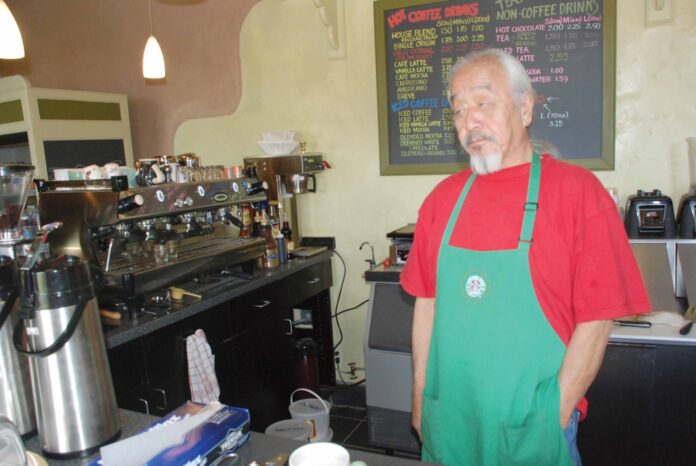
The idea sounds counter-intuitive: open a large coffee shop in a sleepy rural town, smack in the middle of an economic meltdown.
But Paul Namkung had been preparing to open the cafe for years now, and this summer seemed as good a time as any.
“It’s gone so much better than I had hoped for,” said Namkung, who started selling coffee and sandwiches at the Three Ravens Coffee House in Tierra Amarilla two months ago. “Then again, I’m not trying to make a lot of money. If I were trying to do that — or if I were relying on tourists — I wouldn’t have opened.”
Unlike many businesses to the north in Chama, Three Ravens does not depend on tourism, which varies with the seasons and is subject to economic pressures. Instead, Namkung banked on building a local clientele, plus a second steady, largely recession-proof stream of customers.
His business is down the street from the Rio Arriba County complex and Tierra Amarilla Courthouse, and it’s among the few restaurants in town with reliable operating hours. Even in a recession, Namkung figures jurors will always be eager for a cappuccino or hungry for a sandwich during breaks in a long trial, he said.
Namkung said he can afford to keep his coffee house running largely because he incurred no debt in opening it. Namkung had bought the then-condemned building 10 years ago and has since paid it off. He renovated the building and bought equipment gradually, as he came up with the money, rather than taking out a business loan.
“When I could pay for a window, that’s when I put in the window,” he said.
That’s just as well, because banks have tightened lending practices since the economy went south, Valley National Bank President Al Hernandez said.
“It’s not just us. Right now, you’d have a hard time getting a loan from anybody,” Hernandez said. “If you’ve been with us for 20 years and have an excellent history, we’ll probably at least hear what you have say (about your business plans). But if you just drove in from out of town, it’s probably not going to happen.”
Nonetheless, some new businesses have sprouted up in the area since the economic crisis hit last September, most of them in Española, which has received about two dozen business permit applications from new businesses in the past year. Those include out-of-town contractors that are working on bathroom renovations at Wal-Mart and building a dialysis center off Industrial Park Road. They also include at least three food establishments, two acupuncture clinics, a small clothing boutique and a Mexican record store.
Interviews with new business owners suggest success during the down-turn has meant relying on one of two strategies: keeping overhead costs low and catering to local customers.
Like Three Ravens, another new business also counts catering to locals as its survival strategy.
JoJi’s Sushi and Teppan Grill opened Nov. 14, 2008, in the strip mall adjacent to Wal-Mart and Lowe’s Home Improvement. It’s opening date was the product of chance, not choice, owner Louise George, of Española, said.
George’s family had been gearing to open for about three years.
“It’s just the way things came together that we opened now,” George said. “We didn’t know when we started the process it would be a bad economy when we started.”
George said she has no way to compare whether the restaurant is doing any worse than it would have in a better economy, but so far, JoJi’s is “holding its own.”
“As a new business, we’re not earning a ton of money,” she said. “But we’re doing all right. We’re covering our overhead.”
George thinks that’s because the restaurant is filling a unique niche in the Española Valley. Other restaurants cater to tourists with New Mexican food or fast food. But JoJi’s is the only Japanese restaurant in town, which helps draw local customers when tourism tapers off.
“The thing behind our place is we love this kind of food, and we were always going out of the Valley to find it,” George said. “So we’re doing good because there’s really a desire for something different in the Valley.”
JoJi’s employs 14 people, and all except its three chefs are from the Española Valley, she said.
Others have opened during the recession out of need, not choice.
Rigoberto’s Mexican restaurant opened late last year off Riverside Drive in Española in a former Taco Bell restaurant. The Mexican immigrant family who owns it operated a similar restaurant in Mesa, Ariz., that had gone broke last year.
“We all went out and looked for a different line of work,” manager Jose Alvarez, who worked at the Arizona location, said. “I went and got my trucking license. But a lot of us just couldn’t find other jobs. We opened now because we needed the work.”
Business in Española has not been any busier than in Arizona, Alvarez said. But though revenue at both locations has been similar, the restaurant is making a profit here because overhead costs are lower. For example, the restaurant paid about $3,000 more in rent in Arizona, Alvarez said.
“Here at least that leaves us enough to make a living,” he said.