Abiquiú School Moves Classroom to the Mesa

Published:

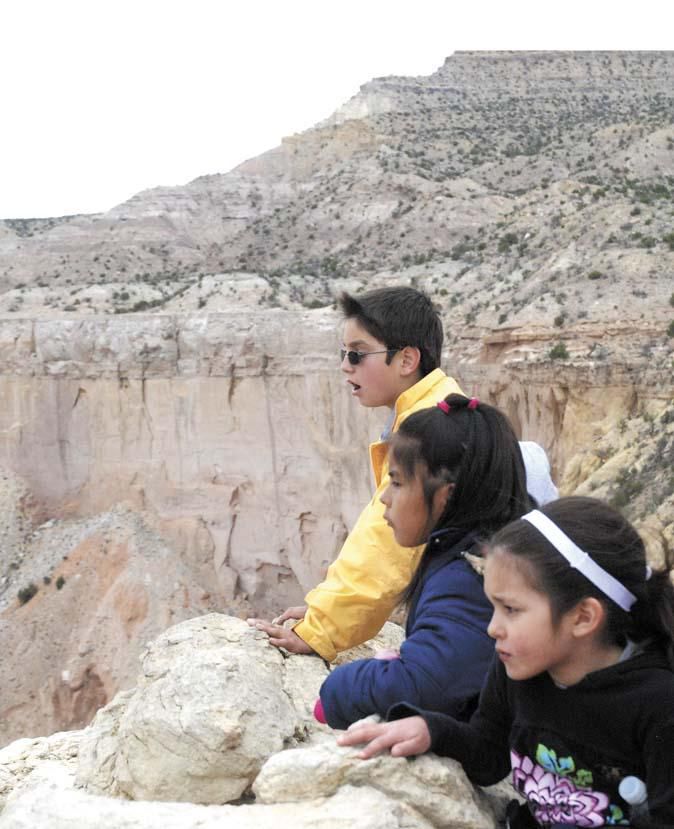
    It’s 9 a.m., about the time most elementary school students are taking their seats in florescent-lit classrooms and getting ready to open textbooks. Zachary Martinez is also beginning his school day. He’s sitting with five classmates on top of a mesa overlooking Ghost Ranch and the long, green sweep of the Northern New Mexico landscape as it stretches out over the glassy surface of Abiquiú Lake and the craggy silhouette of Cerro Pedernal on the horizon.

    “It’s a cool view,” he says.

    Martinez and his classmates have just finished a short hike and are listening to a lecture on the area’s geology. When they are finished, they’ll return to the Ghost Ranch museum to look at fossils of the Coelophysis dinosaur, which happens to be their school’s mascot.

    Outings like these are common at Abiquiú’s La Puerta School for the Arts, Sciences and Agriculture, a small, nonprofit private school that’s just about to finish its first year of classes.

    La Puerta head teacher and founder Erin Manzanares said the school’s goal is to focus on individual student learning and give them hands-on experience outside the classroom in the subjects they are studying.

    “These experiences allow the students to connect what they learn with what they see and participate in outside of class,” Manzanares said. “If we are learning about animals, like chickens, we’ll go out and get some chickens. We’ll get to see them, touch them — not just read about them.”

    Manzanares said the students have visited art galleries, farms, museums and the Abiquiú Lake dam over the course of their first year.

    “It’s been really fun,” Martinez said. “I feel like I learn more, and like I want to lean more, when we go out and get to see the things we are reading about.”

    Manzanares was a former public school teacher, having taught at Fairview Elementary for two years. During that time, Manzanares said she saw first-hand the challenges facing both teachers and students, which helped plant the idea of starting her own school.

    “I was burnt out after two years,” Manzanares said. “Between the large classroom size and just the system in general, I think kids are just getting overwhelmed, and I wanted to start a school that was different, where everyone works and learns at their own level.”

     Manzanares then went to Holy Cross Catholic School and worked as a teacher before setting out on her own to start La Puerta. Manzanares said she began speaking with friends, family and parents in the community, who were enthusiastic.

    “We got a great reception from everyone,” Manzanares said. “I think parents were eager to try something different than what we are doing in other schools.”

Seed Money

    The community didn’t just say they supported Manzanares’ idea, but showed it. The school’s website lists 54 “founding members,” who each donated between $100 and $5,000 to get the school on its feet.

    La Puerta was designated as a nonprofit entity by the federal Internal Revenue Service July 21, 2010, according to tax documents.

    Founding member Sue Parker, who is also the school’s music teacher, said the donation was well worth it.

    “I think we were able to create an ideal learning environment and give these kids a chance to really shine and grow,” Parker said. “I believed in this school enough that I was willing to put it on my property and everything.”

    Located just off Highway 84 on State Road 554 nera Abiquiú, the students at La Puerta spend part of their day in a new two-room prefabricated building that sits on Parker’s property. The school leases the property for $1 a year. The school also has a small music studio and a chicken coop out back.

    La Puerta received $51,000 in donations this year, according to its operating budget. That money, plus the $4,750 per-student annual tuition, made the school possible.

    “The average cost per (public school) student for the state is about $6,000,” Manzanares said. “So if you think about it, we are able to give students a better education at a lower cost.”

‘Night and Day’

    Roger Naranjo, whose daughter attends the school, said the he thought of the tuition as an investment in his daughter’s education.

    “She loves this school, and as parents we love to see our kids actually excited about going to school,” Naranjo said. “Since she came here, her grades are better and her attention span and attitude are great at home. It’s really amazing.”

    Zachary Martinez’s father, Mario Manzanares, also said he saw a dramatic improvement in his son’s performance after he came to La Puerta from Abiquiú Elementary.

    “I was skeptical at first, but then I saw him improve,” Mario Manzanares said. “It’s like night and day. His academics are better, and I think he’s more confident. I’m very proud of him.”

    Martinez said he thought going from his previous classes, which could have as many as 20 to 30 students in them, to La Puerta’s mixed-grade, six-student class helped him.

    “You have way more time with the teacher, and (Erin Manzanares) always lets us ask a lot of question,” Martinez said. “So it’s easier to learn stuff.”

School Different

    La Puerta’s curriculum is aligned with state standards, but also includes activities and projects most students don’t get the chance to experience, Erin Manzanares said. For example, a typical day at the school begins not with a quiz or a lecture, but with yoga.

    After getting some exercise, the students hold a morning meeting, then are required to do chores. Sometimes they work inside cleaning and sharpening pencils, or they work outside taking care of the school’s chickens, whose eggs are later sold to the community.

    “The idea is to give (students) a sense of responsibility and to show them that this is their school,” Manzanares said.

    The classroom also has its own economy in which students get faux money for completing chores, turning in homework and other activities. Students who misbehave are given “tickets,” which cost money. At the end of each week students must reconcile their accounts and can use the money to purchase items from the school’s store.

    La Puerta student Vincent Ortiz said the students also had to pay taxes on their earnings on April 18.

    “We had to pay 2 percent for our taxes,” Ortiz said. “It works just like real life.”

    Because all of the students are different ages, Manzanares said much of the classroom learning takes the form of projects, which allows students to work on a subject at their own level. The projects often incorporate several different elements, including research, writing and creative arts.

    Recently, students were asked to pick a historical character. They not only had to write a research paper on their historic figure, but were also required to draw a report cover page, write a poem about the person and put on a theatrical presentation, complete with costumes, to students at an elementary school.

    “We do all kinds of different things with our projects,” said Ortiz, who also made a small headdress as part of his project on the Native American leader Geronimo. “It’s way better than just reading it out of a book.”

    Manzanares said students at La Puerta also have to write in reflective journals about what they do each day at school.

    “I hope to teach them not just how to learn, but think about how they are learning,” Manzanares said. “If you went up to them and asked them, they would be able to tell you what they learned and how they put everything together.”

    The students’ work is kept in a portfolio, and their success is measured by the progress they make toward meeting state academic standards for their age group.

    “We are measuring them against themselves and looking at whether they are improving on an individual basis as opposed to against their classmates,” Manzanares said. “I think it’s much more comprehensive and effective, because now the student will understand where they are at and what they are working towards as opposed to just having a letter grade which doesn’t tell them very much.”

    Unlike a public school, the classroom is a mix of different ages, from 5 to 10 years old. Manzanares said the mixed classroom allows students to learn from one an other.

    “It great because the older kids become role models and examples,” Parker said. “And the younger kids learn from them, and it makes the learning process much more interactive between the students. They are all very close to one another.”

    Manzanares said she plans to add six more students next year and to hire a full-time assistant to help her during the day.

    “We will still be able to make sure these kids get the same quality of education, even if there are a few more students,” she said.

    Four of the school’s five board members are also on its staff, with Manzanares as head teacher, Parker teaching music, Suzanne Snow teaching yoga and Dinah Manzanares teaching Spanish. The board’s fifth member, Secretary-Treasurer Ann Cunningham, also helps oversee the school’s finances. The school employs one instructional assistant and one classroom volunteer. Of those, only Erin Manzanares and the instructional assistant are paid. The school’s total salary budget for the current school year is $55,000.

Student Service

    In addition to their academics and activities, the students at La Puerta also regularly participate in community service projects. This year they have worked at the San Martin de Porres Soup Kitchen in Española, serving food and singing to the needy there. The school also regularly lends a hand at the Abiquiú Library, where it maintains a small garden.

    The class also purchased a goat for a family in Kenya, with whom they hope to correspond and learn how to take care of the animal so the class can purchase a goat of its own in the future.

    Manzanares said community service plays a major role for the students at La Puerta.

    “It not only teaches them the importance of serving others, but it gets them thinking about their role in their community,” Manzanares. “And they love being out there and helping others. They get excited about it.”

    Ortiz agreed.

    “It’s important to help people and to care about them,” Ortiz said. “But it’s also pretty fun too.”

    Coming up on the end of its first year, Manzanares said the school is in the process of becoming accredited, which will allow it to receive federal funding. Next year Manzanares said the school’s goal is to double the number of students in the first- through sixth-grade class for a total of 12 students.

    All six of the school’s current students said they were coming back to La Puerta for the 2011-12 school year.

    “You bet I’ll be back,” Ortiz said. “Next year’s gonna be great.”

    For more information: visit www.lpsasa.org or call 685-0006.

    How to help: Manzanares said La Puerta welcomes donations of money and school supplies. She said students are looking to gather agricultural supplies and tools for future projects, including hoses, trowels, shovels and materials to build a hoop house. A list of other donations, including office supplies or sponsoring a student, can be found on the school’s website.

Related articles

Recent articles