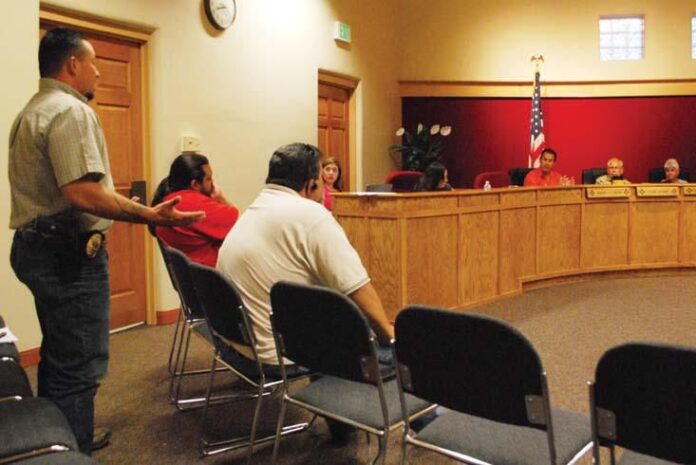
After the Española City Council struck down the latest version of the Española Police Department’s union contract with one councilor accusing the union of attempting to “guilt-trip” the Council into providing more vacation allowances to police officers, it reversed that decision Tuesday night in accordance with legal advice that it cannot reject the contract without explanation.
City attorney Frank Coppler told councilors they needed to make a good faith effort in the union negotiations as per the state Public Employees Bargaining Act. This means the Council cannot merely strike down a contract and have the union go back to the drawing board, but it must suggest specific changes.
The Council failed to do this when rejecting the contract last week, then unanimously approved the contract Tuesday under the stipulation that both the city and the union work under a time line to have a new contract for fiscal year 2012 in place by the end of August.
The Council initially voted 5-2 against the contract June 20 following an address by Public Safety Chief Leo Montoya during which he aired union infighting to councilors, marking the first public rift between the chief and the union since Montoya took office in January.
The only support for the contract at that time came from District 4 Councilor Robert Seeds and District 3 Councilor Chayo Garcia, both of whom questioned extending the time line behind it. The union must get Council approval for a contract each fiscal year and cannot begin negotiating subsequent contracts until this happens, according to union president Det. Bryan Martinez. The contract approved Tuesday covers the 2011 fiscal year, which ends Thursday (6/30), but will continue until a new contract for 2012 is negotiated.
Had the Council not approved the contract, union members would have had to continue working off the most recently approved version, in this case from fiscal year 2010. The negotiation process for the fiscal year 2011 contract had been going on since last August, and Seeds questioned why it took so long to get the contract approved.
The proposed contract included pay raises for officers contingent on the city having money for them. The contract also stated bargaining members promoted to detective would receive a 10 percent pay increase, field training officers would earn an extra $85 per month and officers who were put on-call would earn $150 per pay period, among other pay increases.
Martinez said though this language is new to the contract, the pay practices described are not.
“That’s all stuff that’s practiced right now,” he said. “It’s just now in black and white.”
The contract also includes sign-on bonuses for new employees and an additional $100 per employee per quarter for a uniform allowance.
Additionally, Martinez said the contract increases the rate at which officers earn time off but reduces the number of hours they can carry over from year to year to 390 hours, down from 596. The contract states the city can buy back this leave time from the officers as they do for other city employees.
District 1 Councilor Pedro Valdez said he wanted the officers to have fewer carryover hours per year — about 100. He said this would mirror what workers in the private sector receive.
“This way it encourages the employees to take vacation and spend time with their families,” he said.
Martinez said following the meeting this would be less than the 328 hours other city employees are allowed to carry. City employee union president Joaquin Maestas confirmed that number.
Officer Danny Pacheco painted a grim picture for councilors of the current working conditions in the department. He said it’s hard because not only are officers working 12-hour shifts, but they’re not getting the time off they deserve.
“They’re not sleeping right or eating right,” he said. “That’s putting a liability on them and the city.”
Valdez said he didn’t want to be put on a guilt trip.
“You can’t walk in here saying you work 24 hours and you’re not eating or sleeping,” he said. “The way you’re talking is a guilt-trip.”
If the money isn’t in the budget, then the Council’s hands are tied, Valdez said.
“We pay you with taxes,” he said. “If it can’t be done with the taxes, then it can’t be done.”
Whether or not there is money in the Department’s budget depends on who you ask and where you look.
The city’s fiscal year 2012 public safety budget was structured around a plan to close the Española Jail and transfer the Jail employees to the Department, according to Montoya. City Manager James Lujan said the Department has the potential for six new positions, one of which the city could use a grant to hire.
However, the budget shows the Department’s budget was actually cut by $95,000 to $2.3 million, rather than receiving funding for additional positions.
Montoya added a majority of the Jail employees have not been able to pass physical agility tests required to become police officers, then asked a reporter to not report that statement.
Montoya also pointed to infighting within the union and told councilors the union was really divided and unable to reach a consensus on the items in the contract.
“They can’t agree on anything themselves,” he said.
District 2 Councilor Greg Ortega echoed that concern.
“Obviously they’re really divided,” Ortega said. “This contract is for the purpose of benefiting the few.”
Martinez said later Montoya’s comment may relate to an impromptu meeting he and officer Daniel Espinoza, the union vice president, had with the chief. Martinez said they disagreed on demands such as a provision prohibiting promoted officers from being transferred. Martinez, who said he felt the chief has been fair in dealing with the union, accused Montoya of taking notes on these discussions. He said he would no longer meet with Montoya to discuss union matters unless the full union leadership is present.
“The chief has no business getting involved period,” Martinez said. “That’s union business.”
Montoya said Tuesday he’s for the union, but he was concerned they were fighting among one another. He said it would be easier to deal with the union if they were all in agreement.
Martinez said 12 of the union’s 17 members voted to approve the contract last October, at which point it was sent to the Council’s public safety committee and, until Tuesday, it had moved no further.
“They put it on the back burner,” Martinez said.