With a focus on community, El Centro Family Health works to bring the cutting edge of health care to Northern New Mexico.
They have been a part of the health care equation in the area since 1972, when they spun off from HELP, the Home, Education, and Livelihood Program. Starting with clinics in Española, Las Vegas, Wagon Mound, Peñasco, and San Miguel, the organization has since expanded to 14 clinics in 14 communities and seven counties.
They split their list of clinics into the East Side and the West Side, said CEO Lore Pease. On the east side, El Centro has clinics in Springer, Wagon Mound, Roy, Las Vegas, N.M. and one at Highlands University in Las Vegas.
On the west side, El Centro is in Española, Coyote, Embudo, Taos, Peñasco and Truchas.
In addition to that, the organization operates three dental clinics in Las Vegas, Peñasco, and Española, and eight school-based clinics. El Centro’s clinic at Española Valley High School was the first school-based clinic in the state when it opened in 1984.
With these clinics, they serve roughly 18,250 patients, with about 71,350 individuals coming through their doors every year.
Most of the company leadership is local. Those managers generally hire their 200 employees locally. They are the biggest employer in many of the small communities they operate in, Pease said.
“We like to say we’re the heart of the community,” said regional administrator Cindy Gallegos.
All types
of patients
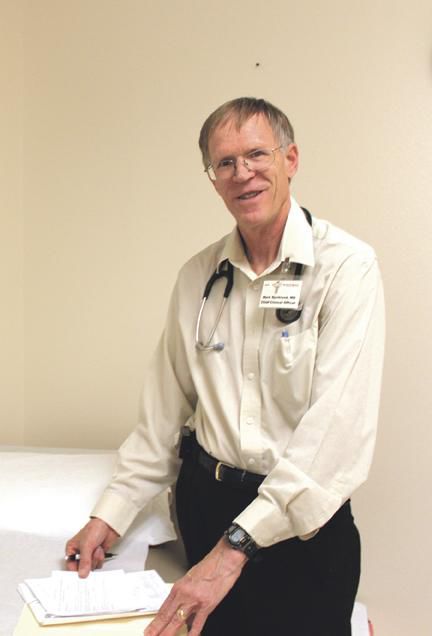
They take all types of patients and use an income-based sliding scale to determine the price of their services for each patient. Dr. Mark Bjorglund, El Centro’s chief clinical officer and physician at the Truchas and Española clinics, describes community health centers as a safety net, because they don’t turn any patients away.
“It’s great to be able to say we take care of any patient that walks through the door,” Pease said. “We’re there for the community. We’ve been in Espanola since ‘72. We have always been here for the community and all our communities, and we’re not leaving. This is where our heart is, this is where our mission is. The people in the communities, our families and friends, are most important.”
Bjorglund said what El Centro is best at is primary care with a team approach.
When a patient comes in, they aren’t just seen by their provider and sent on their way, Pease said. If a patient comes in to see their provider and they are diagnosed with any kind of complex disease like diabetes or obesity, then that provider will “tag-team” them off to somebody in the health programs department who will give them the training they need to eat a healthier diet and exercise, or whatever treatment fits the illness. If a patient needs counseling, El Centro has behavioral health counselors at the clinics to whom the provider can pass the patient.
After that, El Centro employs community health workers to call patients to follow up and see how their treatments are progressing. Pease used her mother, who is a patient at El Centro, as an example. She was told to keep active, which she did by taking walks when the weather permitted. However, winter weather made this difficult.
“So, her community health worker called her and said, ‘So are you exercising?’ She says ‘How am I going to get out and exercise in the snow and ice?’ So the community health worker says, ‘Are you watching TV?’ she says ‘Yes’ and she says ‘During the ad, I want you to march in place.’ My mom’s response to me was ‘Do you know how long an ad is?’” Pease said.
Medical hug
Bjorglund said these community health workers are trained in specific tasks, like smoking cessation and operating blood glucose meters. He uses the example of a patient prescribed an anti-depressant medication. The community health worker would follow up with the patient to see how the medication was working and if they were experiencing any side effects.
This team approach to health care is something that is being implemented throughout the country because of the Affordable Care Act. Called Patient Centered Medical Home, Pease said it is a model where you have a community and you’re accountable for that community.
“You wrap around a community,” said Health Programs Director Tana Beverwyk-Abouda. “Like a medical hug.”
However, El Centro was already using this approach before it was made a part of the government’s healthcare reform bill. Bjorglund said these “medical homes” are also required to provide certain kinds of access to patients, such as after-hours services and same-day admissions.
“The health commons was a great example of that,” said Gallegos. “We all work in collaboration with all the entities to work together as a team. It’s been a great collaboration with everyone.”
Partnerships
If something comes up where a community needs something and El Centro is not providing those needs, the organization has become adept at collaborating with other groups to help provide what the community needs.
“We know how to access other resources. We’re like a magnet,” said Pease.
El Centro has partnerships with many organizations to help bring services to their patients, including Hoy, Las Cumbres, Casa de Corazon, Team Builders, the Health Services Department, Presbyterian Hospital, and schools and law enforcement around the state.
Certain partnerships are meant to bring cutting-edge health care to remote communities.
A partnership with the University of New Mexico Cancer Center connects them to Assured Imaging, a for-profit radiology company that provides a mobile mammography unit to help detect breast cancer. El Centro coordinates with them to bring this service out to the communities they serve, free to the patients.
One such event in Tierra Amarilla saw 104 women in two days. Gallegos said some of the patients told them that when they go into Española, they are more concerned with running errands and taking their children to their own doctors that they end up putting themselves last. This service is a way to make it easier for patients to get the early detection services they need.
“If you end up with breast cancer and you live in Española, chances are much higher that you’re going to pass away from it than if you live in Albuquerque, simply because of access to preventative care,” Beverwyk-Abouda said. “Statistics for health disparities for being in a far out area are striking.”
In addition to breast cancer detection, El Centro brings similar mobile units out for diabetes detection and retinal eye scans. And they don’t bring these detection services in to tell a patient they have a serious illness and leave it at that. They also coordinate treatment options afterwards.
Follow-up treatment
“A big issue with the mobile prevention screens is that they come, they park in a parking lot, and they leave,” Beverwyk-Abouda said. “And then you get a post card saying that you have a lump that looks suspicious, and then what do you do? But, when that van is parked in the parking lot of your hometown clinic and it’s connected with a community health worker who you’ve been working with for 10 years, then you get that postcard and you know exactly where to go.”
El Centro is also able to bring complex treatments and specialty care to rural patients through a partnership with UNM’s Project ECHO, which uses teleconferencing technology to consult with primary care providers and help train them to treat and manage complex illnesses in their patients.
Beverwyk-Abouda gives treatment for hepatitis C as an example. This disease was the first that Project Echo sought to tackle, she said. If a person gets the disease in a city like Albuquerque, there is a cure. The treatment is tough, and takes six months to go through, but it is possible to clear the virus.
Patients in rural areas don’t get that opportunity, she said. The cure has severe physical and psychological effects that need to be managed by experts and specialists and psychiatrists, which are difficult if not impossible to come by in a community like Embudo.
“It’s about being able to treat people in their home instead of asking people to travel to Albuquerque and back and forth and what that does for their health. It’s not about getting medication. Medications are easy. It’s about specialists,” Beverwyk-Abouda said.
Pease agreed. The key is access.
“The key is trying to get them to the specialist,” she said. “They won’t travel. Some of them don’t have the money to travel, some of them don’t have the means to travel. There’s no bus service like there is in Albuquerque where you can hop on and get there, so they just don’t go.”
Because of the consultations, Pease said the provider ends up being almost a specialist in their own right because they have learned so much that they are able to understand what patients with complex illnesses really need. Another positive side-effect is that doctors in these far-flung communities feel less isolated when they are able to collaborate in this way with professionals in other places, which Beverwyk-Abouda said can decrease burnout which can lead to turnover.
Pease calls funding one of their biggest struggles. Only 5 percent of their funding comes from donations. Another 45 percent comes from state and federal grants. The rest comes from program services.
“Part of the job for everybody is figuring out, with our limited resources, how are we going to accomplish what we want to do?” Bjorglund said. “That’s probably one of the most satisfying and frustrating parts of my job. Sometimes you’re really limited. In Truchas a few years ago, there was a delegation from Russia who wanted to see the clinic at one of the health centers up there. They were all kind of commenting that their EKG machine was more sophisticated than ours at the time. So that’s an example of the limited resources we have to work with. Having said that, we provide good quality care.”
Helping yourself
For those who want to get involved in El Centro, the best way may be to take an active role in one’s own health care.
“I’m a big advocate for health literacy in the community. I really, really think we need to be doing more as a society to teach people that they can ask questions, that their health is in their control,” said Beverwyk-Abouda. “There’s been a real hierarchical set-up of health care in this country, and its been to the detriment of the patient and providers. Most providers want to have a conversation with the patient about what they can do, and patients have been taught to be quiet and they’re terrified and they don’t ask questions.”
She believes that patients taking their health into their own hands and educating others is the best way for people to get involved.
However, for more tangible ways to get involved in the organization, Pease said that they have been looking for volunteer greeters for their Rio Arriba Health Commons and Las Vegas clinics, and need volunteers from Truchas and Taos for the two open spots on their board.
The organization is also trying to grow their own local health care providers to help deal with the shortage experienced in the rural communities they serve. Through a program called Semillas de Salud, which literally translates to “Planting the Seeds of Health”, El Centro identifies youth in these communities with an interest in health care and medical sciences and creates a pipeline of mentorship and support through middle school, high school, and college all the way to job placement in health care.
Bjorglund said the idea behind the program is that locals understand the culture and the environment, so if El Centro can get them interested in health careers, those will be the best recruits.
“The hope is that they come back and practice, because it means a lot to patients if the same provider stays in their community. If that provider is from their community, it’s even better,” said Pease.
The program is three years old, so no students have been able to make it completely through the pipeline, but they have had nursing, physician’s assistant, and medical students coming to their clinics to do their rotations, along with doctors coming to do their residencies there.
El Centro also practices what they preach. The company helps employees take an active role in their own health with their employee health initiative.
“We’re a big employer, so if El Centro employees can walk the walk, we’ll be more convincing to our patients and more trusted in our community,” said Beverwyk-Abouda. “Having a nurse come in and talk to a child about smoking when he or she smells like smoke is not very convincing.”
Part of this program is lunch time fitness classes that connect the entire El Centro clinic network over televideo in a system-wide workout. They also bring healthy lunches to eat before the class. It also includes a health tracking system through Christus St. Vincent Hospital which calculates how much exercise someone goes through in a day, measuring things like yard work and yoga classes into an equivalent amount of steps.
Staying healthy is important to Pease because she believes health leads to happiness.
“Without health, you’ve got nothing,” Pease said. “You can’t go anywhere, you can’t do anything. I’m coming out of a disease. I’m recovered, and I know what it’s like to have a disease that you have to live with. It affects your emotions, your mental state, your physical state. It affects how you live in your community. Your health is your key to happiness and life.”