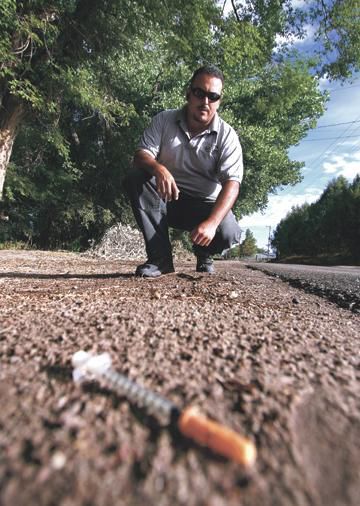
Española City Councilor Cory Lewis received a call three months ago from a constituent whose friend was visiting from Taos. While picnicking at Valdez Park, behind city hall, the friend’s daughter found nearly a dozen hypodermic needles, presumably discarded by area junkies.
“People throwing dirty needles in our streets and in our parks is a huge problem” Lewis said. “It’s a dangerous situation and it’s frustrating.”
Indeed, city officials have been scratching their heads for some time over how to discourage the city’s heroin addicts from improperly discarding dirty needles in public spaces, a topic discussed at a city safety meeting Aug. 6. Unfortunately there is no clear solution.
In response to his constituent’s complaint, Lewis met with interim city manager Joe Duran to ensure that each morning the city’s public works crew sweeps area parks for dirty needles, which Duran says are often found in baseball dugouts, buried in sandboxes, or hiding in the tall grass.
Duran said upwards of 10 needles a day are found throughout the city’s parks. Because city staff doesn’t keep a running tally on how many needles they’re finding, it’s impossible to ascertain the true scope of the problem.
Needle calls up
According to records provided by the 911 Center, the number of calls reporting dirty needles has surged since 2008, as far back as 911 call records go.
That year the Center received 42 needle calls. That number climbed slightly to 56 calls in 2009, dipping down to 46 calls in 2010. Last year, however, the Center received 74 needle calls, a 38 percent increase from the prior year. And needle calls this year are on track to surpass that, with 47 as of Aug. 6.
Factor in the unreported syringes found by city parks and road crews, residents and business owners those numbers climb even higher. Most of the 911 needle calls originate from along Riverside Drive rather than city parks, but the records also show that no section of the city is needle-free.
Councilor Robert Seeds said he’s received two calls in recent weeks from constituents who have found needles in two different parks. Some had been tossed in the tall grass, while others were found buried in sandboxes.
“Unfortunately, until we change the mentality of some people there’s nothing much we can do,” Seeds said. “It’s a shame that you walk your dog and have to worry about it getting poked with a needle.”
Councilor Eric Radosevich, too, is at a loss. While he hasn’t received any constituent complaints, he has also found needles, including once during a funeral at Holy Cross Cemetery.
“I wish there was some kind of awareness program to teach these people how dangerous this is,” he said. “I wish they’d at least have the decency to throw them away.”
The dirty needles aren’t only a problem the city must grapple with, but they affect other entities with business in the area, as well. Rio Arriba County Manager Tomas Campos said special precautions are taken when inmate work crews do road clean-ups in the Española Valley to ensure found needles aren’t smuggled into the Detention Center.
“We have to watch our prisoners closely when they’re down there so they don’t pick anything up,” he said. “You don’t find them north of Abiquiú,”
Dangerous job
North Central Solid Waste Authority manager Gino Romero said two Authority trash collectors have been stuck by improperly discarded needles in the last two years and must now be regularly tested for AIDS and hepatitis C.
He has also ended trash collection service at the homes where the men were pricked.
With no other solutions in sight, Duran floated an idea he observed while visiting Amsterdam, where special boxes are placed throughout the city’s infamous red light district wherein junkies can safely throw away their dirty needles.
Duran suggested similar boxes could be placed in city parks and along Riverside Drive.
“They need a location to throw them instead of throwing them in the grass or out of their cars,” he said.
Seeds, however, is skeptical the approach would work.
“Do you really think a drug addict would really use those boxes?” he asked.
Hospital advice
Although city officials urge residents to call 911 to report needles, Brenda Romero, an administrator with Presbyterian Hospital, suggested residents, if they choose not to call 911, place needles inside a gallon milk carton to keep everyone safe.
“It’s what diabetics do,” she said.
Romero also noted the state Department of Health runs a needle-exchange program in Rio Arriba County that encourages proper needle disposal.
On the morning of Aug. 6, Lewis was shown a dirty needle on North McCurdy Road, just feet from his home. Lewis said he never had to worry about stubbing his toe on a dirty needle while growing up in the area. Now, he said, it’s hard to walk anywhere without finding one.
Each year, during the City’s spring clean-up event, Lewis plants little flags next to the syringes he discovers along North McCurdy to make them easy for city staff to later locate.
“When we’re done, if you look down the road, you’ll see a bunch of flags,” he said. “This is a very serious problem in our community.”
Lewis and Seeds have both asked city staff to sweep through the parks each morning before children arrive, which Duran said they’re doing. Lewis added he’d like the city’s beat officers to do more community policing, to get to know who is who in trouble areas.
“They need to get out and walk the area and police properly to make sure people aren’t in the fields and parks doing narcotics,” he said. “Driving around just isn’t enough.”