Katherine Eagleson and the park rangers at Abiquiú Dam made life a bit easier for the Falco tinnunculus. Commonly called the American Kestrel, the 4-ounce adult’s numbers are declining and The Wildlife Center’s executive director, along with the Army Corps of Engineers, gathered residents to educate them and increase the small falcon’s breeding chances.
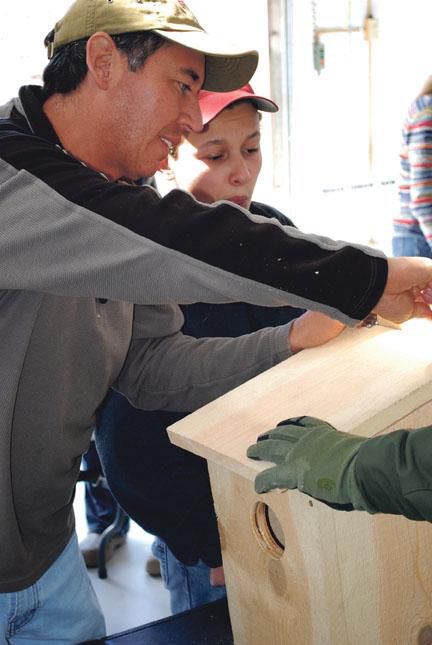
Fifteen people gathered at the visitor center at Abiquiú Dam April 20, learned about the Kestrel and built wooden boxes ideal for Kestrel nesting.
Eagleson brought Squirt with her, a 7-year-old female whose damaged right wing prohibits her return to the wild. Eagleson said falcons require full use of both wings to hunt successfully. Squirt preened and posed for shutterbugs as Eagleson shared her knowledge of the Kestrel and other birds that are denizens of Rio Arriba County.
When Eagleson asked the crowd about the Kestrel’s food source, Ruben Trujillo, of Hernandez, guessed that Kestrels eat worms.
“That’s a good guess,” Eagleson said. “They like grasshoppers mostly.”
Before the presentation, Eagleson said the drought has hard-hit the insect population and that translates to less food for birds. While farmers and ranchers can rejoice at fewer of the pesky leaf-eating insects, it means smaller and fewer meals for Kestrels.
“They’ll really eat anything when they’re hungry,” Eagleson said of the Kestrel. “They’ve been known to eat other birds but prefer arthropods (insects with an exoskeleton, segmented body and jointed appendages).”
Five other breeds of falcons are native to New Mexico. They all eat other birds as a primary source of food. The Kestrel is unique in its preference for grasshoppers.
The small, mostly brown bird has a slate blue line along its side and a black tail. Females are striped all the way down their bodies and males have solid black tails.
Kestrels don’t build nests, they steal other birds’ nests, Eagleson said. Ideally, the nest sits between 12 and 20 feet off the ground.
The female lays about four eggs in May and sits on them for 30 days. Following hatching, the female will care for the chicks for 12 days. The chicks grow quickly and leave soon thereafter, Eagleson said.
The time-line from laying eggs to chicks learning to forage on their own is so short, Eagelson said sometimes they will lay eggs twice in one year in the southern part of the state.
Eagleson said she scouted Abiquiú Lake April 13 and found good locations for the nesting boxes. She also found a plethora of bird nests on the north side of the lake.
“We have double-crested cormorants, avisats, great blue herons, ring billed ducks and western grebes on the northern edge,” she said. “We’re trying to get buoys put in place to eliminate the wake on that end so the nests aren’t disturbed.”
Eagleson had nothing but praise for the park rangers at the dam.
“These guys are great,” she said. “They work to protect the natural habitat and try to balance the many requests they get. They’re putting in three acres of wetlands below the dam to increase the breeding grounds.”
The group moved to a garage at the visitor center and broke into four groups. Each built an enclosed nesting box.
A father and son team from Los Alamos stood back and admired their work.
”That looks good,” Wayne Torrez said to his son.
“Yeah, we did great,” Jacob Torrez said.
Eagleson said the four boxes built by volunteers and another six that Wildlife Center volunteers built will be placed strategically around the lake and she hopes they’ll be occupied in May 2014.
The Wildlife Center is starting a “Friends of Abiquiú Lake” group. They seek people interested in the preservation of habitat at the lake and who can be a community voice in the Corps’ projects. For more information contact Eagleson at 753-9505 or email friendsofabiquiulake@gmail.com