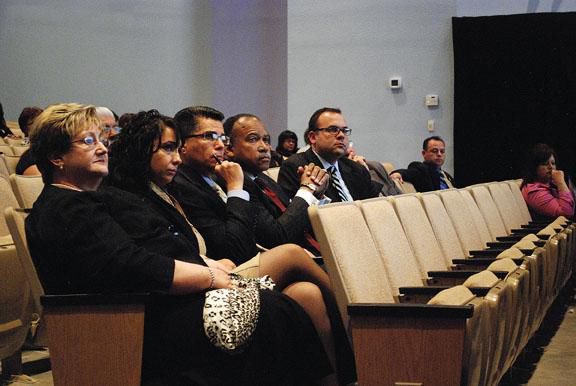
Emotions ran high at an April 25 community forum held at Northern New Mexico College. About 60 members of the community gathered at the Nick L. Salazar Center for the Arts to discuss the impact of drug use in Española.
The discussion was for the community, but it informed an audience that included representatives from the White House: Deputy Director of State, Local and Tribal Affairs for the Office of National Drug Control Policy Ben Tucker and ONDCP High Intensity Drug Trafficking Area Program Analyst Darren Neely.
U.S. Attorney for the District of New Mexico Kenneth J. Gonzalez —who grew up in Pojoaque—also was there, as well as HIDTA’s New Mexico Deputy Director Ernie Ortiz, Española City Mayor Alice Lucero and Director of Public Safety Eric Garcia.
Several people told stories about generations of their families being affected by heroin use. Some expressed anger and disappointment that living in Española comes with a stigma. Many advocated for funding for more local resources to deal with drug addiction.
“I travel 20 miles away for work and the city where I work is much more wealthy than Española,” said resident Chris Roybal. “I see the stigma they put on residents of Española, the pueblos and the valley. It’s up to us to remove the stigma.”
Rio Arriba County Health and Human Services Director Lauren Reichelt said that the community needed to look past what outsiders think of Española.
“I do realize that we have very high rates of drug abuse, and also diabetes, but those are illnesses and not character flaws,” Reichelt said. “This is a vibrant community with hard-working people and it’s a good place.”
Many commented that Española needs its own long-term inpatient treatment centers, especially for youth.
“There’s no help for the kids here,” said Española Municipal Court Outreach Coordinator Richard Marquez. “Most of the people at the sobriety services in Santa Fe are from Rio Arriba County. We need those services here.”
“We really need a detox facility for kids and adults, plus a rehab center where we can keep them in there until they’ve got the help they need,” Deacon Jerome Romero said. “You’d be surprised that there are a lot of people who use who look just like me. We need to work together and get this done.”
For some it was more important that the community change its attitudes about drug use. New Mexico Department of Corrections Parole and Probation Supervisor Labriana Belmontes said that while it was necessary for Española to not allow drug use to be the norm, the community also needed to learn how to give second chances.
“We can send them to treatment and they’ll come out clean, but the community then shuts them down,” Belmontes said. “They come back to us and say, ‘I can’t get a job because I came out of jail.’”
There was also a lot of concern about youth who are caught with drugs.
“A lot of it starts in the home,” said Española City Councilor Dennis Tim Salazar. “It’s important for the parents to be aware of everything that’s going on.”
“The people in charge of looking for drugs are looking in the wrong direction,” said Jordan Vigil. “They’re looking at kids who get caught at school with it in their backpack or the kid whose parent finds it in their clothes drawer. They need to be looking at the people selling these drugs.”
“What about the third- or fourth-grader who gets in trouble for bringing weed to school?” said YMCA Teen Center Director Ben Sandoval. “Are we kicking them out of school or are we looking to see what their real problem is?”
Speaking after the meeting, Tucker, from the ONDCP, said hearing what the community had to say about drug use in Española was powerful.
“These kinds of discussions are the kinds of discussions that help us draft the strategy and it helps us understand what is happening at the local level, because so much of what we do at the policy level has to be informed by what is happening in our communities,” Tucker said. “You can’t make policy and think about policy from Washington, D.C. You have to go out and meet the people, you have to talk to them and you have to listen.”
Tucker was at the meeting right after a big event for his office; The ONDCP had released its 2013 National Drug Control Strategy the day before. He said that what he’d heard at that night’s meeting was motivating and helps him determine whether White House policy is on track.
“One of the things that’s been pretty clear in recent years is that we rely on law enforcement to deal with the drug problem in the country, but the truth is that we can’t really arrest our way out of this problem,” Tucker said. “We have to have a balance that allows us to really solve the problem and we can’t solve the problem unless (we) work with local communities.”
Yet having a few big hitters from Washington D.C. isn’t going to turn Española’s drug problem around, said New Mexico’s U.S. Attorney Kenneth J. Gonzalez.
Gonzalez talked about the communities of Dorchester, Mass. and Richmond, Va. He said Dorchester was at one time labeled as having the highest murder rate in the nation and Richmond had the highest rate of firearms fatalities and injuries. Both communities were able to affect change by implementing their own solutions. He said Dorchester and Richmond were examples of what people can accomplish when they stop waiting for someone to help them and decide to implement change on their own.
“They were absolutely fed up with what was going on in their streets and they just finished looking to somebody else to make changes for them and they did it themselves,” Gonzalez said.
“Yes, there were police involved, but there were (also) healthcare providers, there were clergy, there were people involved with social work, there were teachers, a mix of people from all segments of (the community) and the result was positive change.”
Gonzalez then presented a challenge to Española. He asked every person to not leave the room without an idea of what they personally could do to tackle drug abuse in the valley.
“Decide and do it,” Gonzalez said.
“Be like Dorchester and be like Richmond. Be an example so that somebody five years from now or 10 years from now is looking back at a project in that little speck in Northern New Mexico called Española. Give them something to talk about —about how there were big problems in Española and Chimayó and how the people that cared the most did something about it.
“I have the jurisdiction of the entire state of New Mexico. We have problems all over New Mexico. We have serious problems in Roswell, we have big problems in Farmington. I’ll tell you right now, Española is where my heart is. You’re my people. That’s why I’m here and I believe that you can do it.”