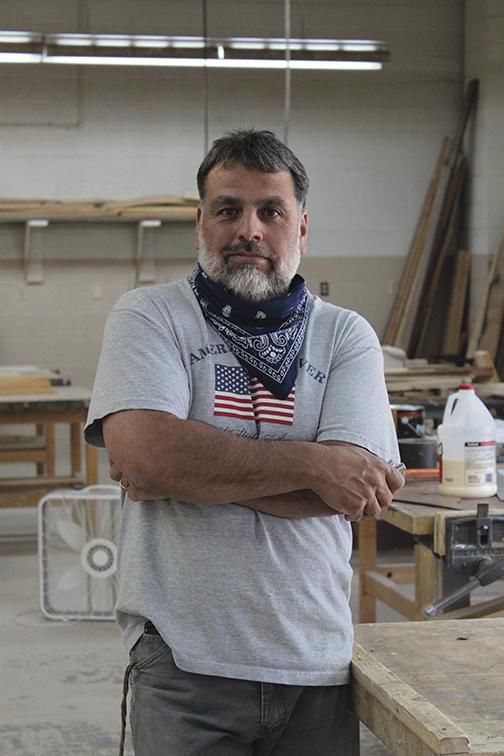
Vietnam War veteran Eloy Romero, 65, first enrolled in Northern New Mexico College’s colonial furniture-making course as a sort of therapy, but the experience soon turned into an act of cultural preservation.
“I started having a lot of problems with my PTSD,” Romero said, “and my wife told me ‘Why don’t you take woodworking at the college?’ She said, ‘Because if you sit and mope about your problems on the couch, you’re going to get worse.’”
After Romero started the course, he started advocating for it among other veterans he knew, eventually bringing in around 10 others to take it as well, he said.
Romero said the process of woodworking helped many of them begin to heal.
“We were so emotionally disturbed from what we had gone through,” he said. “This was our therapy. This piece of wood and us.”
While not originally set up specifically for veterans, former teacher Rik Gonzales said the program drew them through word of mouth. He estimates 13 have attended over the years, along with many other students, several of whom went on to become great artists in the medium, he said.
Fellow student and Vietnam veteran Felix Vigil said if these programs fade away, the tradition of colonial furniture-making might fade as well.
“If programs like this don’t keep going, you’re going to lose it,” Vigil said. “The tradition ends.”
Romero said his family tree has deep roots in New Mexico, going back 400 years, so preserving the traditions of the region is important to him.
First function
When Spanish settlers arrived in the land which would become New Mexico, Romero said they brought only crude woodworking tools such as axes and saws and chisels, lending a rustic quality to the furniture they built for their homes.
While there is a certain beauty to the style, the pieces were also practically constructed to meet the builders’ needs.
“They did what they could with what they had,” he said.
Vigil said the furniture was often crudely built because of the crude tools the settlers had to work with. While builders often tried to incorporate a design to beautify their creations, they were all built to be useful.
“You couldn’t go to Sears or buy your furniture or anything like that, so you made your own,” he said. “It didn’t look too good, but it served the purpose.”
Gonzales said people eventually started to decorate the furniture with designs from various influences.
Robin Gavin, curator for the Museum of Spanish Colonial Art in Santa Fe, said New Mexico’s iconic furniture style is a unique combination of local materials and influences from around the world. They include Spanish and Islamic styles brought to the colonies by Spanish settlers and a New Mexican aesthetic derived from Hispanic and Native American traditions.
In addition to these influences, Juanito Jimenez, who teaches retablo painting at the college, said contact with the United States to the east also influenced the furniture. He said people probably saw items coming over the Santa Fe Trail and thought to themselves, “We can duplicate that.”
Romero said he likes the style because of its variety.
“Everything is different,” he said. “I can do something and the guy next to me is doing something completely different.”
Romero said the style is also influenced by what the settlers didn’t have.
“A lot of it is just joints, mortise and tenons, because they didn’t have any nails back then,” he said.
Once the Santa Fe Trail opened in the early 1800s, Romero said furniture started flowing in from cities in the United States such as St. Louis, Mo., and locals started ditching their hand-made furniture for the imports. Later, he said, wealthy people in Santa Fe and Taos began to snatch up the pieces for peanuts to fill their colonial-style homes and museums.
The influx of factory-made furniture from the East caused the style to ebb in popularity. However, Jimenez said under Franklin D. Roosevelt’s New Deal programs, Works Progress Administration craftsmen in New Mexico helped revive the style by incorporating it into their construction projects, such as their work at the Bandelier National Monument.
Future in doubt
After 12 years of taking the furniture-making course at the college, Romero said he kept coming back to help keep the area’s culture and traditions from dying.
“If we don’t keep it alive, we lose it. We lose our Spanish culture,” he said. “Just like if we don’t keep our language alive.”
Romero said the El Rito campus was important because of the programs that focused on traditional New Mexico crafts such as weaving, colonial woodworking, adobe building construction and retablo painting.
Vigil said Northern is the only place he knows of that teaches these art forms.
However, with recent changes at the College, the future of the furniture-making courses is in doubt.
With the course changing to continuing education rather than a course for credit, new requirements to meet a certain enrollment to be able to offer a course and without a full-time teacher dedicated to it, Romero said he felt the program was basically dead.
“Like they say, all good things come to an end,” he said. “But, to me, it’s very important that we continue to do what we’ve been doing.”
He said if the College found another teacher for it and continued to offer the course next year, he would probably return.
College President Rusty Barceló said the college will not be abandoning the heritage arts, but would be trying to reformulate them within a continuing education model. She said she would even be setting up a scholarship to support students wanting to take the courses, because she doesn’t want to lose them.
“It’s the history of Northern New Mexico,” she said. “If you see all the great artists out there, most of them have some connection to the El Rito campus. We just have to rethink it.”
The arts would be part of a larger project to revitalize the El Rito campus, she said.
Jimenez said two art styles began in New Mexico, the art of indigenous people and the art of the Spanish colonists, but without more cultural preservation they could be lost.
“If you lose these two, you lose a part of the culture in New Mexico,” he said.
However, with Gonzalez no longer at the head of the program, Jimenez said he didn’t have much hope for its future quality or survival.
“The program might exist for a time as continuing ed, but they’ll never find an instructor of his caliber,” he said.
Buyers wanted
Gavin said the traditional Spanish colonial style of furniture making, like all traditional arts, is endangered because there needs to be a market of buyers to help sustain it.
“They are handmade, one-of-a-kind items,” she said. “In our dispensable culture today many people do not recognize the amount of work, expertise and just pure dedication that goes into making these pieces and thus are reluctant to pay for the time it takes to make them.”
Gavin said there are some exceptional furniture makers in New Mexico today, but they’re struggling. To help create a market to preserve the traditional arts, Gavin said the Spanish Colonial Arts Society started the Spanish Market in 1926 and continues it today.
Programs teaching the traditional arts are crucial to the continuation of both the practice and appreciation of these art forms, Gavin said. She said she thought the colonial furniture program at Northern was exceptional.
“Traditional arts are part of our cultural identity, and when we lose them we lose much of our history, our culture, our roots,” she said. “This is true not just of furniture and not just of New Mexico, but of any traditional art form.”
Romero compared it to keeping centuries-old traditions such as New Mexican cuisine, the Spanish language and acequias going into the 21st century.
“This is a unique state because we’ve kept all of these things that we do, and we will continue to keep them as long as we can,” he said.