Red or green?
The origin of the state question of New Mexico belongs to the chile plant.
After traveling up from South America with the Spaniards in the early 1500s, the chile has become a food staple in Northern New Mexico.
“Native pueblo people had a long history of growing the fruit,” Ojo Caliente farmer Eddie Campos said. “It was originally brought (by Spanish colonists) up the Rio Grande as a spice to help prevent spoilage of meats and traded with Native Americans on the way up to North America.”
This is how the seed came into New Mexico and started a legacy of farming.
“The language, people and traditions have remained as it was for a long period of time,” Campos said. “The reason we make such a big deal is because we were isolated for a long period of time. The culture and language was preserved in its old form, making this place unique.”
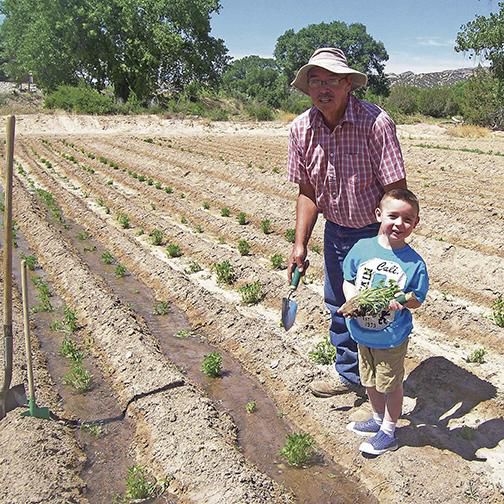
The land in Rio Arriba County is laced with history. Campos works a half-acre plot outside of Ojo Caliente, like his father and grandfather before him.
“My grandfather, Leandro, cultivated the half-acre in front of the house during the late 1800s and early 1900s,” Campos said. “Sometime during the early 1900s my father, Augustine, moved the plot immediately south of the previous plot to the current half acre.”
Campos acknowledges his family wasn’t the first to farm chile there.
“The current location may have been used by Native Americans at some time in the past as pottery sherds and a few arrowheads are encountered from time to time,” Campos said. “Oral history recounts that cooperative chile ristra tying filled the 16 by 16 foot dispensa (storage larder) with double ristras and they hung from ceiling to near the floor the length being nearly 10 feet.”
The success and dependency on chile isn’t lost on Campos.
“It goes back to its historical aspect,” Campos said. “What we call ‘local’ chile has been around through generations and centuries. It’s adjusted to the environment and has done really well for farmers.”
To locals, there is a notable difference between Hatch and Chimayó chile.
“Our traditions here in northern New Mexico are to some extent different from the south,” Andy Maestas said. “Farming done here is pretty small-time compared to those in the Hatch area. Those here are still pretty traditional. Everyone still tries to have a good product in the fall and have something to show for it.”
It’s this dedication that gives farmers the ability to grow and harvest a crop with a strong identity.
“For the longest time it was original seed that was grown here. What’s known as Chimayó chile was pure from this region,” Campos said. “Unless you have some of the Chimayó chile, it won’t have the unique Chimayó taste.”
Family tradition
Eufelia Martinez continues her family’s methods of growing chile, keeping to the local seed that has been used on her farm from the start. Her five acre piece of land on the edge of Chimayó has remained a part of the Martinez family for at least five generations, or roughly 125 years, Martinez said.
“All of the families in the area claimed pieces (and were) passed on through the families. They had to register it as their land, then would be charged taxes on it,” Martinez said. “The entire family lived off of what they grew. My parents had 14 kids helping out and we were all raised to live off the land.”
From the time they could walk, Martinez youth have been introduced to farming, following their elders out to the fields.
Since they grew up on a farm, the next generations learned as they went. They picked up and taught the tricks of planting and harvesting in order to have a successful year, Martinez said.
Deep family tradition is what keeps the chile plant growing strong.
“I’m old enough to remember when the plowing and a lot of the work was done with horses. I’m lucky enough to remember that really well,” Maestas said.
He bought his current piece of farming land in Abiquiú around 30 years ago and quickly began planting, he said.
“My neighbor Louie Martinez and I got going on planting. When his father passed away, we were cleaning out his belongings and found this seed we’re using that can be traced from the Santa Clara Pueblo. We started growing it and it’s been doing really well up in Abiquiú. This certain variety seems to grow real well here,” Maestas said. “It’s something I’ve been doing all my life. As a kid growing up in Chamita my parents and grandparents farmed so I grew up around it.”
Coming back
Maestas went on to marry “a farm girl from Hatch” and spend a good deal of time in Southern New Mexico following his college graduation. When he and his wife made the move back to Northern New Mexico they had a blend of northern New Mexico seed and successful southern growing traditions.
Campos’s return to the valley also occurred after his graduation. When he and his wife came back to the Española area to start building their careers, they “took the easy way out and bought chile from southern New Mexico to put away,” Campos said. “There then came a time where we looked back on what we enjoyed growing up and decided to go back to the unbeatable Chimayó chile taste.”
Campos has been growing chile for nearly 15 years after his parents passed on a few family secrets.
“My parents grew it while I was growing up and that’s when I was exposed to it,” Campos said. “I ate the local variety and got accustomed to it. I needed to get back to that.”
When Campos’s parents couldn’t continue growing chile on their own, they passed it on to their son, fulfilling a life-long goal of his.
“I always wanted to get back here and have a lifestyle where I can still farm,” he said. “Being able to live my dream, to always come back home and live like this, we like to keep things as simple as possible.”
It’s a lot of work
The art of chile growing is all about timing and knowing when to put a plant or seed in the ground.
“If seedlings are planted too early they’ll freeze. If they’re planted too late they won’t mature and successfully ripen,” Genevieve Gonzales said. “The chile plants must be planted far apart. When you plant, you need no more than three in a close area. If you have a bunch in the same little area they will never successfully mature and produce good chile pods.”
The chile seeds used today lead back to the same ones Martinez’s great-great-grandparents used when they were planting and growing, Gonzales said. “The seeds used have a strong lineage that goes back several generations and are saved from the best plants.”
The chile peppers are green until they fully ripen and turn red.
“You can tell they’re ready to be picked when the pod is firm to the touch,” Maestas said.
Hotter climates are also thought to be a contributing factor in how hot a chile pod is, Campos said.
“Climate, for one, is extremely important. I think the climate in the (Española) Valley and in small communities makes an impact on the taste,” Campos said. “The length of the growing season and climate we have here are what make it so good.”
Growing chile peppers is a lot of work, Maestas said.
“It’s very time consuming between the cleaning, picking and selling,” he said. “It’s a lot more work than any other vegetable to grow. Everything about it is difficult, if you’re going to grow it, process it and roast it.”
South versus north
There is a distinctive difference between southern and northern New Mexico chile.
“Velarde and Española are warmer than regions at higher elevations, but not as warm as southern New Mexico,” Campos said. “If we try to grow southern New Mexico chile here it may not do because their season is longer. The plants have to adjust and adapt to local conditions, whatever they may be.”
And with the decreasing amount of chile being cultivated and produced in more recent years due to weather, there is an increased reliance and interest in local chile.
“It’s a good crop for people to invest in instead of depending on Southern New Mexico and what they grow,” Campos said. “I don’t think it will ever be cultivated at a commercial level because there is a lot of work involved, (but) if the price becomes reasonable, we may see higher production. But the bottom line is still that it is a very labor-intensive crop.”
Farmers continue to cultivate the Chimayó type of chile because that’s what people want to eat, Campos said. “There are other qualities (and you) end up remembering that’s what you want when you have the time to grow it. And looking into cultivation, it’s really pure in terms of characteristics.”
Campos agreed that it was also a lot of work.
“It’s one of the most labor intensive crops to grow. Its seems like you’re working on some aspect of it full-time,” Campos said. “Depending on how big an area you’re planting, you’re spending four to six hours each day taking care of the plants. It’s just labor intensive but well worth the effort, otherwise we wouldn’t do it!”
Keeping it like that
It’s this dedication that has made the chile plant sustainable.
“I consider it to be one of the most drought tolerant plants,” Campos said. “As I looked at the water predictions for the coming seasons, I start to encourage people to grow it.”
The plant doesn’t need to be treated with pesticides and isn’t threatened by common garden insects or plants.
But with hybridization, genetics and the introduction of new or mixed seed to the area, the traditional, well known taste of local chile is threatened.
“When New Mexico State University started experimenting, there was the creation of hybrid chiles that still continues with DNA modification and resistance to drought and weeds,” Campos said. “I think that the genetics should be preserved, if at all possible. Most of the farmers tend to do that. They’re pretty happy with what they have and want to keep it like that. What we grow is unmatched.”
Toward the end of the chile season, stringing ristras has been a popular family tradition, serving its decorative purpose.
“A big part of New Mexico decoration is having a ristra out for display,” Campos said. “Some people have also gone to making it a spice or condiment to add to jellies and other foods for an added flavor (and) to make it something unique.”
Today, it’s all about having the luxury to successfully grow and care for chile. Farmers have to be comfortable and reach a point where growers can spend the necessary time tending to the farm or garden to grow high-quality, flavorful chile.