County Once Was Logging Leader in the State

Published:

Under the muddy waters of El Vado Lake lies the remnants of a largely forgotten period of Rio Arriba County’s history. In the late-19th century, a thriving timber industry made the valley, which the lake now covers, a hub of activity and a major rail center for the shipping of lumber from the countless sawmills that dotted the area.

The Cumbres and Toltec Railroad, then operated by the Denver and Rio Grande Railroad, shipped timber from El Vado to destinations all over the west. Oldtimers say the city of Denver was built with timber from Northern New Mexico. A substantial town called El Vado (the crossing) sprang up in the early 20th century around the sawmills, box factory, kilns, a roundhouse and machine shop for working on the locomotives. 

The Cumbres and Toltec, which runs between Chama and Antonito, Colo., now carries tourists instead of timber. When it was constructed in 1880, a promotional booklet for the Denver and Rio Grande “Health, Wealth and Pleasure in Colorado and New Mexico,” spoke eloquently of the forests of timber and the fortunes that could be made from them. According to the Office of the State Historian, ponderosa pines 150 feet high and four feet in diameter covered the mesas and hills around El Vado.

Those forests are just memories now. By the mid 1920s, the supply of timber was dwindling and the timber operations were moved from El Vado. The population plummeted to less than 100, or about 10 percent of what it had been. By 1935, when El Vado Dam was completed and El Vado Lake flooded the valley where the town had been, it was largely deserted.

- Advertisement -
- Advertisements -


Chili Line

El Vado is not the only remnant of Rio Arriba’s once thriving timber industry that supported a network of rail lines to haul out the timber. In addition to the Cumbres and Toltec, a line went south from Antonito through the town of Tres Piedras to Española. It was dubbed the “Chili Line.” Spur lines off of it went to La Madera and Vallecitos.

Sawmills were established in Tres Piedras and smaller mills dotted the area, all fueled by the forests of timber throughout Rio Arriba. West of Chama, a rail line went through the appropriately named town of Lumberton. The barren terrain that now surrounds Lumberton  barely hints at the rich stands of timber that surrounded it.

- Advertisement -
- Advertisements -

Along the route a small mining community at Monero provided coal for the railroad. Monero now is essentially a ghost town, while a drive through Lumberton gives a glimpse of the faded fronts of what once were thriving businesses. The rail line continued to Dulce to exploit the rich stands of timber on the Jicarilla Apache Reservation.

The timber industry and the railroads exploited the burgeoning forests that covered much of the Tierra Amarilla Land Grant, most of which was then controlled by Thomas B. Catron. Catron, a Santa Fe attorney and land grant baron, had gained control of the Grant through a judge’s ruling in 1883 that gave him “full and complete and absolute title” to the Grant.

Tierra Amarilla and other grants throughout the state had been granted by the king of Spain and had been recognized by the Treaty of Guadalupe Hidalgo. The lands were originally granted to individuals and also contained large tracts of communal land used for grazing  and wood harvesting by members of the community.

However, the United States Congress ruled that shares of the Grant could be bought and sold. Catron purchased most of those shares and consolidated his holdings. To this day, residents of the communities located within the Grant have sought to regain their communal lands, but so far have been unsuccessful.

- Advertisement -
- Advertisements -

The timber industry and the railroad complemented each other. The timber was used to lay the miles of track and build the bridges and trestles, as well as the housing for the workers and buildings for the lumber operations. What seemed like an endless supply of lumber proved limited. As the easily harvested timber was cut, the boom in railroads and the timber industry was at its height in the first two decades of the 20th century in Rio Arriba. By the 1930’s rail lines were being torn up and sawmills shut down. 


Post World War II

At the end of World War II, the timber industry started heating up again, fueled by sales of timber on the national forests. The national forests of New Mexico started providing the majority of the timber harvest in the state. The amount of timber being produced in the state peaked in 1968 at just under 300 million board feet. In 1986, Rio Arriba was the top timber producing county in the state, producing 69 million of the 168 million board feet cut in the state.

About three quarters of Rio Arriba’s harvest was from National Forest lands. There were big sawmills in Española and Chama handled millions of board feet. Duke City Lumber had a sawmill in Española that employed as many as 240 people.

“There were seven big sawmills in this area and a lot of smaller ones,” Bill Moore of W. H. Moore Lumber in Española said. “My dad said “There’s enough timber here you could work for the rest of your life.””

Moore came to the state in 1983. In 1989, 136 million of the 210 million board feet produced in the state came from National Forests.  During that time it was possible for small companies in the rural areas of Rio Arriba to make a living cutting timber on Carson and Santa Fe National Forests in Rio Arriba.

“A man with a chain saw and a pickup could make a living cutting logs for these mills,” Moore said. 

Don Cordova, 79, of Cordova Logging Inc. in Gallina, started cutting timber with his uncle when he was 15 years old.  He’s one of the loggers who started on his own and was able to expand his business in the 1970’s when there was still substantial logging going on in Rio Arriba.

“We used a cross cut saw and skidded the logs out with horses,” Cordova said. “In 1967 I started my own business and in 1974 I bought three cutting machines and two skidders. At that time business was good and there were sawmills all over the place. At one time, I had up to 32 men working for me.”

Roy Kuykendall, 75, is a fourth generation logger whose family runs the only sawmill left in Tres Piedras. His great-grandfather purchased the first timber sale on Carson National Forest in the early 20th century.

“I remember when the ranger would mark you timber that was for sale, you’d pay for it and go to work the next day,” he said.   

After 1989, timber harvests in the state started to decline and the timber sales on the national forest began to slowly shrink. They were still cutting about 150 million board feet of timber in 1994, but the percentage from national forests and Rio Arriba was dropping.

The bottom fell out of the national forests timber sales in 1995, when a lawsuit filed by environmental groups led by the Forest Guardians of Santa Fe, halted timber sales throughout the southwest on national forest lands. The timber harvest in the state plummeted on national forest land to just 20 million board feet of 60 million board feet harvested.

The lawsuit was eventually lifted, but the trend had been set. Timber sales for large diameter, old-growth trees dried up. By 2002, the percentage from forest lands had dropped to 14 percent.  By 2007, Rio Arriba, which had traditionally been one of the top three timber producing counties in the state, produced just 4.4 percent of the state’s timber harvest. Timber production fell from 17.9 million to 1.7 million board feet.

“In 2003 is when it really went bad,” Cordova said. 


Logging today

The majority of timber now harvested in the state comes from private and tribal lands. There are just two big sawmills left operating. Both are at Mescalero in Southern New Mexico in Otero County, which accounted for 47.4 percent of the total harvest with 47.4 million board feet. Their timber comes from the Mescalero Apache Reservation.

The timber that keeps Moore Cash Lumber in business comes from the Jicarilla Apache Reservation at Dulce, with a smaller portion from Santa Clara Pueblo. The timber harvest on tribal lands is managed by the tribe and the Bureau of Indian Affairs.

“They have to follow all the regulations the National Forest (Service) does,” Moore said. “They harvest trees on a sustainable level.” 

On the Jicarilla, they are cutting the big trees that at Moore’s yard can be cut into timbers and are peeled for vigas. It has enabled Moore to give employment to men whose jobs were lost at other mills around the state.

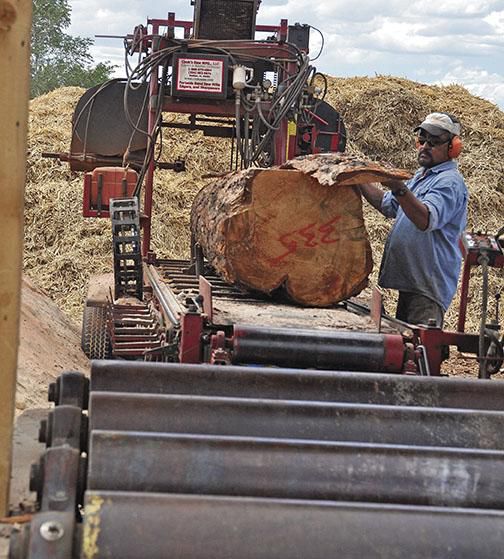
Cutting timbers from the big ponderosa pine logs at Moore’s yard in Española is Carlos Sandoval, 50, of Grants. Sandoval knows how to operate the saw that slices off the bark and outer layers of the logs until the finished product is a square beam. He has worked at mills that shut down in Utah and Albuquerque. People with his skills are diminishing as more mills shut down. Sandoval  started as a teenager and returns to Grants on the weekend.

“I have to go where the work is,” he said. “I’ve been here about a year.”

The lack of sawmills in the state makes it hard to find workers. 

“Nobody’s getting the experience,” Moore said. 

Moore also has a machine that peels the logs for vigas. Moore is up early and still delivers lumber himself in one of several trucks the company owns. A lot of the material Moore handles goes for construction in the oil fields. The company wholesales vigas, sells firewood and the byproducts of the mill.

”We don’t waste nothing,” he said. 

Nearby on top of a hill, the Duke City sawmill stands. For years it provided jobs to Española. It packed up and left in the 1990s, as the supply of large logs dwindled. It was taken over by Rio Grande Forest Products, which tried to keep going, but eventually shut down for good in 2003. Española lost 152 jobs when that mill shut down, according to then Mayor Richard Lucero.

“We lost a  lot of jobs,” Moore said. “Another thing, 25 percent of the gross receipts from timber went to the schools. That’s not happening anymore.”


La Manga

The  lawsuit in 1995 stopped a timber sale in the La Manga in the Vallecitos Federal Sustainable Yield Unit of Carson National Forest. The Unit, created in 1948, was supposed to be managed to provide jobs for local residents. It was supposed to provide jobs for a sustainable timber industry. A sawmill at Vallecitos provided jobs for the local community.

Small companies like La Compania Ocho headed by local activist Antonio “Ike” DeVargas fought the lawsuit. Despite the lawsuit being overturned, companies like La Compania, which would have provided jobs for locals, went bankrupt. 

“We beat them (the environmentalists)” DeVargas said. “But by the time we finished doing it we were broke. We didn’t have the resources to stay in business. Their weapon is money.”

According to DeVargas, the Forest Service has never lived up to the legislation that created the Vallecitos Unit. He feels they have caved in to the environmentalists.

“You need a steady supply of lumber if you’re going to supply your customers,” he said. “You can’t have 100,000 board feet and then say you don’t have any. The environmentalists can sue and stop everything on a technical point.”

The sawmill in Vallecitos sits unused, its equipment rusting and the windows of a mobile home on the property broken out. The business that once thrived in the town of Vallecitos are closed and their buildings falling down The cutting of the big trees that could have provided those jobs has dwindled. 

The big trees that fueled the large and small sawmills that once dotted Rio Arriba County are still not being cut on Santa Fe and Carson National Forests. Local loggers and lumbermen say that it’s not just a coincidence that since the cutting of big trees was all but stopped and national forest timber sales declined that the forest have been subject to large and destructive wildfires in the last 15 years. 

“They’ve burned more timber in two weeks than we could have cut in 30 years,” Moore said. 

One of the effects of logging that environmentalists mention in their lawsuits is siltation of streams.

“Have you seen the siltation of streams that happens after a forest  fire,” DeVargas said. “When you see the amount of fuel and dead trees in the forest, they’re going to burn. To me, they’re being stupid. The forests get destroyed for generations and the local people have nothing.”


Retooling logging

All is not bad news in the forests of Rio Arriba County and on the Vallecitos Unit. In Tres Piedras, the Kuykendall’s have retooled their mill, installing a Scragg mill to handle the small diameter timber that is now being cut during forest thinning projects that now leave the big trees standing but remove the smaller trees. The cutting of these smaller trees is part of a program initiated in 2000 by legislation created by then Senator Jeff Bingaman (D-NM) named Community Forest Restoration Program (CFRP) that authorizes $5 million in annual grants for projects that partner with other entities, including the Forest Guardians and other environmental groups . Since 2001 Program projects have created over 700 jobs in New Mexico. 

“The CFRP has really helped us,” Roy Kuykendall said.

Kuykendall and Sons Sawmill is currently finishing up the Maquinita Ecosystem Health Project in the Tres Piedras Ranger District of Carson National Forest under a $360,000 Program grant. Kuykendall and Sons have previously worked on the Tres Piedras Wildland Urban Interface Restoration and Interface Project under another $360,000 grant. In these projects, Kuykendall has also partnered with Mesa Vista High school and the Mesa Vista Future Farmers  of America, the local cattlemens association and Alfonso Chacon, among others.

Alfonso Chacon of Chacon and Sons in Ojo Caliente received a $360,000 grant in 2012 for the Healthy Forest Healthy Communities in Vallecitos project. Chacon has been involved in the Ensenada Forest Health Restoration, which  received a grant for $360,000 in 2008 and an earlier grant, also for $360,000 in 2005.

Program projects are also being implemented by the TC Company of Terry Conley, whose family opened and operated a small limber mill in Arroyo Seco, south of Española, now owned by Jason Gentry. TC Company received a $360,000 grant for the Crossing Boundaries with Small Tree Utilization Project in the Jemez Mountains that lists among its partners the Santa Clara and Jemez Pueblo Forestry Departments. 

Collaborative efforts are what the forests need. All the entities need to work together.

“Forests know no boundaries,” State Timber Management Officer Andrew Frederick said. “Restoring our forests to a healthy state is going to take everyone working together.”

Related articles

- Advertisements -

Recent articles

- Advertisements -