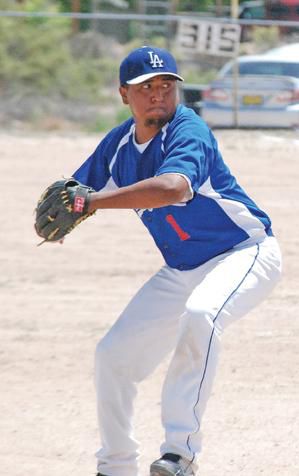
The hops of groundballs on the ungroomed dirt infields are often untrue, the heat can be blistering and no one on the field outside the umpires is getting paid, yet Indian baseball at Ohkay Owingeh and at other New Mexico pueblos and reservations remains an active link to the past and rite of passage for pueblo youngsters.
On a recent July Sunday afternoon, the Ohkay Owingeh Dodgers defeated the Tesuque Rangers 25-6 in Game Two of a three-game, single-day series between the Eight Northern Pueblo rivals. The Dodgers are coached by Eric Phillips.
Many of the fans watch the games from their vehicles to avoid the unrelenting sunshine, which can play tricks with fielders on pop-ups and fly balls in the cloudless skies.
Two young ladies sat in the back of a sport utility vehicle at the ballbark’s entrance off State Road 68 in Ohkay Owingeh, collecting $1 parking admission fees and passing out smiles.
Past popularity
John Abeyta, who played baseball for Ohkay Owingeh from age 15 to 56 said pueblo baseball was a major pastime for tribal members before the digital age.
“Back in the day, there wasn’t too much going on,” Abeyta said. “Some people had cars, some didn’t. It was just an opportunity for tribal members to see the different teams without having to spend money or anything. Now, the casino has taken over that because everyone is at the casino.”
Abeyta said San Juan players, now Ohkay Owingeh players after the pueblo changed its formal name, have had considerable pride wearing the uniforms representing their pueblo. He said pueblo youngsters that played Little League baseball were split up on various teams and looked forward to one day playing together and representing their pueblo.
“Ohkay Owingeh has always had great baseball teams,” Abeyta said. “It’s been a tradition that’s been around since we were all growing up. As a young kid, you looked forward to playing baseball for the pueblo. That was better than anything, better than playing high school or anything. It was a main focus. It was like the main goal.”
Abeyta, 57, said one of his best memories is playing baseball for the pueblo against other pueblos, and playing against other San Juan teams.
“There was a lot of pride back then in coming out in first place and Ohkay Owingeh being No. 1,” Abeyta said. “That was really big for us, and even for the community. The community really supported the kids and there were a lot of people watching the games. The field was completely surrounded. The whole place was full. There wasn’t a parking space left. The elders, the seniors, it was really a family thing. There was lots of yelling. It was really like something everyone was proud of. It’s not as popular as it was before.”
Baseball has existed in Indian communities since the late 1800s when the game was in its infancy and many professional fields lacked outfield walls.
Ohkay Owingeh was no different.
Legendary San Juan flame-throwing pitcher Abraham “Abie” Cruz, a.k.a. Shu Pin, was once reportedly thrown out at third after belting a pitch into the neighboring cemetery in the mid-1940s.
In the 1950s, the San Juan Eagles baseball team joined the All-Indian Baseball League. Longtime state Representative Nick Salazar and his brother Richard Salazar are the only living members of the original Eagles team.
The soft-spoken Nick Salazar later coached Ohkay Owingeh.
“He’s one of those subtle coaches that can get his point across without having to scream,” Abeyta said of New Mexico’s longest-serving sitting lawmaker. “It’s just been a great experience to be able to play against different competition.”
Two teams
Herman Agoyo and Father Joel Byrn, who taught at Santa Fe Indian School, formed a new team, the San Juan Hawks, and the tribal members began competing against each other, brother against brother, cousin versus cousin.
Agoyo said he was drafted onto the San Juan Eagles in 1948 or 1949 while sitting in the stands watching a game as a young teenager. He said he was given a team T-shirt and asked to take the mound.
“I was pulled out of the crowd as an eighth-grader,” Agoyo recalled. “The catcher told me, ‘Just hit the target.’ I always remembered that throughout my baseball career, hit the target. I never had a losing season. I always pitched, and I played shortstop toward the end of my career.”
Agoyo went on to pitch at Manhattan College in New York after high school. The right-hander who switch hit later pitched in the 1960s for a U.S. Army team at Fort Sam Houston in San Antonio, Texas and played semi-pro baseball for the Santa Fe Falstaffers. Agoyo, who also coached the Hawks for nearly two decades, was inducted into the American Indian Athletic Hall of Fame in March 2013.
Agoyo, 77, said the popularity of baseball on the pueblos, and at Santa Fe Indian School, helped prepare him and other pueblo youngsters to compete.
“It was the main sport in elementary school,” he said. “We were dominating over other pueblos at Santa Fe Indian School because of our early knowledge in baseball.”
Agoyo’s wife, Rachele Agoyo, who grew up on the Cochiti pueblo, said as a teenager there was nothing quite as exciting as attending pueblo games.
“That was probably the best socialization we had on the pueblos,” she said. “It was so amazing. We managed to go to all the games, even the away games. You were safe. You were being taken care of by everybody. As a teenager, that was the life, to go to all the baseball games. You knew all the players’ names.”
Rachele Agoyo said the games were well-attended and sometimes rowdy.
“The women, the older women, were just excited as the younger ones,” she said. “I remember as a teenager it would shock me how the older women, like my mother’s age or older, were very emotional and very passionate about their team. It just played into our pueblo life. It was just woven into the pueblo.”
Bats and Hawks
In 1957, Joe Ramos returned from the U.S. Navy and started a new team, the San Juan Bats.
“The guys who were right out of high school didn’t have anywhere to play,” Ramos said. “We made up a team and right away we were good. I think we lost one game all season.”
Ramos said the Bats and another new pueblo team, the San Juan Hawks, became spirited rivals.
“The ladies and all that, they’ll be hollering and calling each other names,” Ramos said. “It was really bad. We really didn’t have fights, but hollering and all of that.”
Ramos said the Bats disbanded a few years ago, and the players dispersed to other Ohkay Owingeh teams, including the Angels.
Ohkay Owingeh currently has four teams; the Angels, Destroyers, Dodgers and Eagles.
Ramos said the Angels are the premiere team on the pueblo. The Angels lost to San Ildefonso about a month ago, ending an undefeated streak of more than a decade, Ramos said.
“The Angels are the best,” Ramos said. “We’ve been together for quite a while, just like when I had the San Juan Bats. I got them right out of high school and we had a good team.”
The Angels are managed by Ramos’s sons, Nathan and Jason Abeyta.
Ramos, 75, a former outfielder, first baseman and coach, said when he sometimes doesn’t feel up to attending pueblo games, his sons encourage him to come out to the games and keep the father-son nature of pueblo baseball alive.
“I can’t stay away from it,” Ramos said. “I’ve been involved since 1957. Even right now, I help my two sons keep score and everything. I cant give it up.”
None of Ohkay Owingeh’s players have made it to the professional ranks, but Ramos said perhaps there’s a Little Leaguer on the pueblo now who will one day make it to the Big Leagues.
“That’s a dream. We’ve been pretty close, but then I don’t know what happens, the booze and everything else,” Ramos said. “It will happen, because you see little guys now that are really into it. We have some good players. Even now, the Little Leaguers from Ohkay Owingeh almost made it to (the Little League World Series).”
Every year, the best players from pueblo teams in northern and southern New Mexico square off for the Native American All-Star Baseball Game, now played at Isotopes Park in Albuquerque, whose rock-less, weedless, well-groomed level field provides a stark contrast to the dirt fields on which most pueblo baseball teams play.
The south beat the north in this year’s game played July 4 in front of another sizable crowd.
Teams from San Ildefonso, Santa Clara and Tesuque make up the other seven Northern Pueblo League teams, in addition to Ohkay Owingeh’s four teams.
The teams are wrapping up their regular season games, played every Saturday and Sunday, and players and coaches are looking forward to the “Big Tournament” playoffs to be played Labor Day weekend.
Ramos said the tournament’s location hadn’t yet been determined, although it may be played at Ohkay Owingeh.
“Four teams from here will meet the four best teams from the south,” Ramos said.
While New Mexico’s 19 independent pueblos have been around for hundreds of years, and pueblo baseball has been a tribal pastime for less than a century, former and current players and coaches will say, and fans in attendance will attest, baseball has become woven into the fabric of their culture.