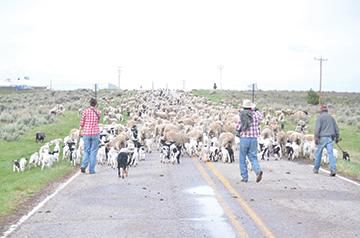
A cold Sunday morning in May is no time for rest for the Shepherd’s Lamb crew at the Manzanares ranch in the San Juan Mountains.
With ewes toward the tail end of lambing, or giving birth and caring for their new-born lambs, dawn until dusk is dedicated to caring for their sheep.
“Antonio (Manzanares) likes to say we make all of our money in a month,” Molly Manzanares said about her husband. “We just concentrate on making sure we save as many lambs as we can. It’s really intense.”
Young sheep, which are referred to as lambs, live amongst the herd under the care of their mother.
A 20-day stretch in May requires a team effort to care for sheep and herd them between pastures at the nearly-200 acre ranch, which runs alongside the Rio Chama, between the communities of La Puente and Los Ojos, on State Road 340.
As one of only two herded sheep flocks in New Mexico, outside of the Navajo nation, the Manzanares’ sheep, which supply their Shepherd’s Lamb company, are the focus of the family, as well the ranch foreman and sheep herder.
“A lot of people don’t realize what goes in to it,” Antonio said. “How much work you put into producing that product, it’s tough.”
Herding
Molly, 57, is no stranger to a farm flock.
The Northern New Mexico native, who grew up in a ranching family, helped herd the sheep across the ranch and across State Road 112, on horseback, in the morning hours of May 15.
Hundreds of sheep, whose combined, nonstop bleating breaks the silence of the calm morning, invade the lonely highway, bringing sparse traffic to a halt as they slowly make their way to their next home, a large green pasture behind Escalante High School.
Sitting atop her quarter horse, ahead of the pack, a flock of sheep in varying sizes follows Molly’s lead.
“You need the horse to control the point,” she said. “Help the sheep, guide the sheep where to go.”
Far behind the flock, and in charge of keeping sheep moving forward and wrangling strays, is a team of dogs and helpers, among them Antonio, Molly’s sister Toni Broaddus, ranch hand Javier Zammaron and Lara Manzanares, one of the Manzanares’ four children.
With the use of sticks, lassos and a bottle filled with rocks to make noise, the sheep follow the direction of the herders and are occasionally tapped or picked up by a herder, if the dogs don’t keep the sheep in line, themselves.
“The borders (Border Collies), they have the eye,” Molly said. “The sheep see them and they’re looking right at them. They can control them with just the way they look. And they crouch. And they’ll hold up a sheep for you.”
Broaddus is among the herders on foot who help corral the few stray sheep and keep the herd moving in one direction.
“When they can’t find their moms, they run and herd that way,” Broaddus said of the babies. “There’s not much you can do about it. They’re fast and high endurance.”
Broaddus, who used to herd sheep on Saturdays and after school, after her father suffered a collapsed lung, later joined her sister on horseback to herd a smaller group of sheep in the afternoon.
A few sheep stray from the flock and end up behind fences or in adjacent fields, causing herders to return to collect them later, once they’ve gone too far into an adjacent pasture.
From the youngest lambs to the occasional adult ram, the herd of mostly Rambouillet and Navajo Churro sheep, slowly but surely make their way across the highway and into the pasture, where herder Domingo Cortez, from Mexico, takes over, giving the Manzanareses a brief break.
On June 5, the sheep will be taken into the Carson National Forest, near the Canjilon lakes, where Cortez will spend three to four months caring for the herd in the mountains.
“It takes a special breed of person to stay up in the mountains with his sheep all by himself,” Antonio said. “With his horses and that’s it. You don’t find those kinds of people.”
After a break no longer than an hour, the group of herders heads back down to the ranch, where more sheep require herding and tending.
History
Antonio, 64, is from the small town of La Puente, which sits a few miles down the road from their ranch. He and Molly moved there in 1988.
He graduated from El Rito Normal School in 1969 and grew up with plans of going to medical school and earning a degree in psychology from the University of New Mexico.
“I fell in love, ran out of money, I was trying to farm, help my dad with his place here,” Antonio said.
He first met Molly when he coached her as a basketball player at Escalante High School, marrying her years later, after she attended both the University of New Mexico and New Mexico State University.
When Antonio and Molly got married 33 years ago, he had a small farm flock, including two cattle.
He also had about 90 sheep, but the Manzanareses first turned their attention to the cattle.
“We were not good cow people,” Antonio said. “My cows would die from anything. They’re supposed to be lower maintenance than sheep. For me, I just didn’t have good luck with cattle.”
After getting rid of their remaining cattle, the couple turned their attention to Antonio’s flock of sheep.
Molly, who grew up with cattle, wasn’t always excited to work with sheep.
“At first I didn’t really like the sheep all that much,” she said. “It took me a while to get used to them. Over time, I have become very fond of them. They do give a lot.”
Her words echo a saying which Antonio described, ‘La Borrega es muy agradecida,’ meaning, “The sheep is very generous.”
The Manzanareses said they learned a lot in their more than 30 years of working with lambs — some of them hard lessons.
In one of the first years of herding, 45 of just over 100 lambs were lost to coyotes, one of the sheep’s many natural predators.
“It was a really hard year,” Antonio said. “The sheep have a lot of enemies, that’s the problem.”
Antonio and Molly used to do all the sheep maintenance themselves — including shearing.
Schedule
Shearing is only one step in the long process of caring for the flock.
Between herding sheep to pastures before their summer stay in the mountains, the Manzanareses, along with Zammaron, help rekindle connections between sheep who have either abandoned their lambs, or taken others.
Pairings of lambs who were separated from their mothers, and sheep, who either lost their lambs or discarded them, are placed into confined spaces on the ranch, where they’ll soon, hopefully, form a bond again.
The flock will be transported to their summer pasture where Cortez will take over, but work on the ranch doesn’t stop there for the Manzanareses.
“Once the sheep are moved up, then we go to other things,” Antonio said. “To irrigating, to fixing fences, we still have to tend to the sheep and the sheep herder.”
The Manzanareses visit Cortez once a week to check on him and provide groceries and supplies.
In approximately four months’ time, the flock will be herded back to the ranch in another two- to three-day process.
“In the fall, the lambs are big and they know how to travel and they’re easy to bring down,” Molly said.
Once back at the ranch, the lambs will be prepared for market, grazing near the ranch before being put out on winter pastures and breeding in December.
Toward the end of April, the Manzanareses hire a crew of five from the San Luis Valley to shear the sheep.
“They can shear these sheep in about three days,” Molly said. “They’re amazing.”
Meat
Live lambs are sold in the fall, but the Manzanareses sell lamb meat year round.
At one point, the family sold lamb to Angelina’s restaurant in Española, before their flock couldn’t support the restaurant.
“It took me a year to convince him to sell lamb there,” Antonio said about Fidel Gutierrez, the owner of Angelina’s. “He started and man, we couldn’t keep up with it.”
A photo of Antonio on horseback still hangs in the dining area of the restaurant.
Now, the Manzanares’ lamb meat is sold at two restaurants in Santa Fe — Fire & Hops Gastropub and Atrisco Café & Bar, as well as The Love Apple in Taos. Atrisco Café buys Shepherd’s Lamb seasonally.
The certified organic Rambouillet from Shepherd’s Lamb has gotten rave reviews from customers across the country.
“We have a lot of customers that say that’s the best lamb they’ve ever eaten,” Molly said.
Shepherd’s Lamb experimented with selling the meat through their website, but shipping costs, combined with the travel to get meat shipped out of Española, made it difficult.
The Manzanares family used to consume up to 10 lambs a year, when their four children were growing up.
Now, when their children, spread across the country, come home for a visit, they request a specific dish from a choice of lamb meat.
“They always ask for ribs, costillas,” Antonio said, noting he used to stockpile them when he couldn’t get rid of them.
Tierra Wools
The meat is a popular byproduct of the lambs, but wool is the Manzanares’ focus.
Tierra Wools, a community effort as part of the Ganados del Valle nonprofit organization, became the responsibility of the Manzanareses in July 1983.
Featuring items on consignment, produced by the community, Tierra Wools is the home for the bulk of Shepherd’s Lamb wool and meat.
“We don’t sell anything on the commercial markets anymore,” Antonio said. “We used to sell all our wool, we’d take it to Roswell and put it on sale and they’d sell it.”
Once a sheep’s wool is sheared in late April, it’s washed at a mill in Mora.
From there, the washed product is sent to Massachusetts, where a small cottage industry network will process the wool into blankets, the Manzanares’ biggest project yet.
“That’s a big project for us now that we’ve sunk everything we had in that project,” Antonio said.
Shepherd’s Lamb had a lot of Rambouillet wool, certified organic, which would be purchased on an irregular basis.
“We decided we would jump in and process it ourselves,” Antonio said. “It’s been two years now in a small way, now we went big.”
The Manzanareses created two batches of wool blankets, which sold out, prompting them to create a third, large batch, which is currently close to sale.
In their most recent shipment of wool to be processed, Shepherd’s Lamb sent 13,000 pounds of wool to Massachusetts, half of the original 26,000 pounds sent to be washed. The wool loses half of its weight once washed.
Unique in their own right, the Rambouillet and Navajo Churro wool is divided for use in different textures.
“The Rambouillet is a fine wool, which is common here in the west in sheep,” Molly said. “The Churro is a long staple fiber — it’s not very crimpy.”
Rambouillet wool, which is thinner, between 20 to 22 microns thick, is fluffy and soft, prompting its use in a lot of blankets.
Churro wool, a coarser product, is thicker, between 40 and 50 microns, and is often used for hand-woven items.
“It’s lustrous, it’s hand woven and shiny,” Molly said. “I like the churro a lot. It just depends what you’re going to make.”
Evolving plan
In 2014, Molly was appointed as State Executive Director of the United States Department of Agriculture Farm Service Agency in New Mexico, which causes her to split time between the ranch and Albuquerque.
“There’s only four Obama appointees in the state and she’s one of them,” Antonio said about Molly’s appointment by President Barack Obama’s administration. “She won’t ever say that, but she’s a presidential appointment.”
After Molly was appointed, Antonio thought about the future of the ranch, noting his age, and their four childrens’ plans for their own futures.
Their oldest son, Agustin, 33, has been in the Army for eight years and lives in Virginia. Their daughter Raquel, 29, is an attorney in Massachusetts and their youngest, Luisa, 29, is a veterinarian in Colorado.
Lara, 32, who helps her parents herd sheep, is an artist and designer who designed the logo for Shepherd’s Lamb, featured on blankets; and for Tierra Wools, featured on billboards in northern Rio Arriba County.
Broaddus, who moved back to Northern New Mexico from Magdalena, five years ago, joined the Manzanareses after being raised with cattle and sheep, along with Molly.
“I am so happy to be home,” Broaddus, a member of the last Chama High School graduating class in 1966, said. “I love being in this country with the family and the whole thing.”
The family, along with Ronnie Garcia of El Rito, are the last sheep herders in the state. Rio Arriba, in years past, was home to thousands of sheep.
“My dad told me there used to be a race to the rail head in Chama in the fall, to ship lambs out,” Antonio said. “All the bands came from everywhere with their lambs to get shipped out of Chama on the train, going to Denver or Chicago.”
Molly and Antonio cited numerous reasons for the decline of sheep herding in New Mexico — among them changing land tenures, grazing acts, government regulation, labor and predation.
Antonio said men in the community also shifted away from agriculture after World War II, when they came back and took jobs outside of their community or simply explored new opportunities.
“Agriculture is not such a mainstay in this country as it was,” he said. “It used to be big, not anymore.”
Lifestyle
The Manzanareses, having worked with sheep for more than 30 years, are feeling the fatigue of the heavy responsibilities.
“We used to trail every year, but we’re getting tired,” Molly said about moving the sheep up and down the mountain. “We hauled them (sheep) the year before last year, I think we’re going to haul them this year.”
The difficult process of trailing sheep up and down the mountains has been just one of many challenges Shepherd’s Lamb has endured in recent years.
Four recent years of drought in New Mexico hurt production and prices, although the Northern New Mexico climate has helped.
“In this area, we’ve been able to manage,” Molly said. “We tend to get summer showers more. We did go through some drought also. We cut back on our herd size a little bit and we got through it.”
Antonio and Molly have been able to enjoy the benefits of their business, despite never truly having time for a formal vacation.
“We’ve been across the ocean, all over the country,” Antonio said. “But it’s always business-related, to a meeting, something.”
The Manzanareses attended a Slow Food Conference in Italy, and Antonio has also traveled to Spain with community members from Northern New Mexico.
Being the last of their kind in the region, the couple reflected on the lifestyle they’ve experienced since moving to their ranch in 1988.
“It’s dying out,” Molly said. “We’ve been talking about how it’s hard work. The sheep are more labor-intensive than other livestock.”
Before heading back to the ranch to tend to more sheep, Antonio noted the benefits of the work they’ve done.
“It’s a nice lifestyle, it’s provided us with a good lifestyle,” he said. “This is the hardest time of the year.”