An animal, native to the Himalaya mountains in Asia, is finding a home in Northern New Mexico.
Robert and Lisa Ferrell, owners of the Wolf Creek Ranch north of Chama, on State Road 17, have introduced yaks not only to the region, but local kitchens, as well.
“We’re very happy that it’s working out, it’s nice diversity,” Robert, 55, an East coast native, said. “It’s a little novel, so it’s exciting for us to be learning something new.”
The Ferrells introduced yak to the menu of the High Country Restaurant in Chama with the help of their ranch manager, and have enjoyed having a productive operation with the yaks — and with their cattle.
“We’re lucky that it’s been profitable,” Robert said. “Not wildly, but profitable enough.”
Already a unique livestock choice for the region, the Ferrells’ introduction to yaks is even more uncommon.
The yak graze at Wolf Creek during the summer, where they feed on grass, drink from the creek and co-exist with cattle in the high elevation and cooler weather.
“The ranch has been in our family for five generations, going on six generations,” Lisa said. “This is 3,000 (acres), the farm is 700 (acres).”
Ranch manager Dave Burdette, along with a few other day laborers, help the Ferrells move the yaks between the Wolf Creek Ranch and La Barranca Ranch, located off Highway 84, between Tierra Amarilla and Chama, during the winter and summer months.
The Ferrells also own La Barranca Ranch.
Calm livestock
Growing no larger than cattle, the dark, horned, thick-wooled yaks are quiet, gentle livestock which act more like familiar, domesticated animals.
“Yaks are more curious,” Burdette said. “They’ll come up to you more like a dog and figure out what you’re doing.”
With no natural predators or diseases threatening their livelihood, their worst enemy, so far, lies in their own breeding bull, five-year-old Poseidon.
The bull, picked up from a rancher in Western Colorado who didn’t want to keep him, hasn’t really proved to be a handful for the Ferrells, except for one incident.
At their home in Durango, Colo., Poseidon once tried to injure a yak calf.
“It must not have been his baby,” Lisa, 42, a Santa Fe native, said. “We saw him flipping the baby up in the air. That was a little nerve-wracking. My husband had to rescue the baby.”
The yak mingle with the cattle with no problem at Wolf Creek Ranch, but don’t interact with any other animals.
“The dogs will try to herd them occasionally,” Lisa said about the family’s three older Border Collies, Cloe, Natasha and Napoleon.
The yaks, which live off the expansive pasture at Wolf Creek, aren’t startled by vehicles or humans and can withstand the occasional nudge or push by ranch hands transporting them.
A handful of Colorado ranches manage yak, as well as a ranch by El Vado Lake, which has less than 15 yaks, but Lisa noted how it was interesting that the animal hadn’t been picked up more often in the high elevation region.
“You can run three yak to one cattle in a pasture,” Burdette said, noting their small appetites.
Finding a home
Approximately four years ago, Lisa found a yak for sale online and the Ferrells decided to purchase it.
“When we came across yaks, it was kind of fitting with our idea of looking for a little diversity and an animal that is naturally fit to the climate up there,” Robert said.
The yak, which came from Saguache, Colo., initially drew surprised reactions among friends and family.
“Everyone pretty much smiles and laughs, ‘Aren’t they from the Himalayas?’” Lisa said. “It’s a funny reaction.”
The 3,000-acre Wolf Creek Ranch, a lush valley which follows the path of Wolf Creek on the east end and the State Road and the Cumbres and Toltec Scenic Railroad on the west end, was the ideal home for a yak.
“When we move them to the high ranch, they really like it up there, it’s a lot cooler,” Burdette said.
Burdette said he had only seen yaks on television before working with them first-hand, with the Ferrells.
Sharing the land with cattle, the ranch also allows fishing, where fisherman can catch rainbow and brown trout, along with Rio Grande species.
Across the creek, lies a major passageway for elk in the Northern New Mexico region.
Sometimes appearing in the hundreds at the ranch, Wolf Creek allows elk hunts.
“Robert does (hunt), he’s a guide,” Lisa said. “I hunt my elk in the refrigerator.”
Lean eating
Along with elk, the Ferrells eat a steady diet of grass fed beef and yak, which go to the butcher when they’re two years old.
“If you like McDonald’s burgers, you’re probably not going to like this,” Lisa said about the yak meat. “Because it’s so lean, it doesn’t have that marble taste.”
Robert didn’t say the yak meat was unique, but rather, similar to grass fed beef.
“It has really good flavor, unlike industrial meat that has that fat that appeals to us,” he said. “It doesn’t have that depth of flavor to me anymore.”
Customers regularly purchase yak tenderloin and ribeye steak, as well as sirloin, all butchered at Mel’s Custom Meat Processing in Romeo, Colo., north of Antonito.
The High Country Restaurant and Riff Raff Brewing Company in Pagosa Springs, Colo., are also customers of the Ferrells’ yak. Both feature yak hamburgers, which are only served for dinner at the High Country Restaurant.
Taking his family and crew out to lunch at the High Country Restaurant, June 9, after a day of transporting yaks between ranches, Robert ordered yak burgers for the table.
Savoring the flavor of a medium-rare yak burger, he admitted it wasn’t his favorite cut of meat.
“The most luxurious is probably the ribeye for me,” Robert said. “That is the most luxurious cut.”
Prices for yak cuts will vary, but are similar to prices for bison meat, although yak is usually cheaper than elk meat, Robert said.
Each yak yields 250 to 300 pounds of meat, and the Ferrells will sell one to two full yaks’ worth of meat per month, including to the restaurants, private customers and sometimes a wholesaler near the Denver area.
Hard work
The lunch break was the only break for the Ferrells, their daughter Gabriela, 8, Burdette, and two helpers for the day, in moving and tagging two loads of yaks between ranches.
Joseph Martinez, a student at Escalante High School who lives on the property adjacent to the La Barranca Ranch, and Matthew Garcia, a friend of Burdette, donned gloves and sticks to help push the yaks between corrals and into the back of a trailer at La Barranca Ranch in the overcast morning hours.
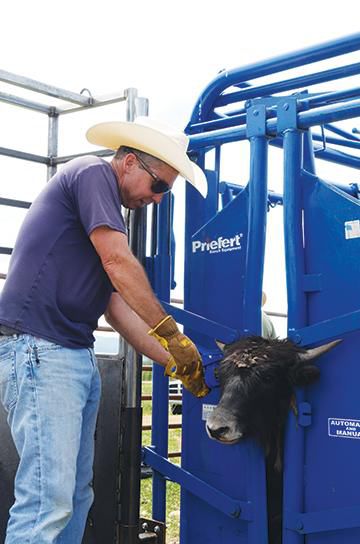
With the help of his family, Ferrell grabbed a clipboard and wrote down the tag numbers of each yak, moving them into a cattle cage and locking them in for tagging.
After Ferrell tagged each yak’s ear, Gabriela grabbed a bottle of parasiticide and applied drips to the yak’s back, before stepping away, as the yak was released from the cage.
Martinez, at the other end of the corral, standing behind a swinging gate, lured the yaks into an enclosure with the help of Garcia and Burdette motioning to the yaks with their arms.
Although docile, Burdette cautioned about the dangers of the yaks and their horns.
“You just have to be gentle with them,” he said. “You can’t push them like a cow because they’ll go through a fence really quick.”
Burdette and Garcia laughed about an incident in the morning, in which they had to run toward a fence, as a yak was released from the cage, in fear of the horns when the yak potentially charged at them.
Although Burdette’s never seen a yak push through a fence, he’s seen the animals display their strength.
After Ferrell backed up his pickup truck and trailer to the enclosure fence, the crew attempted to direct 15 yaks into the trailer for transportation to the ranch.
Despite shoves of sticks and cries of “C’mon yaks” from the crew, the yaks were largely uncooperative in stepping into the back of the trailer, easily distracted by bystanders watching from outside the fences.
After a brief struggle to move the last yak’s leg away from the trailer door, a morning of work was complete.
A return to the ranch in the afternoon was highlighted by the birth of a calf, which struggled to stand on its own, as it was surrounded by its mother and other yaks, in a small enclosure.
The excitement surrounding the birth of a new yak quickly dampened as the crew labored in a heavy wind and rainstorm to move a second load of yaks into the trailer, with more yak hesitant to step into the trailer.
“It’s a pretty hard way to make a living,” Robert said. “Lisa and I both had professional careers before we got back to this.”
Lisa is an attorney by training, and Robert is an astrophysicist who worked in Boston for 10 years, before moving to Santa Fe 14 years ago, after graduating from the University of California, Santa Barbara in 1989, with a doctorate. He graduated in 1984, with a bachelor’s degree from Cornell University.
Family and future
Both Lisa and Robert come from ranching backgrounds. Lisa’s family owned the Wolf Creek Ranch, while Robert’s family had experience with ranching, including his great grandfather, who had water buffalo.
Robert attributes their separate ranching heritages for the motivation to work with the yaks.
“It’s pretty fitting with the heritage to always be progressive and open-minded to things that might work,” he said. “We both know traditional ranching families were very adaptive in trying different things.”
Lisa hopes that the family will be able to maintain their livestock on the ranch and leave something for Gabriela and their son, Thomas, 11.
“That’s our goal, to pass it on to our kids, to make sure that we give them something well taken care of,” she said.
Robert said both Gabriela and Thomas enjoy spending time at the ranch and caring for the animals, but he won’t push them to become ranchers.
“It’s really more about getting them good character and exposed to different things,” Robert said. “I think one of the most important things that we want them to learn is that hard work yields good results.”
Situated in the middle of cattle country, the Wolf Creek Ranch is one of the few ranches in the region that still raises animals.
“A lot of the property has been bought off and it’s just trophy ranches for people, which is great,” Robert said. “We like that we’re still using it as a real ranch and the kids get to experience the actual raising of animals and production. We like to eat meat, and meat comes from somewhere.”
The ranch manager
Ferrell found Burdette, who’s become an integral part of the yak operation, through another ranch manager, four-and-a-half years ago.
“We kind of needed help and Dave was looking for a place to manage,” Robert said. “Dave’s awesome, he’s what makes the whole thing possible.”
Burdette, a native of West Virgina, made his way to Chama 11 years ago, after living on the West coast.
“We lived in California and we were looking to get away from the rat race, and we found Chama,” he said.
Burdette and his family help keep track of the livestock for the Ferrells, and recruited Martinez and Garcia to help on the ranch this summer.
Burdette was also responsible for convincing the owners of the Riff Raff Brewing Company and the High Country Restaurant to pick up the yak burgers — the Ferrells’ most popular cut of yak.
“He’s got great common sense, he’s just a good guy,” Robert said.
Burdette has enjoyed working with Ferrell, and embraced the challenge of managing the yaks.
“They’re a lot of fun,” he said. “Especially when you see the people eating the meat and they come up to you and say, ‘Wow, that’s delicious.’”
No plans for expansion
The Ferrells have only sold a few yaks over the past few years, all to one woman, in what Robert said was an unusual request.
“That’s not only rare, that’s the only time,” Robert said. “We’ll consider anything if someone contacts us, but that’s not what we’re trying to do.”
Yak wool, bones and skulls have not gained traction among paying customers in the region, although the Ferrells will sell it if it’s requested.
The meat, sold by a company called El Barranco Meats, only sells locally, and the family is fine with their business reach.
“I think right now, we feel pretty good about the size of the operation, how it fits into the rest of the staff,” he said.
Robert was considerate of Burdette’s free time away from the ranch when speaking about his hesitancy to expand the ranch’s livestock.
Lisa said the family is so new to yak, that they’re unsure what they’ll be doing with their livestock in 10 years’ time.
However, both Lisa and Robert take a certain amount of pride in raising a unique animal in a region where trophy ranches outnumber operational ranches.
“The United States doesn’t eat yak, it’s still considered a unique type of delicacy,” she said. “You don’t just go to the stores or restaurants and find yak, even though you should, because it sure tastes good.”
The size of the Ferrells’ yak operation has enabled the family to experience the process of raising meat, butchering and selling the product to customers, as well as working with various members of the community.
“It’s nice we were able to get into this, not just in the commodity cattle business,” Robert said. “We’ve met some really good people through it and have been able to provide a good product for people. That just feels good.”