Richard Coltharp
El Rito Media
“She wears a necktie and a Panama hat.”
– Bob Dylan, Black Diamond Bay,” 1976
For more than half a century, in a modest little shop a couple of blocks off the Plaza in Santa Fe, Milton Johnson has been writing a story.
He’s not writing it on a computer or even a 1940s Royal typewriter – although that would be closer to his style. Johnson’s story, with a cast of a thousand characters, is written on the heads of his customers, and all the subplots they’ve created.
Johnson makes hats.
The smallish sign hanging in front of his shop on McKenzie Street reads “Panama Hats” on one side and “Sombreros Panama” on the other.
These Panama hats, however, may not be what you think of when you think of Panama hats.
For example, did you think a Panama hat could sell for $25,000?
Check out more videos of Milton Johnson’s process at Montecristi Hat Works.
Who would pay $25,000 for a Panama hat? Or any other kind of hat, for that matter?
“We use some of the finest materials in the world,” said Johnson, 81, who opened Montecristi Custom Hat Works in 1974. “And we have some of the finest craftsmen in the world.”
The hats are beautiful, works of art. But still. $25,000?
“They’re for those people who like the best, and they can afford it,” Johnson said.
But if you can’t or won’t buy a $25,000 hat, Johnson can deliver a more affordable version – and still custom-made to fit your head precisely.

The beginning?
It’s difficult to determine where Johnson’s Montecristi hat story began.
Maybe it started when he was a tiny Texan.
He can’t remember the first hat he had. But there’s a black-and-white family photo taken at Beva’s, an old restaurant in his hometown, Fort Worth, Texas, that shows Milton at age 3 or 4, holding a toy truck and wearing a cowboy hat.
Or maybe the story began when he returned home from the Vietnam War and finished his political science degree at the University of Texas in Austin.
After graduation, Johnson found himself selling textiles and traveling through South America – Colombia, Peru, Panama, Bolivia, Ecuador.
“When I traveled from Austin, and moved to Medellin, Colombia, for five months, it was a real eye-opener,” he said, recalling that the 1960s were turning into the 1970s and there was little or no tourism in Colombia.
A trip to Ecuador and a visit to the town of Montecristi flipped a switch.
He was in his early 20s, Johnson said, and wandered into a Montecristi shop where he came upon a hat unlike any he’d ever seen, or felt – soft, solid and beautiful. The fabric, he discovered, was woven from an Ecuadorian palm called paja toquilla.
That tidbit of information, by the way, unveils another discovery: Panama hat is a misnomer. Panama just happened to be the Central American nation where a lot of tourists bought quality hats made in Ecuador – or cheaper knockoffs.
If Johnson’s hat story didn’t begin in childhood or his post-college days, perhaps it started in 1974 at an unfamiliar campground outside of Santa Fe.
He was traveling in an old pickup with his young wife, Katrina, and their 3-month-old daughter Echo. After a long day’s drive from Austin, with a vague plan to relocate to the Four Corners, they stopped at the campground to spend the night. But when they left the truck, just briefly, they returned to find their goods stolen. Frantic, they rushed into town to replenish and encountered a couple of shop owners who not only helped them stock up but also suggested a place to stay.
Johnson never left.
The now
Maybe it’s less important to know how or when Milton Johnson’s Montecristi hat saga began than to know what it has become.
Last December, a week before Christmas, Johnson was working with customers in the lobby at Montecristi Custom Hat Works. One customer, a Santa Fe resident who had known Johnson for a quarter-century, was shopping for his 15th or 16th Montecristi hat. He loves the hats, and his respect and fondness for Johnson is obvious.
“Milton’s one of the local characters of Santa Fe,” the customer said, only to be interrupted by another customer, this one a first-timer from out of town.
Duane Kent of Castle Rock, Colorado, helps lead weeklong mule rides. He’d heard of the Montecristi hat store – and Johnson – and made the trip to Santa Fe to size up the goods. And to get sized up himself.
He tried on a sample hat.
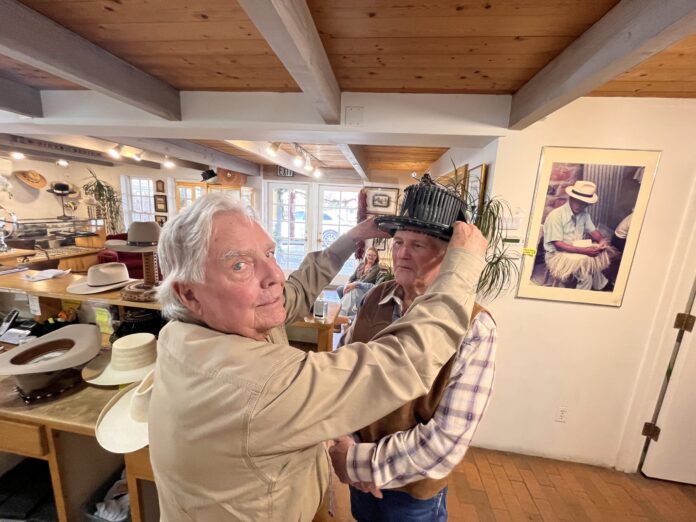
“You make these hats look really good, Duane,” Johnson said, before swapping the sample for a black-and-silver, wood-and-metal contraption that resembles, well, nothing you’ve ever seen.
The device is around a century old, from France, works like an adjustable antique bicycle helmet and precisely sizes a person’s head. From the measurements, Johnson makes three marks on a blank 5-by-7 index card that becomes a sort-of cranial thumbprint for the customer.
Kent wanted to know if hats can be repaired if damaged by weather or other culprits.
“We can usually work the little things out,” Johnson said. “But if your mule sits on it or something, that’s different.”
Montecristi also offers felt hats, for a different feel or a winter cover. The best felt hats come from beaver, and that has complicated Johnson’s supply chain due to world events.
“We’ve seen a 65-percent increase in beaver prices,” Johnson said. “The best beaver comes from Ukraine and Russia. With the war going on, we’re now having to get it from Canada.”

The middle
One day in the late 1980s, Johnson was working in the shop when a pair of familiar customers walked in. Not familiar as in family or friends, but familiar as in anyone who watched television had probably seen them many times.
One was film critic Gene Siskel, famous for his verbal sparring with fellow critic Roger Ebert.
The other was Oprah Winfrey. No description needed.
“We were still on Galisteo Street, and in walked Oprah, with Gene Siskel, the movie review guy,” Johnson said. “We started with some non-custom hats, and Oprah decided she’d rather have a custom. So, I measured her head and it was 25 inches. I said, ‘My goodness, Oprah, your head is the biggest measurement I’ve ever done on a woman.’”
To which Siskel quipped, “Geez, Milton, what do you say when you WANT to sell somebody a hat?”
Oprah was good-natured enough to invite Johnson to a housewarming party for one of her talk show’s producers, the reason Chicago-based TV stars Siskel and Winfrey were in Santa Fe. Johnson responded by bringing a friend, singer-songwriter Roger Miller, to perform at the party. The Grammy-winning Country Music Hall of Famer lived near Tesuque at the time.
Johnson has created hats for actors, musicians, politicians and other celebrities, but doesn’t normally name-drop.
“We don’t like to throw out the names, any more than they want us to throw their names out,” Johnson said.
He almost always uses the pronoun ‘we’ to describe his operation because, he said, the business would not work without the staff at both Montecristi and his other store, Santa Fe Hat Company, which sells non-custom hats off the shelf.
On the December day that mule-rider Duane Kent visited Montecristi, a crew consisting of Eddye Santos, Noé Lopez, Juan Morales and Synde Partin were keeping things humming at the hat works.
But it takes months for a worker to get the hang of things, Johnson said, and two years or more before a new employee can be called a craftsman.
And you won’t get your hat overnight.
“We still do it the way I learned 50-something years ago,” Johnson said. “We thought about getting mechanized. With a hydraulic press, you can do 30 hats an hour. But we’re not all about volume. We’re about making the best product with the best quality materials and service for the life of the hat. “We use some of the finest materials in the world. And we have some of the finest craftsmen in the world.”

The end?
On a visit to The Shed, a longtime Santa Fe institution known for its red enchiladas and chilled margaritas, Johnson’s arrival feels like a joyous reunion. He can barely make his way to a table as old friends and customers stop him to bid hello.
Montecristi customer Sam Priest is at The Shed celebrating his honeymoon. He bought a Johnson-made hat for his wedding because Johnson made a hat for Sam’s dad, Duncan Priest of New Zealand. Such are now common occurrences for Montecristi: customers from all over the world; customers bridging two, three and four generations of families who’ve bought Johnson’s hats.
In these moments, it seems as though Johnson could go on forever. Make great hats, take care of loyal customers, eat great enchiladas and enjoy his status as a community treasure.
And maybe he will.
“Some people work 30-40 years to retire, they get a gold-plated watch, and then they drop dead the next day,” Johnson said. “My fingers don’t work so good anymore and the hat steamer fogs up my glasses, but I can still teach these guys how to do the detail work.”