A Place to Call Home

Published:

It happens to be, whether by accident or humanity’s gross negligence, that more people exist on this planet than there are quality homes for everybody to live in. The Española Valley is no exception.

    Rotting floors, broken plumbing, missing bathroom doors, exposed wires spilling from electrical sockets, a neighborhood filled with drug use and violence — these are all factors which have driven residents to seek something better for themselves and their families. The only problem is an upgrade — a better apartment, remodeling or purchasing a home — costs money.

    If Northern New Mexicans are fortunate, though, their search for an improved living situation will land them in the arms of the Española branch of Habitat for Humanity.

    Patricio Pacheco was so fortunate. More than two years ago he and his family began looking for a better place to live. Their apartment at the time was expensive and unsuitable for Pacheco, who uses a wheelchair for mobility following a 60-foot fall he took in his youth. The family considered renting or purchasing a home but found it hard to obtain a mortgage, and many of the existing residences in the area weren’t handicap-accessible.

    “We tried to look at houses first, but none seemed to fit our budget,” Pacheco said.

    Then, they decided to apply for a home with Habitat and were selected for the new home program, giving them an opportunity to own their own home.

    “We felt very blessed, excited and happy we were chosen,” Pacheco said.

    Today, the residence off of State Road 30 where Pacheco lives with his father, mother, god-father and dog Gizmo, stands completed. It’s edged by an expansive garden of vegetables the family plans to sell at the Española Farmers Market, a shed, a lawn of green grass and a carport shielding a vehicle and a set of chairs from the elements.

    Inside the home, the cabinets and sinks are low so Pacheco can access them more easily and the doorways are wide for easier maneuvering between rooms via wheelchair. Even the shower is roll-in for his convenience. It has all the characteristics of a custom-built home,

    “It’s really hard to find a good home,” Pacheco said. “It’s great to have a program like Habitat for Humanity in the Valley.”

    Pacheco, who will mark the eight-year anniversary of his fateful fall this June, believes “custom” is far different than confinement.

    “I’m not confined — that’s definitely the wrong word,” Pacheco said.

An element of good fortune exists in the Pacheco family’s situation. Other home-seekers who apply for a home with Habitat are still left out in the cold.

    After working for 23 years in the construction industry helping to build homes for other people, Jose Morales decided it was time for him and his family to own one of their own. Morales is an epileptic, and so is one of his three daughters. Morales said they began exploring the purchase of a new home with his partner to improve their living situation, and he was prepared to move out of the place he was renting from his mother in-law. He said his neighbors use drugs and he was hesitant to simply transplant the family into a low-income housing complex, which he thought would not improve the situation.

    “My kids do really well in school,” Morales said. “I just wanted something better for them. I don’t want to go live in the projects.”

    However, this time it wasn’t meant to be. After standing at the Habitat office Monday, waiting for a chance to speak with Habitat Director Yvonne Maestas about the denial of his application to participate in the new home program, he left feeling a bit dejected but resolute.

    “I’m not going to give up,” he said. “I’ll keep applying.”

    During a recent round of submissions for assisted home ownership, the organization received 14 applications and it has received as many as 20 before, Maestas said. The problem is only one home gets built per round. Maestas said although the numbers of applicants are unrepresentative of the total number of people actually wanting an affordable home — with many, she speculated, not applying because of an expectation of denial — it makes for a difficult selection process.

    “Sometimes we narrow it down to four qualified applicants,” Maestas said. “And then we can only choose one.”

    Since 1994, the Española branch of Habitat has successfully placed eight families in new homes, she said. The group is in the process of completing a Habitat for Humanity subdivision near the Pacheco residence, with the first house in that lot expected to be completed before year’s end. And with Maestas’ goal of building one house per year, in eight more years the subdivision should be complete, providing needed homes to a slew of families.

    But not anyone who needs a home is qualified for one through the organization. In fact, need is only one of the three major criteria which go into the equation, Maestas said. An applicant must also be willing to help build the home they want to live in, contributing between 300 and 500 hours of “sweat equity,” and an applicant must be able to afford the home. Although the 30-year mortgage for the house and property comes with no interest, monthly payments are between $400 and $600. Maestas said the average cost for a modest home still amounts to around $150,000.

Habitat has branched out beyond just building new homes. Many flock to the location on Riverside Drive in Española to purchase home carpentry, hardware and plumbing supplies at the Habitat Re-Store, which relies on donations from local contractors, businesses and individuals. These donated goods are sold to raise money for the home-building projects.

    Most recently a thrift store was added on the premises to sell second-hand clothing, furniture and electronics given to the organization. Recently, an entire house full of possessions was donated when a man moved out of his home in Los Alamos to go to Texas.

    Maestas said both the thrift store and hardware shop have helped create more stable funding for Habitat so it is not entirely at the mercy of government grants and large private gifts.

    “They make the difference for us financially,” she said. “Otherwise, we were dependent on grants or donations.”

    When Habitat first started in the Valley, its forte wasn’t new home construction at all. It specialized in home repairs until it could gather enough support to finance the larger undertaking of building an entire home. The program for home repairs, now called Building Kindness, still exists. And according to David Canfield, the program’s organizer, it’s busier than ever.

    He said the group of volunteers who assist with the home repairs gets together on Saturdays. He takes applications for projects ranging from painting, roof and structural repairs, installation of handicap-accessible ramps and railings, and others. To qualify, an applicant must fall below certain income thresholds, and own and reside in the home in need of repairs. The volunteer labor is provided by Habitat, while the homeowner generally covers the cost of materials for the project.

    At this point though, Maestas said the organization is in far greater need of willing volunteers, both skilled and unskilled, than more projects. She said although the group’s volunteer list is over 300 people long, when volunteer coordinator Pat Devries recently began calling the people in the database, the number who actually show up is more like 50.

    “We need volunteers to build more houses,” she said.

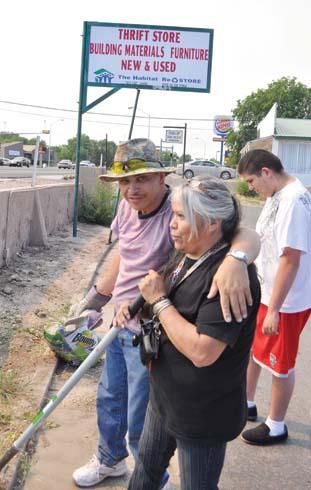
    Her call was in part answered by Flo Trujillo, who assists in bringing persons with special needs from Las Cumbres out to Habitat to help with various projects. Trujillo had two young men working Monday on the landscaping and digging up weeds in front of the Habitat office during the morning hours before it became too hot. She said they fix up odds and ends about once a week.

    “It’s a good program,” Trujillo said.

    Maestas said the relationship with Las Cumbres began years ago when a caseworker from Las Cumbres was out “pounding the pavement” trying to find something productive and meaningful for the people she worked with.

    Maestas promptly agreed, believing the new endeavor, like the thrift store and the hardware store, was just another extension of the Habitat for Humanity mission.

    “These are things we feel we should be doing,” she said. “The spirit really is people giving from their heart.”

Related articles

Recent articles