A nation without newspapers? Never happen. Although we are told regularly by television personalities and read it in news magazines with some regularity that newspapers in the near future will no longer be a part of your life. We suspect there is a certain taint of glee in these predictions as they come from sources that have little or no knowledge of the newspaper business or are simply competitors.
Admittedly these are tough times for everyone, not just newspapers, so while some newspapers might fold or merge, so will a lot of banks, auto dealerships, grocery stores and other marginal businesses. Even Starbucks is closing some outlets as people are figuring out that rather than pay $4 for a cup of coffee they can get one at a local café for $1.50 with refills.
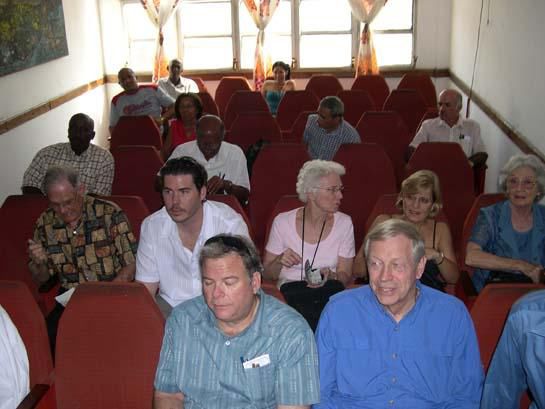
But the thought of a country without newspapers is a truly disturbing thought. I was fortunate recently to visit Fidel Castro’s Cuba with a group of American newspaper people and that was some revolution he stirred up. If ignorance is bliss it explains why Cubans are so happy. Well, perhaps “happy” isn’t the word but in the cities we visited they seem to accept their lot in life.
Sadly, they must be the most uninformed people in the western hemisphere because they have no newspapers and there is no freedom of press, despite Castro’s promise to allow just that as soon as the revolution was won. Of course the first thing to go was the newspapers so Cubans have no idea of what is going on in the world around them.
We found no newsstands because there are no real newspapers. No magazines, nothing that might give Cubans a hint of what life is like in other countries. In Santiago, a city of 200,000 people an 8-page tabloid publication is published once a week but it is little more than government propaganda.
There is a national newspaper called “Grama”, named for the boat Castro and his band of revolutionaries sailed in to cross from Mexico to Cuba and launch their eventually successful revolution. But again, it is nothing but propaganda. To print anything else would subject the newspaper to closure.
There are no billboards or signs advertising products or businesses, only pro-government information and promotion the continuing revolution.
One newspaper we attempted to visit declined, explaining that should it allow such a visit it “might get in trouble”. We assume “trouble” would come from the government.
The Santiago newspaper did allow us to visit and it proved interesting but I never figured out why it took all those people to publish and eight-page tabloid.
As I reflected on my impressions on Cuba and particularly the newspapers, I realized Fidel Castro early on learned the power of the press and used it. Once his revolutionary goals were realized, he started closing down newspapers that were critical of his changes and eventually he had a nation without newspapers. He had a nation of “blissfully ignorant” citizens who would lack the information necessary to challenge his government.
It seems to work for him. There were people everywhere. They seemed “content.” They were in the parks, playing chess or checkers, arguing baseball or just smoking and enjoying the sunshine. But no one was reading newspapers. No newspapers in the coffee shops or restaurants. No newspapers at the grocery stores.
Is that what the television commentators and some writers predict for the United States? What a bleak existence! The politicians would love it. Would readers of the Rio Grande SUN prefer not knowing when their tax dollars are misspent, embezzled, misappropriated or just “lost”? Or when someone in law enforcement crosses the line and is eventually charged with police brutality? Or when their community is finally going to get a new post office?
A book I read recently told in great detail the critical role the American newspapers, all of them weeklies, played in the American revolution in which not one person but a number of men stepped up and won our independence. Rather than establishing a dictatorship in the style of Castro, with the support of the newspapers they established a true democracy which, battered and ill-used, it survives today. It made me proud of my profession. No one can accurately predict the future but I predict we’ll always have newspapers; good ones and bad ones and some great ones. Rather than “blissfully ignorant,” I prefer to be “cranky and enlightened.”