Acequias, the Life Stream of Agriculture

Published:

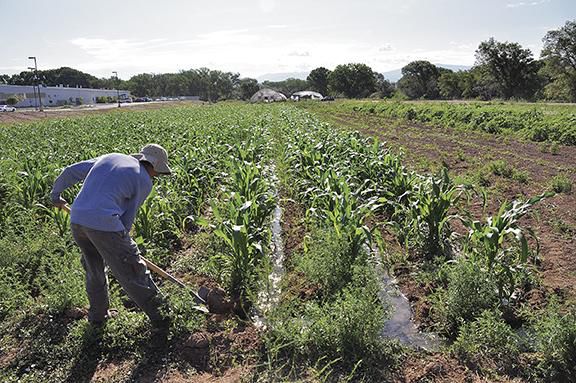
 Española organic farmer Don Bustos makes his living growing vegetables that he sells to local restaurants. Although Bustos has adopted modern growing techniques such as drip irrigation and hoop houses that have enabled him to grow his produce year-round, the foundation of his operation is a ditch that runs through the top of his property.

Known as an acequia, it delivers water from the Santa Cruz River, which is hundreds of yards from his farm.

This simple way of bringing the life-giving water to land has been providing Bustos and other farmers in the Española Valley and throughout Northern New Mexico with the way to make a living.

“We have been using the same acequia for hundreds of years,” Bustos said. “Before it wasn’t like it was a luxury, it was a necessity. It was used for everything, even drinking, cooking, watering livestock.”

- Advertisement -
- Advertisements -

The acequias of Northern New Mexico are over 400 years old.

Prior to 1701, there were already 18 acequias along the Santa Cruz River on the Santa Cruz Land Grant, which was established in 1695.

Rio Arriba County has 172 acequias, more than any other county in the state.

Although the acequia system was used throughout the area settled by the Spanish, it still exists only in New Mexico and southern Colorado. From Chama to Chamita, acequias have supported an agricultural, land-based culture that until just recently derived most of its living from the land.

- Advertisement -
- Advertisements -

Most residents point to the opening of Los Alamos National Laboratory in the 1950s as the time when the area’s economy started to change because jobs were available.

“Prior to that, people lived off the land,” writer and farmer Estevan Arellano of Embudo said. “The first generation after Los Alamos still took care of the land. The second generation, not as much. The third generation has a very limited connection to the land.”


How it began

- Advertisement -
- Advertisements -

When Don Juan de Oñate led the first expedition to settle what is now New Mexico, it didn’t take him long to realize the necessity of acequias. Arriving at the confluence of the Rio Chama and the Rio Grande north of Española, he established the first settlement, San Gabriel, on July 11, 1598. Just one month later, the first acequia was established in what is now Chamita, diverting water from the Rio Chama.

The word “acequia” has its origins in Yemen, according to Arellano, from the Arabic word “as-seqiya” meaning carrier of water. It is believed that it was the Moors who introduced the use of acequias to Spain during their occupation of Spain. Much of Spain is arid or semiarid, similar to the climate found in the Southwest.

Before the Spanish settlement of any new territory, it was required that the resources first be assessed.

“They were very specific,” Arellano said. “The first thing they had to do was make sure they had plenty of water. It had to be approved by the governor of the territory.”

When the Spanish arrived, the indigenous Native Americans of the already established pueblos had irrigation systems in place to grow crops. These were greatly expanded by the Spanish. 

This was before there were pumps and electricity to move water from one place to another. The acequia system relied on gravity to move water from the river to the adjacent lands, which required a level of skill to be able to read the landscape and determine where the water would flow. It also required some feats of engineering and construction.

Examples of this can be found throughout Northern New Mexico. Part of the acequia system that services Truchas is a stone channel carved from the base of a cliff. In nearby Las Trampas, a wooden flume transports water from one side of the Rio de las Trampas to the other. In nearby El Valle, the acequia runs above Forest Road 207, yet just a short distance away it is below the road and to all appearances appears to run uphill. It is a tribute to the skill of the early builders of these systems that they are still in operation hundreds of years later.


How it works

The basic layout of an acequia system begins with diversion on the river or stream that brings the water into the main acequia, called the acequia madre. Along the acequia madre, each landowner-user, or parciante, has a head gate that can be opened to allow the water to flow onto their property to irrigate crops, pastures and orchards. These small ditches are called sangrias, literally translated as “bloods.”

“It’s the same as moving the blood through the body,” Arellano said.

The water that is not diverted from the acequia madre is returned to the river via a ditch called a desague

Each parciante was responsible for maintaining their portion of the acequia, including the head gates.

Every year at an annual spring cleaning to clear debris and sediment from the acequia called a limpieza, the parciante was required to either participate or provide a peon to do the work. This requirement still exists to the present day in the bylaws of the acequia that serves the community of Sombrillo and other acequias throughout the state. 

Today, a parciante is assessed annual dues for the maintenance, repairs and improvements to the acequia. They are also assessed a fee by the irrigation district that their acequia belongs to. Thus, a parciante along the Sombrillo acequia pays a fee to the Sombrillo Ditch Commission and to the Santa Cruz Irrigation District.

How it’s run

Because of the importance of the acequias to each member of the communities, a democratic system of governing them was established in the 18th century and still exists as perhaps the oldest established democratic system in North America.

The governing board of each acequia is now considered a political subdivision of the state.

Every two years, the parciantes vote and elect a mayordomo whose job is to oversee the distribution of the water. Today, if a parciante wishes to use the water, he must inform the mayordomo of his intentions and it will be determined if and when the parciante can use it.

A mayordomo has the authority to close a head gate of a parciante who is using water that has been assigned to another parciante. He can also close and lock the head gate of a parciante who has failed to pay his dues.

The mayordomo’s duties include inspecting the acequia to keep it clear of obstructions and checking for leaks. He notes where the acequia may be in need of repair. To do this, he must be able to walk the ditch. The parciantes need to maintain a clear right of way along the acequia, allowing the mayordomo to walk along its length and provide access for maintenance. This can lead to confrontations with landowners who are not aware of this and that it is part of acequia law.

“Realtors and judges don’t understand acequia law,” Arellano said. “They think (the mayordomo) is trespassing and call the cops on the guy. Realtors should explain things to the buyer and judges need to take classes on acequia law.”

The laws governing acequias were among the first adopted by the Territorial Assembly in the 1850s after New Mexico became part of the United States. Under these laws, parciantes are not allowed to build within the easement. If a fence is put across the easement, a gate must be provided for the mayordomo to pass through.

According to Arellano, there were at one time two mayordomos, one to fulfill the duties described above and another to assure that each parciante was using their land for the benefit of the community.

“The second mayordomo made sure everyone planted something on their property,” Arellano said. “At that time, anyone who didn’t plant was a liability. They had three years to plant trees and prepare the land for agriculture. If they didn’t, they lost their rights.”

In addition to electing the mayordomo, each acequia association elects a board of three commissioners every two years consisting of a chairman, a secretary and a treasurer. The chairman directs the activities jointly with the other commissioners and presides over acequia association meetings. The secretary keeps records and meeting minutes and assists in the business of the commission. The treasurer sends bills for the collection of dues and penalties and maintains records of dues paid. Money collected from dues is to be used for the benefit of the acequia and cannot be spent without the consent of the chairman and the approval of the secretary and treasurer. The treasurer makes payments for labor and materials.


Whose water is it?

With the rapid development of New Mexico and the Southwest, the issue of water rights has come under scrutiny. Water needed for the development of industry and for the increased population in urban areas has placed water rights, their sale and their transfer in the spotlight. Since all the water in the state’s rivers and lakes is already allocated, this is an important issue for future development.

A water right is the right to use water from a specific source at a specific location for a specific use. There are two kinds of water rights. One involves acequia rights, which pertain to water taken from a particular ditch. A water right is the state’s rule as to how much water can be taken out of a stream. When a piece of land is sold, it is assumed that the water rights go with it unless specified by the seller that the water rights are separate from the property.

With multiple entities now claiming water rights, including municipalities, water may be flowing in a stream or river but it may not belong to the acequias.

The Rio Chama Acequia Association, for example, includes 28 acequias and has the oldest water rights in the state. However, upstream reservoirs on the Chama now store water that belongs to Albuquerque under the San Juan-Chama water project, as well as irrigation water for the Middle Rio Grande Conservancy District.

“We are entitled to the natural flow of the Chama,” chairman of the Association Fred Vigil said. “For a 24-hour period we don’t pull any water from the Chama. The flow is monitored by so many entities.”

Water rights may be sold by the owner and then transferred to another location, but that must be approved by the Office of the State Engineer. In addition, local acequia associations can rule against the transfer of water rights out of their district.

With water being such a valuable commodity, water rights have recently been offered at auction for $25,000 per acre foot (the amount of water to flood an acre with one foot of water).


How efficient is it?

Although the acequia system has sustained agriculture in New Mexico for hundreds of years, the value of water has led some to question the efficiency of the system. They say that too much water is lost to seepage, leaks and evaporation. Modern techniques such as drip irrigation are more efficient, delivering more water to specific areas and plants.

However, there are benefits to the acequia system and flood irrigation that are not limited to crop production.

“Flood irrigation recharges the aquifer and drip doesn’t,” Arellano said. 

The areas under flood irrigation by acequias also create a larger environment.

“It extends the riparian area farther beyond the river, “ Vigil said. “Not only that, what doesn’t seep into the ground and the aquifer is returned back to the river.”

Studies have proven that acequias and flood irrigation recharge the aquifer. Modern technologies do have benefit when combined with the acequia system. Bustos now runs water from the acequia into a holding pond. From there it is pumped to hoop houses and onto crops. Don Bustos, the organic farmer, now is able to grow crops year around.

“It’s more than just the aquifers,” he said. “It’s how the community manages it themselves and works together in different ways.”

The last two years have been very dry and it has challenged the acequias. The alternative of pumping the aquifer is not a viable option.

“In some areas (of the state), the water table has dropped 40 feet and now the water is so salty they have to treat it,” Bustos said. “Water is going to be huge and the acequias will be an important part of it.”

The recent trend of eating locally-produced fruits, vegetables and other agricultural products that do not have to be transported long distances burning fossil fuels also has renewed interest in the acequia system and its benefits. That has helped people to look at water differently in different ways beyond residential and industrial uses and return to its traditional and historical uses for agriculture.

“We’re going backward to go forward,” Bustos said. “After hundreds of years, the acequias are still functioning.”


Related articles

- Advertisements -

Recent articles

- Advertisements -