Embudo Valley Rocks

Published:

    It’s a Wednesday evening in Dixon, a small agricultural community that hugs the banks of the Embudo River in Rio Arriba County. In front of the building that was once Zeller’s General Store and now houses the Dixon Cooperative Market, Embudo Valley Community Center and KLDK-FM radio station, a crowd of local residents has gathered for the Dixon Farmers Market. Some are purchasing fresh greens and peas for dinners, while others simply sit in the shade of the building, sipping soft drinks and connecting with neighbors.

    “It’s actually the hub of the community,” Archie Tafoya, a volunteer disk jockey at the radio station, said.

    Next door to all this activity is a smaller building holding the Embudo Valley Library, where patrons young and old sit at one of the library’s four computers, doing everything from searching the Internet to playing video games. Patrons who have brought their own computers sit at a table working on their own projects. Nearby, a copier and a fax machine are available to patrons to use. Without the library, such services would require trips to Española or Taos.

    “This is the spot,” Amy Hoy, of nearby Pilar, said. “In Taos, you’re limited to 30 minutes with a 20-minute wait in line. You know everyone here and it’s a neighborhood gathering spot.”

- Advertisement -
- Advertisements -

    Not everyone in Dixon has a computer or Internet access, but the Library has provided a spot for young and old to accomplish tasks like studying for a paper, filing taxes, looking for a job or preparing a resumé. From July 2010 to May 2011, the library logged over 6,000 computer uses and 17,000 patron visits, and checked out over 12,000 items, including books and videos.

    “It’s great for the kids,” said Rinconada resident Louie Roybal, whose daughter Vanessa attends Peñasco High School. “It helps them out a lot doing homework and finding information. It’s great for the community.”

    The library is open to all who enter. Some, including tourists, are just seeking a place to go to the bathroom, as the library has the only public restroom for miles around. College students attending Celebrando Las Acequias, an event hosted by Embudo resident Estevan Arellano, recently used the library to work on their projects. The Celebrando recognizes the role acequias (irrigation ditches) play in growing food for the community. Dixon, Embudo and other surrounding communities were originally agricultural in nature centered around a stream or waterway. The Rio Embudo still irrigates the orchards, garlic fields and vegetable gardens of the local residents.

    “(The library) is a great community asset,” said Elena Arellano, Estevan’s wife who served as the librarian for eight years. “For a lot of new people, this is the first place they are stopping.”

- Advertisement -
- Advertisements -

    One of those new people was Katherine Hardy, who moved to a farm near Velarde and was at the library using her own computer.

    “Everyone is really welcoming,” she said. “They have a good selection of books.”

    Library Director Jay Mann arrived at Embudo in December and has taken over the duties of welcoming patrons to the library, but his duties also include looking for funding for the library’s projects, writing proposals for grants and giving directions to those looking for the bathroom while answering any number of questions from the patrons.

    “It has shown me how critical a library can be to a community,” Mann said. “My previous experience was at branch libraries in cities. Here, some one will call and ask, ‘Is my son there? Can you tell him to come home?’ I enjoy helping people. Those moments of connection when you’re able to do something for them they need done.”

- Advertisement -
- Advertisements -

Beginning, History and Future

    From humble beginnings in 1992, the library has grown from renting two rooms in what was the old Dixon post office to a nonprofit community organization that provides all of the above plus much more for the residents of the Embudo Valley.

    The library was founded by a group of volunteers in 1992 to fulfill the needs of the community. With donated books and volunteer librarians, it began paying $200 a month in rent to the owner, Tomas Atencio.

    “We had no idea if it was going to work,” Shel Neymark, one of the original Library and Community Center Board members and now Board president, said. “That first day, we checked out 50 books. When I saw two school kids leave carrying an armful of books, I thought, ‘This is going to work.’”

    Board member Connie Wood, a 40-year resident of Dixon, remembers the early efforts to find the money to keep the library going.

    “We got 12 businesses in town to each pay a month’s rent,” she said. “We’d hang a banner in front that said, ‘This month’s rent paid by (the name of the business).’”

    The library was able to attract grant money to keep operating and slowly grew. Dixon, however, was losing businesses. The only bar and the only store in town closed. Board members knew something had to be done.

    “We felt we needed something open to everybody,” Neymark said. “We outgrew our original building and were leasing space, but that space was no longer available. What were we going to do?”

    The Board discussed buying the old general store, called Zeller’s, along with the house the Zeller family had lived in and about 1.5 acres of land with it. The price tag was $250,000 and seemed out of reach. An anonymous donor pledged $200,000, but only if the community could raise the other $50,000.

    “In three weeks, we raised the $50,000,” Neymark said. “People who couldn’t afford to buy their groceries were pledging $500. That’s how excited everybody was.”

    In May 2002, the library moved into its new location. The Zellers’ former home became the library’s new home. Along with the move came a great deal of work needed to turn the former residence into a library, complete with computers, a copier and a fax machine. Shelves needed to be made to accommodate the growing collection of 14.000 books.

    “People came together to work on the facilities — woodworkers, electricians,” Neymark said. “The amount of volunteerism was unbelievable.”

    In addition to moving the library facilities into the old Zeller home, the old store now housed the station facilities for KLDK-FM radio, founded by Clark Case under a Federal Communications Commission grant. The low-frequency FM station broadcasts a community bulletin board daily and also lets school children from the area broadcast their own radio show. The station is owned by the library and has an all-volunteer staff that includes Tafoya and Case.

    The land behind the library is now a park with a small orchard. The library recently revived the Fiesta de Santa Rosa, which features a queen and a parade through town, and holds Fiesta events in the park.

    In addition, part of the old store now serves as a community center hosting events that can be anything from an acequia meeting to a resident wanting to show pictures of a recent trip to neighbors. Local author Stan Crawford held a book signing there.

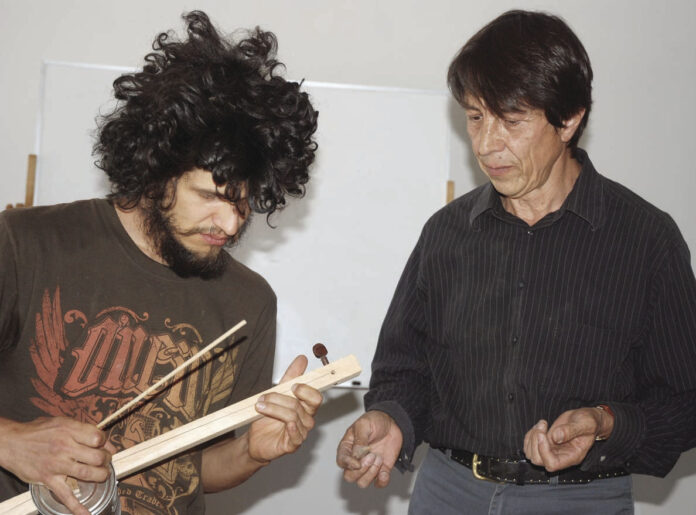
    It is also the site of a summer program for kids. This year’s program includes a trip to the Santa Fe Opera and an after-school tutoring program. Local musician Carlos Vivanco demonstrated June 16 how to make a simple musical instrument. Vivanco is at home in New York City, but finds something at the library and community center that keeps him in the Embudo Valley.

    “The reason is the sense of community,” he said.

    David Peters, of Velarde, who made an instrument with Vivanco’s help, acknowledged the special atmosphere.

    “I see a lot less community in a lot bigger places,’ he said.

    The center also hosts a family literacy program called Ahora that introduces preschoolers to reading and simple crafts, as well as an after-school tutoring and homework program.

    When it moved to its present location, the library leased space in front of the old store for a farmers market that is now held every Wednesday and is managed by Board member Dan Pollock. It gives local farmers an outlet for their fruits and vegetables.

    The success of the market and the lack of a local grocery store led to the creation six years ago of the Dixon Cooperative Market, which now occupies another portion of Zeller’s former store and pays rent to the library. With 250 members and growing, the Co-op store offers a wide variety of groceries but focuses on the needs of the community and on products produced by local farmers.

    “We want to provide locally grown food at reasonable prices to the local population,” Co-op Board President Shelby Leonard said.

    A recent $97,000 grant from the federal Agriculture Department will eventually allow the Co-op to expand into the space now used as a community center.

    “We’re really excited about the opportunity to grow,” Leonard said.

    That goes hand-in-hand with the future plans for the library, which hopes to begin construction at the end of this year on a new library building, according to Neymark.

    “Never in my wildest dreams did I expect this to happen,” Neymark said. “Just to see this take root from a group of people getting together to start a library, to have an impact like this.”

    The library is one of four members of the Rio Arriba Independent Library coalition that also includes libraries in El Rito, Abiquiú and Truchas serving a total population of 17,500. Dixon’s library serves a population base of 8,500.

    In 2006, the library and center received the John Gaw Meem Piñon Award for Civic Affairs from the Santa Fe Community Foundation.

Related articles

- Advertisements -

Recent articles

- Advertisements -