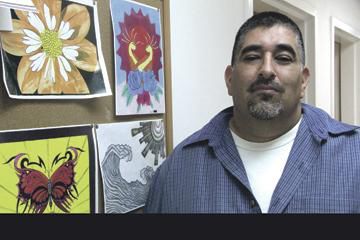
After 35 years in the Española Valley, the word Hoy and the Hoy Recovery Program have become synonymous with helping Rio Arribans battle alcohol addiction and drug dependency.
Earlier this month during one of the first rainy afternoons of the summer season, Hoy Director Adam Baca explained the significance of the Spanish word as it applies to rehabilitation and second chances.
“Today is the day to make a change,” Baca said inside his office on Hoy’s Velarde campus. “Today is a day for a good start.”
Hoy began in a small building on Corlette Road in 1974 as an alcohol rehabilitation center, Baca said. Since then, though, the private non-profit program has evolved to offer both outpatient and residential services for people battling any type of drug and alcohol addiction or dependency.
Hoy’s outpatient program, based in Española, provides treatment services such as counselling appointments and group therapy sessions, but patient’s don’t live at the Hoy facility, Baca said.
This program is designed for referrals from the justice system — the Española facility even offers DWI school for first time DWI offenders — but it also caters to anyone trying to get clean through intensive intervention and supervision, according to informational literature printed by Hoy.
The outpatient program includes family therapy, educational group sessions and aftercare planning to help clients continue their treatment once the outpatient program concludes, the literature states.
Residential Help
In contrast, patients in Hoy’s residential program check-in to Hoy’s Velarde facility for stays of 30, 60 or 90 days, Baca said. Which program a patient enters and how long a patient stays in the residential program is based on each individual’s needs.
Residential patients receive counseling services similar to those offered to outpatient clients, but each residential patient is also assigned a specific counselor to work with during the duration of his stay, the literature states. Spanish speaking counselors are available at both the outpatient and residential programs.
Hoy served 205 residential clients and 338 outpatient clients during fiscal year 2012, according to figures provided by Baca.
Clients seeking admission to the residential program must be approved by OptumHealth, unless they plan to pay for the treatment out of their own pocket, the literature states.
In 2009, OptumHealth received a contract from the state government to manage behavioral health care for New Mexico consumers and families, according to OptumHealth’s website.
Baca said OptumHealth and Hoy entered into an agreement for fiscal year 2012 worth $1.17 million in which Hoy provided services to its clients and then sought reimbursement from Optum.
For clients in the outpatient program, services are provided and then Hoy sends a bill to Optum which it may or may not agree to pay, Baca said. Meanwhile residential program clients require prior approval from Optum. Optum approves residential clients on a 30-day basis, but counselors can recommend clients for additional 30-day periods of residential treatment.
While this system is far from perfect, it offers a chance for at least some clients struggling with addiction to cover the approximate $175-a-day cost of Hoy’s residential treatment program, Baca said.
“Because we serve a lot of people who are uninsured or poor, the state money is really the only option for them,” the director said.
In the last fiscal year, which ran from June 30, 2011 to July 1, 2012, Hoy expended its $1.17 million contract with Optum in May, Baca said. That left Hoy responsible for covering all patient costs in the month of June, costs the program pays out of its general operating budget. While this hurts funding for other aspects of Hoy’s operation, Baca said the program sees little other choice.
“We understand that, but we don’t want to turn clients away because of that,” Baca said. “If we can afford to pay for the services then we ethically have an obligation to do that.”
A Holistic Approach
When asked what makes Hoy unique versus other substance abuse treatment centers, Baca stressed what he called a “holistic approach” to recovery.
Hoy’s holistic methods encompass a wide range of activities, from farming fields and tending livestock; to making art and writing poetry; to practicing tribal healing methods, such as sweat lodge ceremonies, Baca said. Such activities exemplify how treatment is about more than just avoiding substances.
“Just stopping use is not enough,” Baca said. “Our clients have a need for clarity and a feeling of self-worth, and informal support structures within the community.”
For example, through learning about agriculture and working in the Velarde center’s modest fields, clients can learn about healthy lifestyle habits and pick up practical skills, skills that can help clients find work once they leave the residential treatment program.
“Poverty is a big driver of addiction,” the director said. “Anything we can do to help clients make money in a legal and healthy way we will do.”
Baca added the holistic approach to recovery helps clients form an understanding of how their addiction works and how it has emotionally affected them and their families. This, he said, is tantamount to a successful recovery.
The holistic philosophy adhered to at Hoy encourages self-expression through activities like writing and painting.
“For a lot of people, they have had trouble being honest with themselves,” Baca said. “Writing allows them to be honest and open. Poetry can be a really valuable tool, and so can art.”
Such activities also show clients that happiness and fulfillment can be obtained without drugs, Baca stressed.
“A lot of clients feel that when they are in recovery, life is over; there is no more fun,” he said. “But they can have fun without being high or drunk.”
Fiesta de Salud
These aspects of holistic healing and many more will be on display Aug. 11, during Hoy’s Fiesta De Salud, Baca said. The Fiesta is an annual celebration of traditional healers, food and entertainment held at the Velarde campus and open to the public.
Baca said more than 500 community members attended the Fiesta in 2010. The event was not held in 2011. Those interested in attending this year should RSVP by calling 852-2580, or emailing hoyrecovery@windstream.net.
The director, though, stressed that the holistic methods of treatment which will be on display at the Fiesta next week are only one aspect of a larger recovery philosophy at work in Hoy.
“It’s important to remember that we balance everything with evidence-based, best-practice models,” he said.
A Failed Client
Last month while walking through the hallways, dormitories and fields of the Velarde campus, Baca argued Hoy has helped countless individuals in their battles against addiction.
“Yeah, we see lives changed everyday,” Baca said.
However, the director refused to comment about one life which was lost in the Hoy center three years ago, and which later became the basis of a state District Court wrongful death lawsuit filed against the treatment center.
The lawsuit alleges that 26-year-old Joshua Clayton checked into the Hoy residential program Aug. 5, 2009, according to court documents. Over the next four days Clayton, who had stayed at the program’s facility during a previous rehab attempt, allegedly told Hoy staff members that he felt extremely ill and needed to be hospitalized.
For reasons unexplained in court documents, Clayton’s repeated pleas for medical attention went unanswered, and on Aug. 9 another patient found him “slumped over, unconscious and unresponsive on the floor next to a urinal,” the lawsuit states.
Autopsy reports revealed Clayton died from alcohol withdrawal syndrome, “which any reasonably competent substance abuse treatment facility should know requires immediate medical treatment,” the suit states.
Hoy and the plaintiff in this suit, Clayton’s father Rodney Clatyon, reached a settlement in May causing the formal charges against the rehab facility to be dropped, court records state.
Baca, who was not employed by Hoy at the time of Joshua Clayton’s death, would not comment on the suit or what changes, if any, Hoy has made to its procedures and policies since 2009. He referred all questions regarding the suit to Albuquerque-based attorney Joan Waters, who did not return numerous calls for this story.
Fred Vigil, the chairman of Hoy’s Board of Directors, also declined to comment on the lawsuit earlier this year.
Plaintiff’s attorney Robert Gutierrez said Hoy did not admit to any wrong doing as part of the settlement. The attorney would not release the settlement amount.
But as the sky over Velarde turned darker with thickening rain clouds July 5, Baca did admit that recovery for any individual is a long and difficult process, and that solving Rio Arriba County’s drug problem will require more than just the work done at Hoy.
“And it’s not just our community,” he said. “It’s the state and the country, too.”
Hoy can keep fighting drug addiction and alcohol dependence on a local level, but until there is a large-scale restructuring of the War on Drugs, economic development in rural communities, improved access to health care and the criminalization of drug addicts, the problem will persist, Baca said.
“Everybody needs to take part in this issue,” he said.
Hoy Recovery Program
Board Members (2012)
Fred Vigil, Chairman
Sharon Dogruel
Rebecca Truelove
Stephanie Martinez
Yolanda M. Romero
Perez Ciddio
Finances (2010)
Total Revenue: $1,869,540
Grants: $1,851,043
Total Expenses: $1,528,908
Salaries: $828,550
Professional fees and other payments to independent contractors: $110,603
Supplies and materials: $117,179
Repairs and maintenance: $27,125
Total Assets: $1,574,285
Cash, savings and investments: $1,074,214
Land, buildings and equipment: $38,388