Hidden Beauty of Insects at Northern Library

Published:

    When Oliver Greer started his insect collection with a single wasp he found at age 10 in Tiburon, Calif., he said he had no idea what it would become.

    “It’s a childhood hobby that’s just gotten way out of control, but in a very good way,” Greer said.

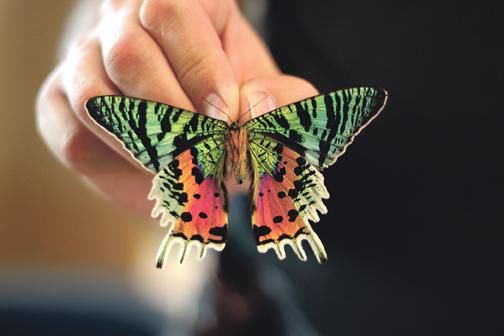
    Now, his extensive collection of 2,400 framed and mounted bugs, featuring insects from every tropical region of the globe, greets visitors at Northern New Mexico College’s newly opened Ben Ray Lujan library, where it will remain until the end of April.

    Biology professor Dr. Ulises Ricoy helped bring the collection to the college after meeting Greer at the Santa Fe Children’s Museum two years ago as Greer exhibited the collection. Greer said the exhibit stunned Ricoy when he viewed it with his daughter.

    As Northern tries to recruit and retain students in science majors, Ricoy said the exhibit has sparked students’ interest.

    “Before they know it, they’re already reeled in. They’re already talking about the science,” Ricoy said.

    He said the point of bringing the collection to the college is to engage the whole community in a conversation about science.

    The full collection consists of about 7,000 insects. It includes a wide variety, ranging from giant beetles to tiny butterflies. Out of those, 550 are local insects, many of which were caught or found by Greer. 

    While larger collections exist, Greer said the amount of insects on display rather than in storage beats out the collection displayed at the Smithsonian Institution.

    Ricoy said what impresses him most is the personal nature of Greer’s collection

    “He is pretty much a self-taught naturalist,” Ricoy said. “He’s so passionate about these specimens.”

    Greer learned how to mount the insects while working for California State University entomologist Dr. David Kistner at age 13. Kistner had an extensive collection of butterflies, moths and beetles from his travels around the world, but most were kept in storage rather than on display. Greer said he helped the scientist spread and pin the collection for display.

    Working for Kistner, Greer said he received what remains the crown jewel of his collection: The giant Fijian longhorn beetle Xixuthrus Heros, one of the world’s largest beetle species. He received the bug as payment for his three years of work, in 1981.

    The rare specimen is now extinct, because the Fijian natives ate its large, edible larvae out of existence, Greer said. A World War II veteran brought this specimen back to the university from Fiji after the war and donated it to the science department.

    “First seeing the picture, then seeing the real thing, it was like seeing a dinosaur, a real dinosaur,” he said.

    There are fewer than 20 of these beetles in the world’s museum collections. Greer estimated 30 or 40 more may be in private collections.

    Another favorite of Greer’s is a green June beetle found by Robert Englund of Nightmare on Elm Street fame in his California garden.

    Despite Greer’s fear of spiders, his collection also includes one of the largest tarantula specimens recorded. While the largest is 11 inches long, his is 10.5.

    “That’s plenty big. Especially for an arachnophobe,” he said.

    That’s not the largest specimen in his collection. That distinction goes to a 24-inch whip spider from Peru.

    What makes Greer’s collection unique is the mounting, he said. Rather than have the insects in the standard academic style, Greer lets his bugs stretch out to accurately show their wingspans and the lengths of their legs and antennae.

    “I realized years ago that I got no satisfaction pinning my specimens to look like everyone else’s,” he said. “Why bother? If I do mine that way, nothing will distinguish my collection from anyone else’s.”

    For insects such as beetles, the academic style keeps their legs scrunched up against their bodies and the antennae swept back. His bugs have their antennae out straight, pointing side to side, while the legs are stretched out as far as possible. Butterflies he pins to make them look as if they are at rest.   

    Greer said he also works patterns into the framed collections, treating them like a drum solo to produce a rhythm in the design.

    A chef by trade, Greer said he’s currently trying to get his bug business off the ground. After the entire collection is framed and mounted, his ultimate plan is to get it marketed and on tour around museums. He expects to finish the work over the summer.

Related articles

Recent articles

Weave a Mug Rug