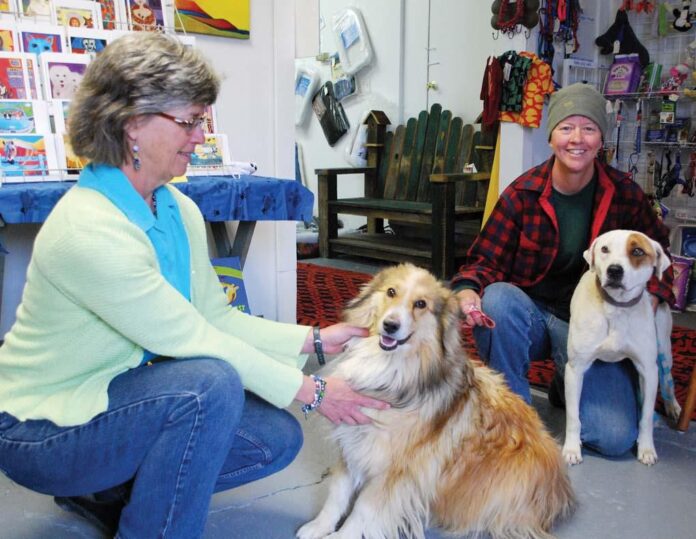
Man’s Best Friend’s Best Friends

Published:

    Tiny meows carried from the back of the building as litter-mates Hans Solo, Yoda and Princess Leia, who later became known as Prince Lee or P. Lee, cried for attention.

    Chama Valley Humane Society volunteers Charlotte Ownby and Jean Garlie rounded up the kittens coddled and cooed to them.

    The building is the home of a new animal-focused store, The Humane Place, which opened May 27 in the heart of the village downtown. Inside are all sorts of goodies for four-legged (and even two-legged) friends. Cards, jewelry, pet toys and pet beds are all for sale with all proceeds going to the Society.

    “We’re not trying to compete with other pet stores, but rather complement them,” Society President Konnie Andrews said.

- Advertisement -
- Advertisements -

    She said The Humane Place carries items that other stores usually do not, adding there aren’t a lot of options for pet owners in the Chama Valley. People can drive to Los Ojos’ Valley Feed Store or Lowe’s SuperSave in Chama, Andrews said.

    The Humane Place also stocks fun items on consignment like ties and tiaras for your furry friends, and 25 percent of the proceeds from those items goes the Society.

    Andrews said the store will be open Thursday through Saturday for the summer. She said the organization is hoping to get a boost from the tourist season centered around the Cumbres and Toltec Scenic Railroad. The store won’t likely be open during the winter because the building isn’t heated, Andrews said.

    “We just need to make enough to keep the doors open,” she said.

- Advertisement -
- Advertisements -

    And by getting people in the door, they can let people know what kind of programs the organization offers, and make people more aware of how to take better care of their animals, Andrews said.

    Andrews said she got involved with the Society in 2008 when an abandoned pit-bull mix wandered onto her property. She didn’t want to take it to animal control and found a local chapter of the Society to lend her a hand.

No Shelter, No Problem

    There is currently no animal shelter for abandoned or unwanted animals in the Chama Valley, Andrews said.

- Advertisement -
- Advertisements -

    But Chama Mayor Archie Vigil said the village has been working on one. Construction began last summer, and Vigil said he’s hoping the $200,000 project will be complete by the end of this month.

    “It’s not a very, very big one,” Vigil said. “It’s just enough to take care of the animals caught by animal control.”

    The shelter will have eight kennels for dogs and about eight for cats, he said. Vigil said animals can also be housed outside.

    The shelter won’t be a no-kill shelter, but Vigil said he hopes to work with the Society once the shelter is complete. Vigil said Rio Arriba County Manager Thomas Campos has also showed interest in using the facility once it’s complete.

    So for now, many of the Society volunteers also foster abandoned animals found in the area, Andrews said.

    “We have a real cat problem here, in Los Ojos and (Tierra Amarilla),” she said.

    Andrews said the animals in animal control’s custody have three days to find a home before they’re euthanized. She said the organization has been working with animal control to take care of some of the animals until they find a permanent home or are taken to cooperating shelters and sanctuaries around the state and in Colorado.

    “It’s a no-kill solution for people that don’t want the animals,” Andrews said.

    She said the organization also attends adoption events throughout New Mexico. Andrews said the Society adopted out five of its foster animals at an event called Fetch-a-palooza in Albuquerque last month.

    Occasionally, there are animals the organization can’t take in because they’re unapproachable, Andrews said. She said that’s only happened twice that she knows of.

    “We almost always take the animals,” Andrews said.

    Andrews said all the animals the Society is able to foster get spayed or neutered and get all their appropriate shots. That’s why the organization charges adoption fees: $45 for dogs and $35 for cats, she said.

    “We work with the situation,” Andrews said.

    The Society also gives away half-off vouchers for neutering and spaying for people who have pets. People can take the vouchers to a local veterinarian to get their pet fixed, she said.

    “They’re not free; (the Society) pays the other half,” Andrews said. “We’re just trying to get people responsible for the animals in that respect.”

    The Society also helps out by lending crates, leashes and books, she said.

    “We want to make things available,” Andrews said. “And to help them with questions they have.”

Success Stories

    Amy Rapt, who lives outside Durango, Colo., recently adopted a puppy from the Society. Rapt said she was looking specifically for a large-breed, male puppy. She said she and her family have always enjoyed the personalities of male dogs adding that she was also looking for a snow-friendly dog because her family lives up a mountain.

    She said she found her dog Rozzi, a long-haired German Shepherd and Husky mix, through the Society and the website www.petfinder.com.

    “He’s perfect,” she said.

    Rapt said it was wonderful working with Andrews to adopt Rozzi.

    “They were just awesome,” she said.

    Rapt said Andrews didn’t want to give Rozzi to a first-time dog owner, but was satisfied with Rapt and her family because of their affection for big dogs and outdoor lifestyle.

    At first Rozzi was shy, but step by step, he’s coming out of his shell, she said.

    Rozzi had come from the Jicarilla Apache Nation reservation and hadn’t had much interaction with people, she said.

    She said she’s still apprehensive of introducing Rozzi to a large group of people, but said he has plenty of time to warm up to his new home.

    “I’m very excited,” Rapt said.

    Catherine Nowicki, of Pagosa Springs, Colo., described a similar experience after adopting her kitten, Luke, from the Society. Luke was a litter-mate to P. Lee, Yoda and Hans Solo.

    She said she also found Luke and the Society on petfinder.com.

    “They were wonderful to work with,” Nowicki said.

    She said the fact that the Society doesn’t have a shelter means the animals are getting more human interaction and attention.

    “It’s pretty awesome for the animal,” she said.

    Luke and his litter-mates were raised by hand by Andrews, Nowicki said. Andrews found the litter when they were only weeks old.

    “He’s awesome,” she said of Luke. “He’s very healthy.”

Dog-Eared

    The Society received notice at the end of May that the group has received a $1,600 grant from United Way of New Mexico to jump-start a “Read to the Dogs” program, Andrews said.

    “It’s to help us get started,” Andrews said.

    She said the Society has started identifying local dogs for the job, though no currently fostered dogs are being considered. Andrews said that’s because the dogs might end up finding a home during their training to become certified therapy dogs.

    And there’s a whole host of the qualifications needed for the therapy dog team, which consists of the dogs and their handlers, to pass the test.

    Society volunteer Kytha Gernatt is the trainer in charge of making sure the dogs are ready for their big day.

    She said the dogs have to remain calm and be responsive to their handlers, and the dogs should be interested, but not overly excited.

    “We need to know how the dog is going to react,” Geratt said.

    Andrews said therapy dogs are often put in new situations with strange people and smells, so they need to be able to adapt. Once registered as a therapy dog, the dogs can be used in myriad situations.

    “Animals tend to relax people and lower blood pressure,” she said, adding that’s why they’re used in nursing homes and for people who have had traumatic experiences.

    She said therapy dogs also can help children who have been having difficulty learning to read. Andrews said other children can be cruel and tease the child, and adults can get impatient.

    “Dogs don’t do that; they just sit there and listen,” she said.

    Andrews said that can help children gain self-esteem.

    Dogs can also be a useful tool for children with autism, she said.

    “(Children) can relate to the animal in a way that they don’t relate to people,” Andrews said.

    The Society has brought in a volunteer to help spearhead the “Read to the Dogs” program. Retired reading specialist Bronwyn Lyman will be leading most of the program once the organization has trained enough therapy dogs.

    “This is really new,” she said.

    Lyman said she’s been in contact with Tierra Amarilla Elementary Principal Kit Trulove, who has voiced some interest in using the dogs for students learning to read.

    Trulove did not return a call in time for this story.

Related articles

- Advertisements -

Recent articles

- Advertisements -