Narrow Street’s Residents Suspicious of City Fix

Published:

The residents of Pacheco Lane are frustrated with the city, and in some cases, with each other.

Many of those frustrations came to a head during an Aug. 6 Española Public Works Committee meeting in which the city presented a draft of a resolution to expand and pave Pacheco Lane. The Committee passed the resolution unanimously, but not without much confusion and agitation from both the councilors and the audience.

The audience was dominated by Pacheco Lane residents led by Willie Atencio, who was frustrated that he and some other residents had signed the easements allowing the city to expand the road into their properties a year ago and still nothing had been done.

Atencio told the Council that since the city had not taken possession of the easements, they were still paying for taxes on the land.

When Councilor John Hernandez asked Atencio how much taxes they were paying, he said it was a small cost.

“It’s actually very little—but it’s the principle of the thing,” Atencio said.

Councilor Robert Seeds told Atencio and the rest of the audience that their tax worries should take a back seat to the passage of the resolution.

That did little to assuage Atencio.

“We’ve had five people in charge of this project and everyone has told us something different,” he said.

Besides Seeds’s assurances that the resolution would be everything “we all dreamed of for the past 22 years,” few people in the council chambers were able to decipher the draft, which contained two different resolutions. The meeting suffered from the absence of City Attorney Frank Coppler, who was supposed to present the draft.

As audience members kept asking which draft the committee was discussing and what it meant for them, the councilors would often turn to each other and discuss the issue amongst themselves. Finally, with little input from the Pacheco Lane residents in attendance, the committee passed the resolution, which was moved on for a full council vote on Tuesday. 

According to the draft of the proposed resolutions, there is one key difference between them. In the first resolution, the city has the right to condemn the easements that have not been signed and proceed with the project. The second resolution will only expand and pave the easements that have been signed while ignoring the hold-outs. Both resolutions give Pacheco Lane hold-outs 90 days to sign over the easements and promise to have the project completed within six months of the resolution’s passage. 

Currently, 14 easements have not been signed out of the 27 the city needs, according to a list obtained from the Public Works Department.

Ralph Alarid, along with his wife Sadie, was the first person to sign the easement. He attended the last committee meeting and said he’s skeptical that the project will be done in six months despite the promises. 

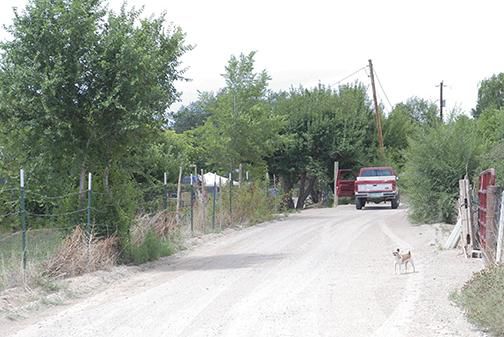
Many Pacheco Lane residents said they’re unhappy with the road in its current state. According to resident accounts, the street now is so narrow that one car is forced to back up if two vehicles are traveling on opposite sides of the road. Also, ambulances, fire trucks and other emergency vehicles have trouble entering and leaving. A couple of road posts and gates have been flattened from vehicles trying to navigate the narrow terrain. 

The distrust and disappointment that some Pacheco Lane residents show toward the city for slowing down the construction process also extend to some of the holdouts who refuse to sign the easements.

Frances Hoover-Jaramillo and her family have owned property on Pacheco lane since 1950. Hoover-Jaramillo’s son, Anthony Raymond Lopez, signed the easement, much to her approval. She’s had to call an ambulance to her house in recent times and is concerned with the lack of space such vehicles have to operate. Hoover-Jaramillo said she believes that the area has had a lot of turnover in recent years and become less neighborly, leading to some of the holdouts.

Another Pacheco Lane resident, whose husband had yet to sign the easement but intends to, said that Councilor Pedro Valdez has done everything he can to get the project done but the holdouts were dragging the process down.

Corrine Martinez is one of those holdouts, and said she doesn’t plan on signing the easement unless financial compensation is offered from the city. Martinez lives on a fixed income and claims to not have enough money to paint her house, let alone donate her land without redress. She said she’s had no problems with the road in the past and accuses residents like Alarid of giving up little despite being more prosperous. Martinez would be giving up the third biggest parcel of land, at .069 acres, behind Marie E. Pacheco, one of the street’s namesakes, and Charles Radosevich, the father of City Councilor Eric Radosevich. In comparison, Alarid will donate .011 acres of land.

Martinez said she felt it was inappropriate to donate to a city that has given little to her in return.

“Nobody donates my taxes. I still have to pay them,” she said.

Martinez also said she was uneasy with the proposed path of the road, saying it cuts too close to her window and septic tank. But she said she thinks there’s little chance of remuneration and that the city will seize the land for the project with or without her signature.

Related articles

Recent articles