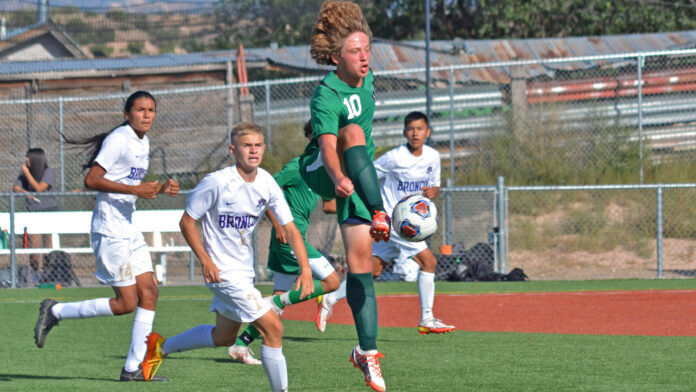
Before every Pojoaque boys soccer game, it is not team coach Juan Ortiz that sets the lineup.
Instead, he hands the clipboard off to the team captains, and players including Caleb Roybal and Luis Hernandez are put in charge.
“They’re the ones that are out there,” Ortiz said. “I kind of give my input, but they know who they want out there, and who’s strong out there at different positions. We let them work it out. And I let them coach each other on the field, because they need to mentor each other.”
“He’s letting us make big decisions, that gives us inspiration to keep going as captains,” Roybal said.
Pojoaque (1-6-2) had what they consider their best game of the season on Sept. 15, forcing a draw against Kirtland Central (2-6-4) after two scoreless overtime periods.
“We’re finally turning the corner now,” Ortiz said. “These guys are finally starting to play better. So we’ll see how it goes in the second half of the season.”
Goalie Omar Hernandez tops the state by a wide margin according to MaxPreps with 134 saves as of Tuesday. Though those numbers might be a bit inflated by Pojoaque counts (he was credited with 15 saves against Kirtland Central, though there were just a handful of shots on goal), Hernandez has clearly had an impact on holding the back line.
“Our defense is doing better now, so hopefully he won’t have to save so many,” Ortiz said. “But pretty much anything that’s not 1-versus-1, he’s going to save it. He’s a really good goalie, but it also means our defense needs to get better, so we’re not giving up so many shots.”
“The stats really don’t mean nothing to me,” Hernandez said. “What I really care about is the team, and just improvement. Those are just numbers. I just want to help my team as much as i can.”
Neither team scored in the match nor were they particularly close. Both had a few corner kicks, and Pojoaque had a few good saves and some shot attempts.
At one point in the second half, two Kirtland Central players helped a Pojoaque player stretch out a leg cramp.
There was some confusion at the end of regulation, but referees pointed out a new rule (apparently not enforced by all) that a tie game now has two 10-minute overtime periods to try to break a tie.
After the game, Ortiz tried in vain to explain the adage of a tie being like kissing your sister to a confused group of teenagers.
“The effort’s always been high with these guys,” Ortiz said. “But now they’re finally starting to connect on passes, starting to work together.”