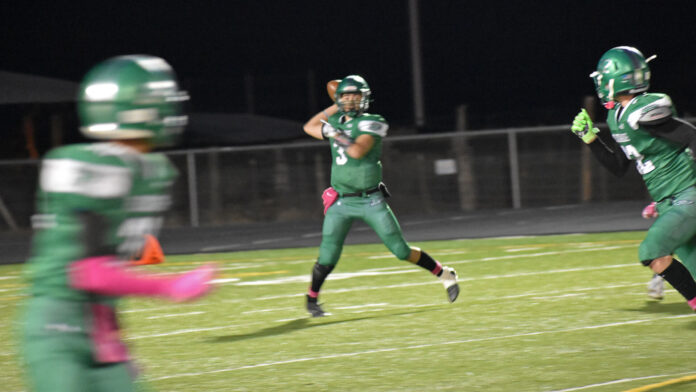
Pojoaque Valley High School Quarterback Adam Pacheco surprised coaches and friends by deciding to try his hand at college rugby.
Pacheco, 18, will be joining the New Mexico Tech Miners rugby team in the fall. He officially signed in May.
“A lot of my friends were confused,” Pacheco said. “They were like, ‘Rugby? I’ve never even heard of that.’”
Pacheco intended to play college football for most of his high school career. He looked at signing with the Colorado School of Mines, West Texas A&M University and Rose-Hulman Institute of Technology in Indiana. But he injured his throwing arm last year and decided to switch directions.
Pacheco opted to delay surgery to his right arm after his senior season ended. Instead, he reached out to the NMT Rugby Coach Chris Hathaway and asked if he could try out for the team. Hathaway invited him to play in a Thanksgiving touch rugby game hosted by the New Mexico Youth Rugby, and from there, Pacheco played a season with St. Pius X High School in Albuquerque. After an impressive showing, NMT signed him.
“I was completely new to the game, so I’d watch film, pick out a position and see what their responsibilities were,” Pacheco said. “I’d just try and break down the game because I didn’t have a lot of time to figure it out. But I like learning new things.”
Pacheco’s father and long-time coach, newly-retired Pojoaque Football Coach Pat Mares, does not think the transition to rugby will be difficult for his son. He praises Pacheco for being a student of the game, studying hours of film each week and offering on-the-field leadership to his teammates, which took pressure off of Mares, who could only coach from the sidelines.
“Rugby guys like to say rugby is the grandfather to football,” he said. “A lot of things transfer. Adam learning the game was fairly simple. Some of the terminology and concepts are different, but he grasped that right away. And his competitive mindset is still there.”
Pacheco hopes to play scrum half at NMT, which is a lot like playing QB. They pass, kick and run the ball.
“The scrum half operates as a link between the forwards and the backs,” according to rugbypass.com.
He fits the athletic profile. Scrum halves tend to have a slight build, so they compensate with speed and agility. Pacheco is quick on his feet at 5-foot-11 and 175 pounds. He demonstrated on the football field his ability to elude pass rushes and make on-target passes from outside of the pocket.
The most important aspect of playing scrum half, though, is decision-making. Rugby is played at a much faster pace than football, which puts the players under greater pressure. Playing scrum half requires repeatedly making the right pass, kick or keep amid the chaos.
“There’s a lot of on-the-fly thinking that goes into playing scrum half,” Pacheco said. “But I think my decision making from being a QB will translate well.”
Mares agrees, saying that Pacheco’s brain has been his best asset in his football career. He began coaching Pacheco at five years old and identified his dedication to studying the game as key to his development.
“Over the years, it got better and better as he studied film to make him the best quarterback he could be,” Mares said. “It transformed how he looks at the game.”
Pacheco said he could not have become the athlete he is today without the support of his family to help him through two shoulder surgeries and to give him confidence as a player. He is particularly grateful for having his dad as a coach for over a decade.
“It’s just been a big part of my life having my dad there all the time, motivating me and pushing me,” he said. “The coaches yell, but when he yells it’s different.”