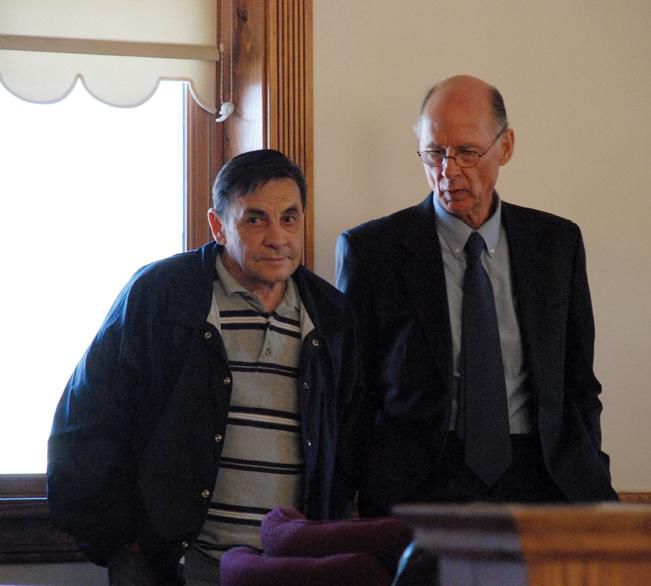
An El Rito man already acquitted of first and second degree murder in a previous trial for the killing of a Tierra Amarilla Courthouse raider was convicted Monday in state District Court in Tierra Amarilla of voluntary manslaughter, according to the District Attorney’s office.
Voluntary manslaughter was the highest charge Tony Herrera, 64, could have been convicted of after the first jury acquitted him of the two more serious charges in May. The jury in that trial was hung on the third charge, with 10 out of 12 jurors voting to acquit, according to the District Attorney’s office.
The family of the victim, Baltasar Martinez, was satisfied with the case’s outcome.
“I am very thankful to see that this jury did see that there was a crime committed,” Martinez’s brother Egripino Martinez said.
Sentencing has not yet been scheduled in the case. Herrera faces up to six years in prison for the third-degree felony conviction and is being held at the Rio Arriba County Jail.
The trial and shooting centered around the issue of property.
Martinez, 62, participated in the 1967 raid on the Tierra Amarilla Courthouse, the same courthouse where his killer was being tried. The shooting occurred at the El Rito home where Martinez was living with his girlfriend Corine Archuleta, who formerly occupied the home with Herrera, her ex-husband. In April 2007, Archuleta filed a civil complaint alleging Herrera took her name off the property deed; he countered that she had never been a legal owner of the property.
While that lawsuit was, and is still, pending, Archuleta and Martinez discussed selling a tractor on the property to neighbors. Herrera heard from his brother, who was Archuleta’s neighbor, that people were looking at the tractor, and he came over to the house May 10, 2007.
And what followed was never in dispute at either trial.
Herrera shot Martinez in the back and arm when he came out onto the front porch, according to statements made in court.
The neighbors who were looking at the tractor, David Cassidy and Adam Drake, testified during the latest trial that Martinez ducked when he saw Herrera’s 30-30 rifle and tried to go back in the house. Archuleta testified that when she found her husband lying dead on the porch, Herrera was driving away laughing and gesturing with his hand as though it were a gun.
Herrera’s attorney in both trials, Tony Scarborough, argued that he acted in self defense because Martinez was armed with a pocketknife. Herrera said he thought Martinez was armed, and claimed Martinez threatened him, in recorded statements made to the Rio Arriba County Sheriff’s Department.
Herrera’s sister-in-law Annie Herrera testified that she watched the incident unfold through binoculars, from inside her house. She claimed that Martinez walked toward Herrera, reached in his pocket, pulled something out and made a slashing motion in front of his body, Annie Herrera said.
Annie Herrera said she saw Tony Herrera reach for his rifle, shoot Martinez in the arm and then shoot again as Martinez went on the porch.
Members of the jury laughed when Hasson asked her if she watches everyone’s house, or only Archuleta’s.
“I always use them,” Herrera said. “I watch everybody’s (house).”
Herrera became somewhat exasperated as Hasson tried to pick apart her testimony. Herrera had said her brother-in-law was protecting himself, and didn’t point the gun directly at Martinez. Hasson asked how he shot Martinez in the arm if the gun wasn’t pointed at him.
“It might have grazed him,” Herrera said. “(Tony) had to get him off. He was right on top of him.”
Herrera testified that although she didn’t actually see Martinez fall, he was running away following the first shot.
The only juror who agreed to discuss the verdict with the SUN said the self-defense argument didn’t convince the panel.
“The defense witnesses were unanimous in what they saw — or what they didn’t see,” the juror said. “They didn’t see any kind of weapon in the victim’s hand — what they saw was him running away at the time of the second shot.”
Hasson began his closing statement by focusing on where and how Martinez was shot.
“Baltasar Martinez was shot in the back and killed,” Hasson said. “He was shot in the back from a distance of 40 to 50 feet. He was running away after having been wounded.”
Hasson explained the distinction between first-degree murder, second-degree murder, voluntary manslaughter and involuntary manslaughter. He said under voluntary manslaughter, the jury could find that Herrera was provoked, under circumstances that aroused intense emotions like anger, fear or resentment. But he is guilty of the charge if his response was unreasonable — if a reasonable person would have maintained his self-control and cooled off, Hasson said.
Hasson disputed the defense’s argument that Herrera acted in self-defense. Herrera told police he shot his rifle to the side — the problem is, that first bullet struck Martinez in the arm, Hasson said. The second bullet struck Martinez square in the back and severed his spinal cord, Hasson said.
The juror said the panel was convinced Herrera did take aim because of something he said in his taped statement to deputies — that he used the rifle to shoot prairie dogs.
“There was disagreement among the witnesses as to whether he was aiming or accidentally shooting,” the juror said. “But to shoot somebody square in the back, it does take some skill to do that. We were convinced by the fact that he had used the rifle to shoot prairie dogs that he had some skill and could shoot somebody at that distance.”
In his closing statement, Scarborough described a scene in which Herrera reasonably feared for his safety and acted in self-defense. Scarborough also tried to raise doubts about the work done by investigators and the prosecution. He asked why the jury wasn’t given a transcript of Herrera’s statements to deputies, portions of which were unintelligible on tape.
“Have all your questions been answered?,” Scarborough asked the jury. “Did you get a transcript? No. That’s reasonable doubt.”
Scarborough asked why the prosecution hadn’t shown Martinez’s actual clothes to the jury, why there were no bullet fragments collected, why there was no DNA testing and why State Police investigator Joe Schiel didn’t map out a trajectory for the second bullet.
In his rebuttal, Hasson said Scarborough’s tactics represented a bunch of red herrings and a “CSI effect,” referring to the television crime drama in which obscure forensic evidence always nails the criminal. In the real world, physical evidence like bullet fragments are often impossible to analyze, Hasson said.
Hasson finished his speech with a plea to keep justice where it belongs — in a courthouse.
Hasson said everyday, people come to the courthouse in Tierra Amarilla to resolve their differences, over land and water and tractors. The dispute between Herrera and Archuleta should have ended that way, he said.
“It should have happened with a judge and a pen, not a bully with his bullets,” Hasson said.