Teaching, Preserving History

Published:

   Andrew Ortega kids about the “10-mile long” wish list of improvements he’d like to make to his native Chimayó.

     First, he’d like to rid the valley of invasive Siberian elms, which, in spite being poor ornamentals, proliferate throughout the valley.

      He also wishes decision-makers within the Santuario de Nuestro Señor de Esquipulas and the Archdiocese of Santa Fe, which owns the property, solicited input from residents on its development plans, as they tend not to do.

      But Ortega’s número uno desea is to stabilize Chimayó’s crumbling Plaza del Cerró. A remnant of the area’s first settlers and 18th Century communal life, the Plaza in many ways is Chimayó’s cultural heart and birthplace of its many distinct traditions.

    There once were other plazas like it but those have since crumbled back into the Earth. Ortega’s traditional weaving family has called the Plaza home for 300 years. He said Plaza del Cerró is the last of the fortified Spanish Colonial plazas still standing in the United States.

    “We’d love to get it restored, but it’s very difficult,” he said. “There’s so many layers of problems with it.”

    A founding member of Chimayó’s Cultural Preservation Association, Ortega has been at the forefront of a two-decade effort to prevent time, neglect and outside development pressures from eroding Chimayó’s traditions and culture – and thus its very identity. 

    Parallel concerns over historically significant structures like the Plaza del Cerró becoming lost to posterity persist due in large part to the Association’s extremely limited financial and labor resources.

    For much of its existence the Association has never had at one time more than eight active volunteers or a budget that covered much more than its operating costs.

    As Chimayó residents have for centuries, the Association has learned to do more with less. In 1995 it opened a museum in the Plaza that has over the years acquired a fine collection of artifacts and photographs of Chimayó’s not too distant past. The museum is funded primarily through donations.

“We live within our means and adjust things to what’s coming in,” Ortega said. “Last year was a hard year for us. We had a two person staff but weren’t generating funds so we had to lay them off.”

    In 2000, the Association brought Los Maestros, a traditional arts program aimed at children, into its fold. Throughout the year it hosts an array of lectures and other events often highlighting specific threads of Chimayó’s intricate tapestry.

    Recently, the Association used its non-profit status to help another group secure a grant that will help them move ahead with cataloging the village’s historic and cultural resources.

    That group, the Chimayó Citizens for Community Planning, has undertaken the broader mission of working with Santa Fe County in drafting a sustainable growth plan for the area.

    “It’ll be interesting to see what the future holds,” Ortega said. “We’re just trying to get people to know how special our past has been.”

The Hard Work

    The Association evolved out of a historic preservation committee formed in the late 1980s under the now-defunct Chimayo Improvement Association, which organized following a rash of car break-ins.

    “The crime prevention association spun off and became their own group and the main group kind of fell apart,” Ortega explained. “So this group became a (non-profit) on its own.”

    In 1995, the same year the Association received its non-profit designation, Ortega offered space to the Association to open what became the Chimayó Museum. Back then the museum consisted mostly of old photographs collected by one of its members.

    “Until then we didn’t really have a place to show them,” he said.

    The museum, which survives largely on visitor donations, pays homage to Chimayó’s centuries’ old weaving traditions among other aspects of its still unfolding history. Old photographs of weavers and craftsmen hang on white stucco walls above the hardened mud floors. Also on display as an old loom, wooden and hand-built.

    An old 1930s-era cash register, once belonging to Ortega’s grandfather, sits among several other artifacts from its not too distant past.

    Although Ortega charges only $300 for rent, the museum has at times struggled to pay its bills.

    “Basically, that covers our expenses as landlords,” he said. “When times are hard we look the other way and when times are good we get paid.”

Economic Engine

    On average the museum attracts on average 1,000 visitors annually, many of them in Chimayó to visit the Santuario. Among the Catholic Church’s holiest shrines, the Santuario is arguably Chimayó’s primary economic engine, drawing upwards of 500,000 annual visitors, many of whom go on to patronize the area’s weaving shops, art galleries, general stores and, of course, the museum.

    “Economically the Santuario is very important,” Ortega said. “It’s the number one reason why people visit Chimayó.”

    The Association’s other flagship program formed independently in the 1990s, but merged with the Association in 2000. The program, Los Maestros, hires teachers from the Spanish Colonial Arts Society who instruct children, like 10-year-old Hallie Vigil, about traditional New Mexico folk art, including time-tested techniques passed down through generations.

    “I like it because it’s fun,” Vigil said.

    Next to the museum’s overhead, Los Maestros is the Association’s largest annual expense due to the $25-an-hour rate charged by the master teachers from the Spanish Colonial Arts Society. The program is free to anyone between the ages of 9 and 17 who’d like to learn an array of artisan crafts from colcha-making and micaceous clay work to traditional wood carving and weaving.

    While individual children, like Vigil, benefit directly, so too does Association since one of the program requirements is for students to share what they’ve learned with others. Each Saturday, students staff an Association-operated teaching booth in Santa Fe’s Spanish Market, where they teach both children and adults the ways of Chimayó’s traditional artists.

    “Passing it on,” said Aida Gonzalez, Los Maestros founder and current Association Board member. “That’s what it’s all about.”

    But keeping Chimayó’s children from moving away as adults—and taking their knowledge with them—is as formidable a challenge as any facing the traditional community. Chimayó, in a way, is hemorrhaging culture.

    “They say that Chimayó’s biggest export is its children,” said Board member Shelley Winship. “Changing that is going to be a huge challenge.”

The Jewel of Chimayó

    Chimayó doesn’t have a definitive origin story in the sense that Spanish settlers arrived and planted a flag, according to Ortega. But driving around Chimayó today it’s easy to see both the practical and aesthetic attraction.

    “The landscape is very majestic,” said author Patricia Oviedo-Trujillo, a former Association Board member. “You have the wind and water worn hills, green valleys with the desert landscape in the background.”

    Nested in the foothills of the Santa de Christo mountains, the Santa Cruz River all but ensured the valley’s fertility, perfect for irrigating fruit orchards and vegetable fields.

    “People here have survived many centuries on their self-sustaining ways,” Trujillo-Oviedo said.

    Ortega said that while the area possessed the prerequisites for survival, no one can say why exactly Spanish weavers chose to settle here.

    “We’re not sure exactly why they came to Chimayó, but they’ve been here a very long time and have always been weavers,” said Ortega, a seventh generation weaver. “Not many people in the United States can say their families have been in the same place for 300 years.”

    The first references of Chimayó as a unified, contiguous community appear in the 1730s, Ortega said. During that time the area was a cluster of plazas and placitas resembling neighborhoods, each with distinct, though interconnected, economies.

    Plaza del Cerró  —on the National Register of Historic Places—was built in the early 1700s. Designed to protect residents against Indian attacks, it necessitated communal living. It is the last surviving of the fortified Spanish colonial plazas, Ortega said. The Plaza is a rectangular series of contiguous buildings.

    Three narrow entryways provided the only outside access to its interior courtyard, which prevented surprise attacks by large groups.

    “In those days the Spanish Crown wanted it to be built around a plaza for protection,” Ortega said. “They did have threats from the Indians, so a plaza was set here for defensive purposes in the 1720s or 1730s.”

    Once a center of civic life, the Plaza today is in peril. A good number of its buildings resemble ruins, with collapsed roofs and interiors overrun by vegetation. At least eight of the buildings, including the museum, remain in use, while others, such as the Chapel Oratorio San Buenaventura, remain in good repair, but go largely unused and are inaccessible to the public.

    Over the years, groups like the Ford Foundation and even movie star Robert Redford have offered to refurbish the historic Plaza, but for reasons that aren’t clear these offers weren’t embraced. One of the major challenges in stabilizing the Plaza are its many property owners, each with their own ideas of what’s best for the Plaza, Ortega said.

    “We had a grandfather who owned a property and when he died it went to his heirs,” he explained. “And there’s like 10 heirs to the property. Its hard to deal with 10 people.”

    Raymond Bal said even though the Plaza “is very, very important to New Mexico,” care must be taken to respect the wishes of its property owners.

    Bal is a former Association president who is currently active in the Chimayó Citizens for Community Planning committee.

    “It’s not a Plaza with grass and park benches,” he said. “It’s a living Plaza. Peoples’ lives are still lived here.”

    The goal, Bal said (and the Association agrees), shouldn’t be to commercialize the Plaza as a tourist attraction, but treat it as a community keepsake for future generations of residents.

    “We recognize the importance of preserving it,” he said. “But any work would have to be done with the least amount of intrusion.”

    Board member ShelleyWinship said the thought of losing the Plaza is “heartbreaking.”

    “I’d like to work with property owners and develop a community-driven plan,” she said. “But no one can agree on what the best course of action is.”

Uncertain Future

    Each Good Friday around 35,000 people make the pilgrimage to the Santuario, some of them to touch dirt believed to usher miracles. The Association received something of a miracle last year when state hotel magnate Jim Long, after visiting the museum, established the Chimayó Hotel in Santa Fe.

    Designed with the input and assistance of local artists, craftsman and cooks, Association president Brenda Romero and Ortega say the Chimayó-themed hotel feels authentic from the chandeliers made by local craftsman on down to the Chimayó-grown chile served in its restaurant.

    “The heart is there,” Romero said. “He relied on a lot of local people to help him. They felt like they were part of it.”

    In exchange for the locals’ help in designing his hotel, which opened last September, Long contributes 1 percent of the hotel’s monthly revenue to the museum, Ortega said. 

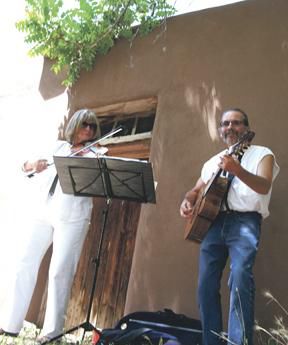
    About 40 people gathered June 24 at the museum for Fiesta en el Museo, an annual summer celebration this year featuring music by traditional New Mexico folk musicians.

    The event is part of the Association’s string of monthly events, which kicked off in May with a book signing and discussion by Trujillo-Oviedo, whose book “Chimayó” was published earlier this year.

    In July, Board member Dan Jaramillo and author Don Usner will give a presentation on Victor Ortega, the famous Chimayóso who helped usher New Mexico from a territory to U.S. statehood.

    Los Maestros students are no longer permitted to sell their arts and crafts at the Spanish Market as they were in previous years. Instead, hotel magnate Long again stepped up by providing space in front of his Chimayó Hotel for the children to vend.

    At Fiesta en el Meseo, Hallie Vigil displayed more than a dozen paintings she made during her time with the program.

    The Fiesta was more or less a gathering of neighbors, who are bound by their shared and interwoven histories and whose ancestral village faces an uncertain future.

    The Plaza may be crumbling, the Santuario may push unpopular development ideas, and Chimayó’s children may move away in search of better opportunities, but some things, Ortega said, haven’t changed much at all.

    Especially when it comes to traditional weavers like himself.

    “If you had a time machine and brought one of those guys back to now and you said, ‘Weave me a rug,’ they’d knock it out in the second,” he said. “It’s the same tradition, the same machine.”

Related articles

Recent articles