On a cold Thanksgiving Day in 1995, a visitor from Wyoming made a discovery in Abiquiú.
Stan Bader, a former U.S. West executive nearing retirement, and his wife, Arin, were cleaning up a property they were purchasing, located along the Chama River just north of Abiquiú.
“There was an old tree on the acequia, right next to the big cedar,” Stan Bader said. “I had a new saw, a chainsaw, and said, “We ought a cut that old snaggletooth there.’”
Bader was cutting away and thought the tree had rotted, initially not seeing anything. What he saw next surprised him.
“Laid over there were four combs, laid perfectly,” Bader said, talking about honeycombs produced by bees. “That prompted me, I ought to save this thing. You could hear them down there.”
Bader picked up some plywood and screws at the local hardware store, and patched up the tree, but not before taking some honey from one of the honeycombs. He and his wife were going to take it back home to Cheyenne, Wyo. for tasting and examination.
Little did the Baders know their discovery would grow into a fixture at their 55-acre Abiquiú property.
The Apiary
Stan’s apiary, or collection of beehives, is a dozen feet away from the Bader’s vineyard.
The Baders’ property, Las Parras de Abiquiú, features three acres of alfalfa, six acres of grapes, and a host of other crops neatly laid out adjacent to their home, garage and guest house.
The eight-beehive apiary is modest in size and presentation, and some of the hives are vacant. The hives vary in size and shape, with some modeled after houses and others composed of simple stacked wooden boxes. Some of the homes are painted with designs, while other boxes are simple in color and presentation.
The hives lie 18 inches off the ground, and are surrounded by a small electric fence, a deterrent for natural predators.
“You don’t have the hives opening right on the ground, that’s where the skunks can get right to them,” Bader said. “That exposes their belly. They can get stung in the lips, nose, mouth, tongue, no problem. If they get stung in the belly, they don’t like it, so they go away.”
Although within walking distance, Bader drives his pickup out of his garage and loops around the back of his garage to take the one minute drive down a narrow dirt path alongside the vineyard to reach the apiary. The truck serves as a safe haven for Bader if bees are swarming or if something more ominous, such as a bear, is hiding in the tall brush behind the apiary.
After backing up his truck to face the truck bed toward the apiary, he walks over to the apiary, and it’s not apparent the hives are active, with the lack of bees buzzing in the vicinity.
Bader deactivates the electric fence and takes a portion apart, and goes to grab his bee suit, a white jumpsuit with a large veil and hat combination. After tucking his thick yellow gloves in the suit’s arms, Bader is ready to check on his hives, look for the queen bees, and check the amount of honey being produced.
I’ve been out this past couple of days, and I’m going to have a little honey,” Bader said. “But nothing like what I thought I might have starting (the hives).”
Bader removes the cover from one of the Langstroth hives, a common beehive structure composed of a box filled with frames, similar to a filing cabinet. The number of bees buzzing around in the air increases, but they don’t appear aggressive.
“It depends how observant and how often you go into a hive,” Bader said. “It’s not recommended that you go in and visit your hives all the time, that’s a disruptive process to them. They get agitated and there’s really no reason to do that.”
Bader carefully grabs a wooden frame, and lifts it straight up to reveal a dark brown honeycomb attached to it, crawling with bees.
Beginning with bees
“Growing up, I never worked bees,” Bader said. “Just was around it.”
Bader grew up in Loveland, Colo. on a 160-acre dairy farm. Among 20 to 25 cows for milking, Bader’s father grew barley, corn, alfalfa, popcorn and red cloverseed.
“I worked summers with my dad, there was plenty of work,” Bader said. “I remember my brother and I saying, ‘If we could just get to July 4, I think we can survive the summer.’”
Bader and his family had to cultivate, irrigate, hand-hoe cornfields, and worked with machines on the farm. Bader’s closest interaction with the bees happened when he and his brother were tasked with fending off skunks, which is why to this day Bader places the hives above ground.
The bees were attracted to the red cloverseed, and gave 60 pounds of honey every year to the farm.
“Dad got better seed crop than he would have otherwise,” Bader said.
He speaks about the alfalfa he grows annually at his vineyard the same way.
Bader worked on the farm with his father during the summers when he wasn’t working toward his mechanical engineering bachelor’s degree from Colorado State University. After completing his degree, he wouldn’t return to his roots of farming until he neared retirement.
“About the whole time I’m sitting in the office somewhere, I would’ve preferred to have been out,” Bader said. “When retirement started to approach, I said, ‘I’m going to go find a place where I can do something outside.’”
The Baders were lured to the Abiquiú property in the pursuit of growing grapes. The Northern New Mexico region was being touted as an emerging grape growing region by New Mexico State University in the mid-to-late 1990s, which attracted the Baders.
“We didn’t participate in that, we just heard about it,” Arin Bader said. “They would make the wine here and they would send it to California.”
The Baders experienced early troubles growing grapes, as their grapes froze to the ground a few times before developing into the six acres they have now.
“We can grow some German white, Rkatsiteli, a grape that’s extensively grown in Russia, it originated in the region of Georgia,” Stan Bader said, calling it a “wonderful” grape.
“All the rest are pretty much French hybrids,” he said.
After taking the honey discovered in the cedar in 1996 back home to Cheyenne, where Stan was working for U.S. West, the Baders sought the opinion of the local beekeeper.
“We tried that honey and it was damn near awful, the taste was just terrible,” Stan Bader said. “It was like, ‘What the heck is wrong with it?’”
The local beekeeper told Bader after one taste that the bees had been in rabbit brush, one of four to five different plants which produce putrid honey. He advised Bader to wait six months and the honey would dissipate. Bader knew the honey was right when it got rave reviews at a friend’s reception eight months later.
“She called me and said, ‘That was the best honey in the world,’” Bader said. “I went and tried some myself, and said, ‘You know, you’re right.’”
Bader began studying beekeeping, and opened the hole in the cedar when he returned to Abiquiú. The bees were still in the tree.
“I put a box over the top of it with a new foundation and all that stuff to see if I could augment what the bees are doing,” Bader said. “That hung around for about four or five years, that hive.”
One hive in the cedar turned into several, and at the peak of his apiary Bader had 18 hives in 2000. Then, mother nature struck the hives.
Hive collapse
To check in on the apiary, Stan Bader prepares a smoker in the bed of his truck for the bees. Using a juniper bark mixture in a small tin smoker, Bader heats up the smoker and takes it over to the hive. While smoking the bees has several effects including calming the swarm, it can also help with mites.
“There are two types of mites,” Bader said. “One is a mite that’s extremely small, that lives in the throat of the bee. The other one is the Verroa, they renamed it here a few years back the Verroa Destructor. It’s a little bit like a head of a pin, size-wise.”
The smoke can knock mites off the bees, but Bader said the bees can take care of mites themselves.
“I’m pretty much not doing a whole lot,” Bader said about fighting the mites. “I did use some of the plastic strips that had been impregnated with chemicals, but I just didn’t like the feel and the idea of having that in the hive where you’re going to take the honey out.”
Bader doesn’t believe mites are a hive-killer, but pesticides used on the crops that bees frequent are.
“Two years ago, I finally lost my last hive over the winter,” Bader said. “I kept losing 40 to 50 percent, half died over the winter. They don’t seem to build up as strong today as they did when I first got in the business.”
The search for queens from bee distributors to start new hives or maintain existing ones was made difficult with a loss of hives everywhere, by way of pesticides and even natural disasters, including recent floods in Texas. The scarcity of queens makes their production that much more important.
“It’s just like the queens are failing, they’re just not as prolific as they once were,” Bader said. “You literally are wondering, jeez, is this hive going to do well and get with it this summer or not?”
If the hive is unable to jump-start the process to produce a new queen organically, beekeepers seek help from distributors.
Queens, sent as live mail packages, have to be slowly introduced to the colony, and are not a guarantee of hive success. As Bader began growing his apiary again, a hive led by a queen from a Georgia distributor died over the winter.
“When they cluster in the wintertime, they make a tight ball,” Bader said. “The colder it gets, the tighter the ball gets, and in the center is the queen. They want to keep her at about 90 degrees temperature.”
Bader said the bees are constantly rotating so they don’t stay exposed to the cold for too long. The bee cluster can move around the hive to where honey may be, although it’s not always easy.
“If it’s really cold for a prolonged period, let’s say 10 days, and if it’s a very small ball, they can be within an inch of honey and starve because they can’t move,” Bader said. “I think last fall was fortuitous, in the fact that we got through with all three of those,” Bader said, speaking of three of his hives that survived this past winter.
Bear trapping
The least common but perhaps deadliest predator to beehives paid a visit to Bader’s apiary recently.
A bear and her cub denned down in the valley earlier this year, and hit three of Bader’s hives.
“It did get hit, which means that brood and honey, it’s like heroin to the bear,” Bader said. “Once they get a taste of that they are going to come back.”
The cub, which the Baders named Blondie after it’s fur color, returned to the apiary five nights in a row, but was nearly caught on her final visit.
“We had her in the trap, and I think she was either too big for the trap or not all the way in,” Bader said.
The bear trap, which still sits next to the apiary, is a large steel cage, on a trailer, off the ground with a door, meant to trap the bear in the cage once it is all the way in.
“The door came around, hit her on the butt, and she just exploded backwards to get out of there, so the trap was sprung and she wasn’t caught,” Bader said.
Bader has encountered enough bears on his property to know to be cautious. A bear’s attack on the apiary eight years ago may have been Bader’s most dangerous encounter. One early evening, people staying in the guest house told Bader they had seen a bear, and Bader went to investigate.
“That bear had taken a hive down, and it’s all in shambles,” Bader said.
He began to put the hive back together, while the bees were in a ball in the corner of the box. The bees, agitated, stung him eight to 10 times on the hands and near his ear, as he did not fully zip up his hood in rushing to aid the bees. But the real danger was yet to come.
“It’s dark, I hear this moaning over in the bush,” Bader said. “Oh God, here comes the bear.”
Bader quickly packed up and got into his truck, and illuminated the bushes with the truck’s headlights, enabling his dog to see the bear and give chase.
“The bear went up in a tree,” Bader said.
Bader’s neighbor to the north, Art Romero, a rancher with livestock across the river from Las Parras, doesn’t see bears near his ranch.
“We’ve had bobcats, we’ve had deer and elk here where I live,” Romero said. “But he told me the bears are close to his place.”
Over the next four years, Bader’s chickens were the victims of bears. Bears killed 11 of his chickens and he never caught the bears at his property. The chicken coop is now surrounded by an electric fence.
One bear was eventually caught, but only after killing all 16 of a family’s chickens across the Rio Chama. Bader said he expected the Department of Game and Fish to “dispose” of the bear.
“The chances (are slim) of relocating that one to a berry and nut diet,” Bader said, laughing.
Honey
Bader said he will have some honey, but nothing like what he expected despite the growing activity of his hives.
The honey will be ready to be extracted in August, but the extraction timing has to be exact.
“If you wait too late in the year to do your extraction, you sometimes can get into sugared honey,” Bader said. “For example, sunflowers have a tendency to cause honey to sugar early.”
When the temperature drops, the honey will not be as liquid as desired, and it may crystallize.
If honey crystallizes, all a person needs to do is heat it up in water, Romero said.
The flavor of the honey will vary depending on which flowers the bees will visit. Bader said because of this, honey will help people with allergies to the local flora.
“I use it with my coffee,” Romero said. “I actually used to suffer a lot from allergies. My eyes itching, everything else. Now I don’t have that at all.”
Bader’s bees frequented an alfalfa patch which Bader recently cut down.
“Alfalfa is a very mild flower and it produces a very light honey,” Bader said. “But if you get into golden rod, chicory, some other plants, they can put a little different spin on the taste.”
Undeterred by the now-cut down Alfalfa patch, the bees have found some down by the Rio Chama.
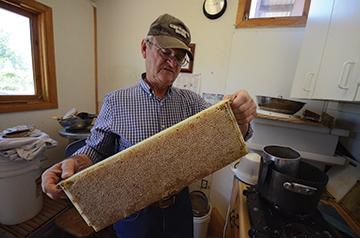
When Bader decides to take honey from beehive frames, he will carefully extract it. The honey is held in honeycombs capped with wax, and Bader will take a hot knife designed to remove the wax and open the cells, placing the honey in a centrifugal spinner in his honey room adjacent to his garage.
“When I do my extraction I heat that honey room up to 90 degrees,” Bader said. “I want that honey to be as fluid as possible.”
Business
When Bader’s apiary was at its peak production, beekeeping provided a stable business outside of the grapes the Baders sell to Black Mesa Winery, and the guest house which is occupied over 160 days of the year.
“I was selling honey during the Abiquiú Studio Tour,” Bader said. “I was getting close to 500 pounds.”
Three pounds are approximate to one quart of honey.
It’s been eight years since Bader produced enough honey to sell on the tour. He will try to sell honey this year, and in the meantime produces Cottonwood birdhouses for the studio tour.
Arin Bader also creates feathered gourd masks, a complex process which requires tedious work.
“It’s our way of participating in the community,” Arin Bader said.
She handles the guest house, and picks strawberries, beans, tomatoes and other crops on the property.
“That’s kind of part of the bees,” she said. “(Bees) are his own thing.”
Stan Bader said he would take honey from two hives soon, but will play it safe with the hives.
“I would rather take less than more and provide them with a sufficient honey to get through,” Bader said, hoping his hives will survive through the winter.
His statement epitomizes his genuine care for the bees, as he would rather protect the bees than squeeze out more honey to produce.
“It’s kind of like animal husbandry except those guys are insects,” Bader said. “If everything goes right, you’ll have a wonderful golden harvest that you can enjoy.”