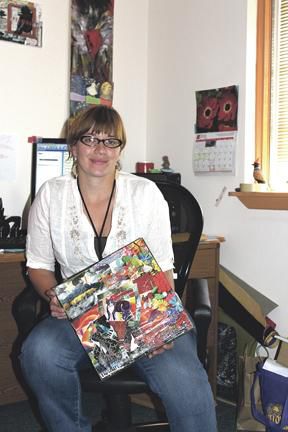
When Anthony Espinosa came to the Valley Community Health Center, he said he told himself that if he didn’t like it, he would leave. Espinosa had been diagnosed with cirrhosis of the liver five years ago. He said in his first session with his current liver doctor, or hepatologist, he was told he needed a psychiatrist, a counselor and a family medical doctor. He was referred to Valley.
“They had told me about Valley, and it’s really close to my house,” he said. “So I went and I walked in, I applied, I got in and I’ve been with them going on two years.”
Valley is part of Presbyterian Medical Services, which has been serving northern New Mexico ever since they first broke off from the larger Presbyterian health mission in 1969 to form their own private non-profit.
“We probably started in the northern part of the state,” said Larry Martinez, the group’s regional director for the North Central region. “One of our oldest clinics is the Questa Health Center, which is in Questa, New Mexico.”
The group originally separated from Presbyterian Health Systems to pursue medical services in rural areas at a time when the larger Presbyterian health organization was more focused on building hospitals, he said.
Martinez said the group’s mission is to provide improved access to health, education and social services to under-served populations in the state.
“I think Presbyterian has shown itself to have the ability to do this for populations that are very unique culturally,” said Martinez. “For example, we’ve been the major provider of services for the Native American populations on the western part of the state for quite some time.”
Rural History
Presbyterian’s operations tend to concentrate in rural areas. Throughout its history, the organization has run clinics in Cuba, Farmington, Santa Fe, Embudo and more. They currently operate 38 health centers in 14 counties.
Martinez, who has been with the organization for 13 years, said his own brother was born in a PMS hospital in Embudo, which has since closed.
“I grew up knowing that Presbyterian Medical Services was the primary provider of services in many of our rural areas,” he said.
Beyond clinics, Martinez said Presbyterian provides home care services for people in need of therapy who are recovering from illness or injury, senior programs, hospice services for people who have been diagnosed with terminal illness, and is the second largest provider of Head Start programs in the state.
“We had been in Rio Arriba County before, a number of years ago,” he said. “We had a behavioral health service here in Española. Then in 2001, the contract was awarded to Ayudantes by the State of New Mexico by an organization that was known as Region 2 Behavioral Health Providers.”
It took eight years, but now Presbyterian is back with the Valley Community Health Center, which opened in November of 2009 in the building formerly occupied by Ayudantes.
They responded to the state’s request for proposals for groups interested in providing behavioral health services in Rio Arriba County earlier that year because they had been here before and were familiar with the population.
In addition, Martinez said, “We felt it was very consistent with our mission to provide access to health care for people in difficult to serve areas, people who can’t pay for their services.”
They won the bid and were awarded the contract to become the community health center for Rio Arriba.
While the State required them to start Jan. 1, 2010, Martinez said Ayudantes experienced an exodus of care providers who had to look for work elsewhere after the contract was awarded to Presbyterian. Since the state worried that the flight of people would keep patients from being properly served, they requested that Presbyterian move in as soon as possible.
During Thanksgiving weekend of 2009, Presbyterian Medical was hard at work identifying patients, seeing them, and making arrangements to continue the services that Ayudantes had been providing them.
“So for all intents and purposes, it was the last week of November 2009 that we became the Valley Community Health Center and started services then,” Martinez said.
Fast Growth
The group has grown significantly since that first Thanksgiving weekend. The Center started out serving 128 patients inherited from Ayudantes, according to Martinez, but that number has since expanded to over 1000 in three years.
Child and family therapist Sarah Whitmire has been with the group since the beginning and has witnessed the Center’s astronomical growth.
“When we started we had three chairs in the waiting room, and now it’s full and there are people out there,” she said.
Martinez attributes the sharp rise to the company being named as a core service agency by the State. There are three core service agencies serving Judicial District 1, which includes Rio Arriba, Santa Fe, and Los Alamos. Those agencies are Presbyterian, Lifelink and Team Builders. These organizations, Martinez said, serve as the medical home for people with mental illness.
The core service agencies essentially in-take individuals, assess them, determine their needs, and refer them to another organization if they can’t provide the necessary services themselves. They are tasked with building a system of care for the people they help.
“I think the need is so great, and the expectations of the state are such that we do the best we can in addressing the needs of people with mental illness here,” Martinez said.
Whitmire said she loves working with children, even the difficult ones. She said she enjoys the challenge they present.
“They’re actually really good kids. Maybe they’ve done some things and had run-ins with the law, but they just need someone to listen and care, and that can bring out a different person,” she said.
LaQueta Gallagher, administrator at Valley, said that in April the health center won an internal award through Presbyterian Medical called the Team Excellence Award.
The Center provides a variety of outpatient therapies for both adults and children. These services range from individual therapy, family therapy, group therapy, psychosocial rehab, which is a life skills program to help mainstream those with mental illness, community support services, and medication management.
According to Whitmire, from spring break until the end of the year, the Center did an enrichment program at Española Middle School to work with the percentage of youth whose constant truancy caused them to get suspended and fail their classes. She said they would do a skills group with them in conjunction with the Teen Center and the group Fine Art for Children and Teens, or FACT.
“Every day the kids would get some enrichment program to try and get the body in the school, and with some I think it really did help. So we’re gonna see if we can do it next year,” she said.
The Center also provided free behavioral health services at the school the year before that, Whitmire said.
Espinosa’s Care
After years of living with the illness, Espinosa said Valley has helped him start to recover, even helping him get on the list for a liver transplant. Without Valley he wouldn’t have even been considered for a transplant, he said.
Espinosa said his previous doctor and psychiatrist gave him medication that further damaged his liver.
“I didn’t get nowhere and didn’t get nowhere and I was getting medications that just got me worse,” he said.
Now his psychiatrist at Valley has been careful to avoid medicines that go through the liver, he said.
“I can feel it and my test results come out more positive than before, when I was with the other psychiatrist and doctor,” he said.
The other patients he knows are satisfied with the services they receive from the Center as well, he said, and he has never had a single problem with them after two years of care.
“They don’t look down on me. They pick my spirits up,” he said. “I highly recommend anybody there, because it’s like being with a family.”
Funding
While most funding for these clinics comes from payments for the services they provide, being a private non-profit gives them the flexibility to go after a variety of revenue streams, including grants and fund-raising events like “Light Up a Life,” which raises money for hospice care through donations and in return allows the donor to place a name on one of many farolitos lining the Santa Fe plaza around Christmas.
The organization’s status as a federally qualified health center allows them to use a sliding fee scale based on the patient’s income level, Martinez said. They are able to cut up to 80 percent from an impoverished patient’s medical bill.
“They still have to pay 20 percent, but if they can’t pay that we generally don’t do anything about it,” said Martinez.
While they don’t get fully paid for what they do, he said the offsets allow them to reach a break-even point.
Presbyterian’s financial filings for 2010 state, roughly 47 percent of its over $73 million of revenue came from services provided that year, either through direct payments from the patients served, private insurance, medicare and medicaid, or federal funds to offset the uncompensated care they provide. Their revenues grew 9.63 percent between 2009 and 2010, thanks in large part to an 11.28 percent increase in contributions and grants followed by a 9.22 percent increase in revenues.
That year the organization spent $316,270 of that on fund-raising, $48,234,265 on salaries, and $21,718,939 on other expenses, out of a total of $69,953,207 in expenses.
Presbyterian Medical Services was unable to provide the most recent filing.
“It’s a house of cards sometimes. Sometimes I feel like if you take out some of those cards we could be in trouble,” Martinez said. “When your mission is to serve the under-served, I think it’s difficult for a private for-profit to go after the same population because they really do need to show a profit, and oftentimes their decisions have to be driven by what, financially, is in the best interests of the organization.”
Martinez said they hope to include a medical care component in Valley’s services in the future. Currently they make referrals to other providers for medical care. They also hope to do as much as they can to reduce substance abuse in the county and do more to intervene in the lives of families experiencing mental health crises to reduce instances of chronic mental illness.
For those who want to get involved, Martinez said that volunteer positions are open and encourages interested people to contact either his office or the Valley Community Health Center. They also provide internships and summer jobs to young people who are interested in working in the medical field.
“We need to do everything we can to make this a healthier world,” he said. “I think its our responsibility as human beings to do everything we can to try to promote good health, because as people have said before if you don’t have your health you don’t have anything.”