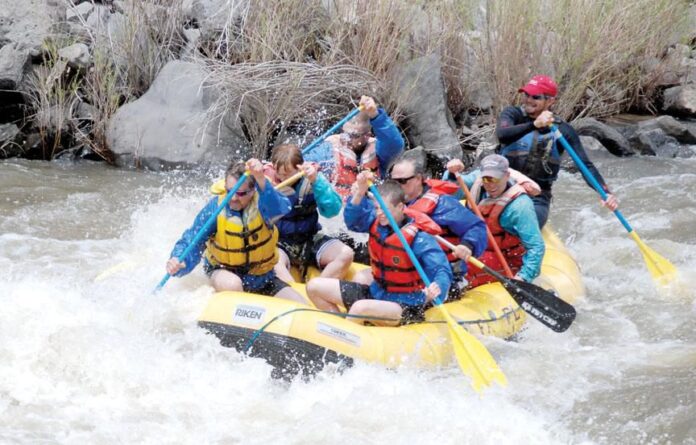
The rafting season on the Rio Grande was off to a slow start until the weekend of May 15 when the take-out point north of Rinconada was abuzz with activity as raft after raft unloaded its occupants.
“Suddenly this weekend it just exploded,” river ranger Del DuBois with the Bureau of Land Management said. “Private and commercial rafting both are booming now.”
As if to punctuate DuBois statement, a group of Boy Scouts from Amarillo, Texas, began to pull up to the unloading area after running the Racecourse, which features a number of Class III (difficult) rapids along its five-mile stretch, including the Narrows and Big Rock Rapid, so named for a huge rock the size of a small house that crashed down from the surrounding canyon walls.
“It was cold, great, amazing,” scout Mason Sharp, of Troop 80,said. “We did this last year. This year was a bit more fun. Last year was pretty calm.”
The water flows on the Rio Grande have been somewhat below normal despite a good snowpack, but that may be beneficial for the rafting season. The flow May 21 was 1,150 cubic feet per second as opposed to a normal mean flow of 1,960 cubic feet per second.
“This is a good, moderate flow, which is great,” guide John LeRoy, of Far Flung Adventures rafting company, said. “It looks like it will stay at a steady level longer during the season, rather than a big spike and then all gone.”
Los Rios River Runners had a group from Houston, Texas, taking their first trip down the Rio Grande.
“It was great,” Brad Johnson, of Houston, said. “We’re doing it again tomorrow.”
The rafting season on the Rio Grande begins in April and continues through the summer. In addition to the Racecourse section, trips are offered through the Orilla Verde Recreation Area near Pilar, which is a leisurely trip with flatter water than the Racecourse. Those seeking more intense whitewater thrills can take a trip through the Taos Box, which features a number of Class IV (very difficult) rapids. This 17-mile trip is for the well-conditioned thrill-seeker.
The water flow begins to recede on the Rio Grande in July and low water levels make the Taos Box too dangerous to negotiate at that time. The Orilla Verde and Racecourse can be rafted throughout the season, which ends in October.
Although the Rio Grande offers New Mexico’s most exciting whitewater, a true wilderness experience can be had on one of the Rio Grande’s main tributaries to the west: the Rio Chama in Rio Arriba County.
The Chama flows through the Rio Chama Canyon Wilderness area where the rapids are just Class II (medium), but the spectacular red walls of the canyon offer unparalleled views. The Rio Chama is normally run over the weekend when flows in the river below El Vado Lake are increased to accommodate rafters. Most commercial rafting companies offer trips on both the Rio Chama and the Rio Grande
The Rio Grande Visitors Center in Pilar is a good place to tet information on rafting outfitters. For more information about outfitters and river conditions, also visit http://www.blm.gov/nm/st/en/prog/recreation/taos.html.