From the rich riparian habitat along the Rio Grande to the subalpine forests at the top of Chicoma Peak in the Jemez Mountains, the Española Valley offers great birding opportunities.
“Any area in the southwest with water is a good area,” Jerry Friedman, of the Sangre de Cristo Audubon Society said. “In Española, it’s relatively easy to cover a lot of different habitats and see a lot of different species.”
Friedman, an Española resident, will be leading an Audubon field trip June 6 to the Orilla Verde Recreation Area on the Rio Grande above Pilar.
“We’ll see songbirds,” Friedman said. “One of the rare birds we could see is the southwestern subspecies of the endangered willow flycatcher. You won’t be able to recognize it unless you hear its song, because it is very similar in appearance to other species.”
Other birds that may be glimpsed along the Rio Grande are yellow warblers, sparrows, blue grosbeaks and Bullock’s Orioles.
“I’ve seen white-throated swifts mating in midair (at the Orilla Verde),” Friedman said.
The canyon walls along the Orilla Verde are nesting areas for large raptors, including eagles, falcons and hawks.
Closer to Española, the Ohkay Owingeh Lakes are home to a breeding colony of black-crowned night herons. Red-winged blackbirds and yellow-headed blackbirds prefer the cattail marshes at the lakes and elsewhere along the Rio Grande in the city. Great blue herons can be seen stalking fish in the shallow water of the lakes and along the shallow riffles of the Rio Grande. Last summer, snowy egrets made a brief stop at Ohkay Owingeh.
“They’re spectacular,” Friedman said. “They’re wandering around in the summer.”
Canada geese have established a breeding population at the lakes and can be seen feeding in the open pastures along Railroad Avenue in Española. The marshes and ponds along the Rio Grande attract ducks and other migratory waterfowl in the fall and winter, but resident populations of ducks, primarily mallards, can seen all year.
Hummingbirds have arrived from Mexico and Central America, where they spent the winter. The most common species seen in the Española area are the broad-tailed and the black-chinned. The rufous hummingbird and the calliope hummingbird will make an appearance later in the summer.
One of the most visible of the recently-arrived songbirds is the western tanager. With black and yellow feathers on its body and a brilliant orange head. This songbird is easily spotted. Friedman said the Española area is a good to spot see Lewis’ woodpeckers and that he recently spotted a rose-breasted grosbeak, which is rare in the western United States and New Mexico.
“It was sure a surprise to me,” he said.
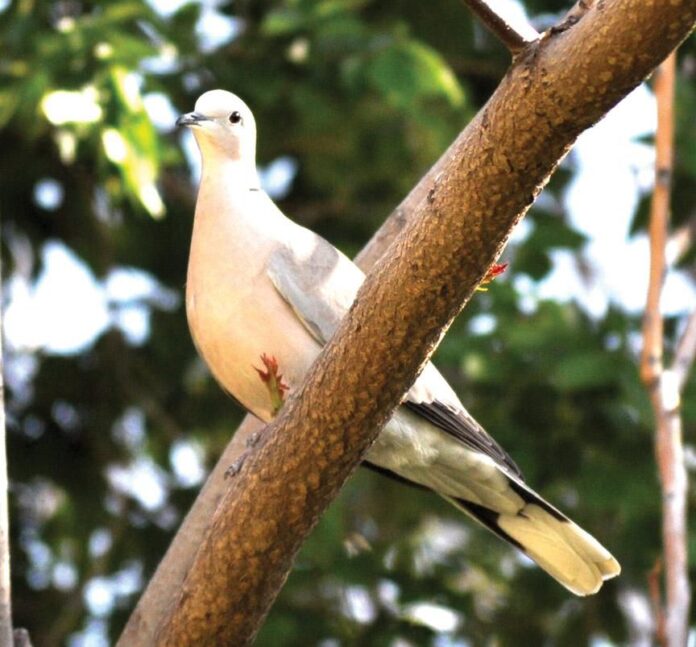
A recent arrival to the bird population is the Eurasian-collared dove. Closely resembling the native mourning dove, collared doves are lighter in color and have a ring around the base of their neck, giving them their name. They are an alien species that came to Florida from the Bahamas in 1975 and have spread.
Friedman highly recommends an Audubon field trip June 19 that begins in the bosque at Española and finishes at an elevation of over 10,000 feet in the Jemez mountains. One hundred different species of birds can be spotted. The trip will pass through diverse habitats and several life zones and is called “A Vertical Mile of Birding.”
“It’s a really great trip,” Friedman said. “It’s hosted by Bernie Foy, who’s one of our best birders.”
The field trips are free, and birders of all levels are welcome, Friedman said. Participants should bring water, lunch and binoculars. The Orilla Verde trip meets at the Rio Grande Visitors Center in Pilar at 8 a.m. and the “Vertical Mile” meets in the Lowe’s Home Improvement parking lot at 7:30 a.m. Visit newmexicoaudubon.org/sdcas.