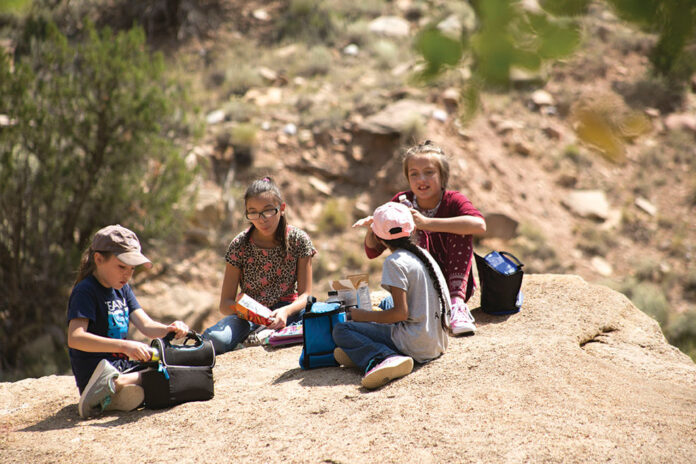
Class Lessons Taught Outside

Published:

    Instead of the books, computers and other classroom staples like desks, the students in the Española School District’s Gifted and Talented Student program donned waders, grabbed measuring sticks and took to the river, Sept. 6, to participate in a day of learning.

    The 11 gifted fifth- and sixth-graders were participating in the first river class of the school year, where they will eventually learn how to determine if the water is healthy.

    Every other week, weather permitting, gifted teacher Jennifer Ortiz and bus driver Mario Maestas, will load students into an activity bus and take them to their open-air classroom on the Rio Chama, for a day of hands-on learning.

    Christie Wall, the New Mexico Wildlife Center’s director of science and education, will provide the majority of the science instruction, with help from Ortiz and Maestas.

    Wall said the idea is for the students to help collect data, such as the amount of dissolved oxygen, turbidity and conductivity in the river and help gauge the water’s and the surrounding ecosystem’s health.

    “By the end of the year, you are going to be able to collect the data,” she told the students as they gathered in the river, along the bank. “Then you are going to be able to tell me what it means for the health of the river. That is the point of river class. That is why we are here.”

    She said the biggest difference between learning science in river class, as opposed to traditional science class, is that the lessons will include fun activities.

    “We are going to learn a lot of science, but we will have lot of fun doing it,” Wall said. “We are going to be in the water. We are going to be hiking and you are going to learn how to collect data. We are going to keep an eye on the (Rio) Chama to make sure it is healthy.”

    Sombrillo fifth-grader Gabby Berg, 10, said she wants to be a pediatric oncologist when she finishes school. She said she is excited about river class because it offers a break from everyday learning.

    “In a classroom, you have a paper and a pencil, but out here, you are able to get dirty and interact and touch more,” she said.

    This is San Juan Elementary School sixth-grader Ojito Garcia’s second year participating in river class. He said he enjoys the class because it offers a break from the traditional classroom.

    “I like coming to the river to do some science,” he said. “It is better than sitting in the classroom. It is pretty nice to be here because it is basically going outside and having fun while learning.”

    The Center funds the entire program, including the stipend the bus driver receives to transport the students back and forth to the river.

    Wall said about half of the program’s budget comes from private corporations and foundation grants, including a $10,000 grant from The North Face and a $10,000 grant from the United Way.

    She said the money is used to purchase equipment, such as waders and the PVC piping used to make the measuring sticks, that are needed to conduct the educational programs for students in the Española and Chama Independent School districts. All school officials have to do, is provide the students.

    The Center offers a similar program to all of Tierra Amarilla Elementary School’s fifth- and sixth-graders and Chama Elementary School’s fourth- and fifth-graders. Altogether, she said the Center serves between 80 and 90 students, but she hopes to see that number reach 100 by the end of the school year.


The gifted program

    Ortiz said, so far, her gifted program is small in numbers, but she expects to see that change, as parents and students finish deciding on what school to attend.    

    “Currently, we are at about 50 students,” she said. “We are still learning of kids transferring in from other districts. We did a fair amount of assessment that needs to be scored.

    So those numbers will increase, shortly.”

    If a parent or guardian believes their child may be gifted, Ortiz said they should contact the student’s teacher. The idea behind meeting with the teacher is to see what type of learning characteristics the child displays.

    “The first step would be to talk to the classroom teacher and ask them if they see the student showing higher order thinking skills,” she said. “Or, do they see the student performing above grade level?”

    Once the teacher concludes the child possesses traits of a gifted student, Ortiz conducts three assessments to determine if the student has above-average cognitive, creative and critical thinking skills.

    Higher order thinking skills are exhibited when a student can move past the who, what, when and where questions and provide substantive explanations for the whys and hows, using information fused from myriad sources, Ortiz said.

    A student must have an Intelligence Quotient (IQ) of 130 or better, to participate in the gifted program.

    Ortiz said parents or teachers who have questions about gifted students and how to possibly identify them, should email her at jennifer.ortiz@k12espanola.org or contact the student’s teacher.

Related articles

Recent articles