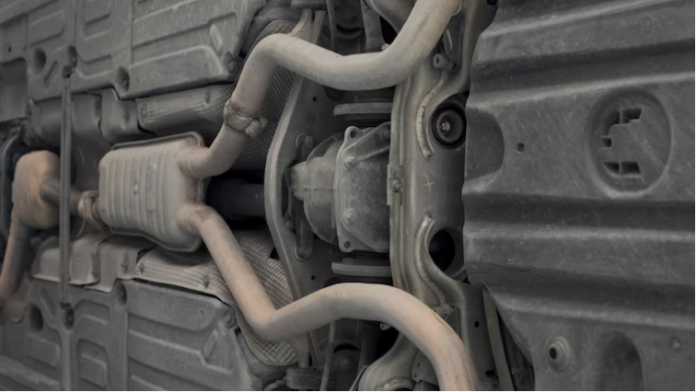
Column: Police Wage War on Catalytic Converter Thieves

Published:

The evidence lay scattered across the gravel near my front door: two yellow DeWalt saw blades, plus a tire jack the thieves hadn’t bothered to take. 

“They’ll just steal another one,” Española Police Officer Anthony Martinez told me as we surveyed the crime scene outside my Santa Cruz casita earlier this month. 

I’d asked Martinez whether there was any chance the criminals would come back for their jack, a tool of the burglary trade. He knew they’d already moved on to their next catalytic converter score.

“It’s not fair to people who just want to work and live in peace,” he said of the crime trend. Martinez had arrived quickly, less than five minutes after my call to 911. But the enterprising criminals who’d ripped me off were long gone, having worked quickly and quietly in the wintry night. 

Investigating the evidence, Martinez said he’d seen too many Españolans similarly targeted; hard-working residents whose cars and SUVs had been hit by catalytic converter thieves when the victims could least afford it, economically speaking. 

The cost to replace and install a catalytic converter can run anywhere from $500 to $5,000, depending on your vehicle type. In Española, where an estimated 20 percent of residents live beneath the federal poverty line, the economic impact from catalytic converter thefts has been devastating. 

As a result of these crimes, families have less money for groceries and gas, less money for education materials for their kids and less money to spend at local businesses. In a city struggling to attract investment and address its homelessness and drug addiction problems, catalytic converter thefts are sinking too many residents deeper into debt.

Beyond New Mexico, the problem is just as bad. Between 2019 and 2022, insurance claims for stolen catalytic converters surged 1,215 percent to more than 52,206 annually in the U.S., according to the National Insurance Crime Bureau. And those are just the thefts people reported. In thousands of other cases, including mine, victims pay out of pocket for catalytic converters rather than file insurance claims and risk a rate increase. The price of repairs is usually less than or only slightly higher than most deductibles.

Thieves and black market buyers want catalytic converters for one reason, experts say: They contain the highly-valuable, precious metals rhodium, palladium and platinum.  The values of these metals have skyrocketed and currently average over $10,000, $1,500 and $1,000 an ounce, respectively. Despite the high market prices, thieves usually receive just $50 to $250 per catalytic converter. 

The coveted parts, which reduce harmful vehicle emissions, are purchased by recycling and scrap metal facility operators, secondhand metal dealers and others known to traffic in stolen metals. When thieves come in with stolen catalytic converters, crooked operators look the other way and fork over wads of cash.

Right now, somewhere in the Española Valley, these bad actors are trafficking stolen catalytic converters without fear of arrest, paying thieves to bring these precious parts in by the trunk-full. It doesn’t have to be this way. Give law enforcement the tools they need to break up these criminal networks, and demand for stolen catalytic converters will dry up.  So will the supply.

To fight the scourge, Española Police Chief Mizel Garcia said he’s planning to procure cutting-edge, sound-recognition technology for some of the city’s busiest parking areas, equipment he said will be paid for with grant money. Statewide, a law making its way through the Roundhouse will help police get the edge on catalytic converter thieves and black market buyers, not just in the Valley but across northern New Mexico. 

Senate Bill 133 would require secondhand metal dealers, and anyone else who buys catalytic converters, to keep records of every purchase they make. They’d be forced to obtain the seller’s information, a photocopy of their identification and proof they owned the car or SUV from which the catalytic converter was removed. Local governments such as Española would be permitted to add more stringent reporting requirements under the law, such as mandatory reporting to police of all catalytic converter purchases. 

These reforms would deal a serious blow to the criminal rings now making a mint off our property; black market networks that span our nation, harm our Valley and cannot exist without the victimization of law-abiding citizens. 

SB 133 was unanimously passed by the Senate Feb. 13 and on this past Monday cleared the House Government, Elections and Indian Affairs Committee with a  “Do Pass” recommendation. Its sponsors come from both sides of the aisle and include Sen. Leo Jaramillo, (D-Española) and Joshua Hernandez, (R-Rio Rancho). 

Passing this legislation means more catalytic converters will stay in more vehicles. It means more citizens in Española and Rio Arriba County will have more money in their pockets, since they won’t be forced to spend hundreds or thousands on costly car repairs. 

The legislation’s Fiscal Impact Report makes clear the alternatives to its passage. “WHAT WILL BE THE CONSEQUENCES OF NOT ENACTING THIS BILL: Theft and sale of catalytic converters to secondhand metal dealers will continue to be loosely regulated, requiring easily-met documentation, and resulting in continued escalation of theft,” the report concludes. 

In Española, this proposed law can’t take effect soon enough. Martinez, the city police officer, said he’d been dispatched to multiple catalytic converter thefts in recent days. So had his fellow officers and counterparts at the Rio Arriba County Sheriff’s Office, where such thefts are eating up larger and larger chunks of deputies’ time — and a frightening share of victims’ paychecks. 

Among the most recent victims were three students at Española Valley High School, who traveled to Albuquerque for a junior ROTC competition and left their cars in the school parking lot. An unidentified man cut the catalytic converters off the students’ vehicles Feb. 26 and got away, authorities said. 

Garcia, the Española police chief, said SB 133 would be a game-changer for his department. 

“We need to be catching the people who are buying these parts,” Garcia said. “There shouldn’t be a demand for stolen catalytic converters. We need to stop that demand and interrupt the supply.” 

That shift can finally happen with SB 133. In Española, we can’t afford the alternative. 

On Crime is an occasional opinion column about criminal justice in the Española Valley by SUN crime reporter Kevin Deutsch.

Contact Kevin at kdeutsch@riograndesun.com or 505-753-2126.

Related articles

Recent articles